

12 White-Light Emissive Materials Based on Supramolecular …
425
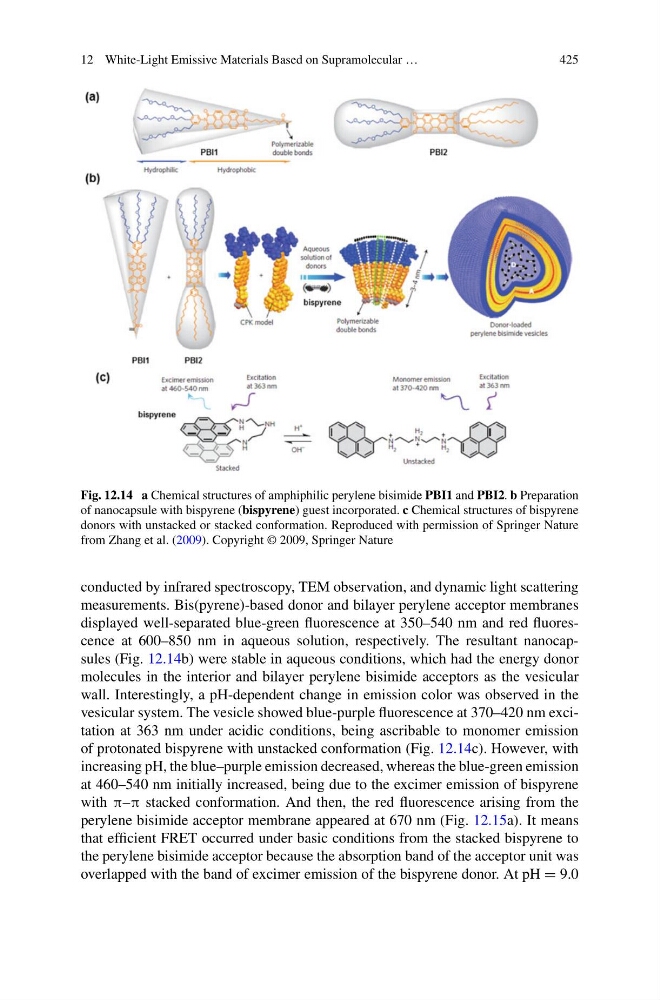
Fig. 12.14 a Chemical structures of amphiphilic perylene bisimide PBI1 and PBI2. b Preparation
of nanocapsule with bispyrene (bispyrene) guest incorporated. c Chemical structures of bispyrene
donors with unstacked or stacked conformation. Reproduced with permission of Springer Nature
from Zhang et al. (2009). Copyright © 2009, Springer Nature
conducted by infrared spectroscopy, TEM observation, and dynamic light scattering
measurements. Bis(pyrene)-based donor and bilayer perylene acceptor membranes
displayed well-separated blue-green fluorescence at 350–540 nm and red fluorescence at 600–850 nm in aqueous solution, respectively. The resultant nanocapsules (Fig. 12.14b) were stable in aqueous conditions, which had the energy donor
molecules in the interior and bilayer perylene bisimide acceptors as the vesicular
wall. Interestingly, a pH-dependent change in emission color was observed in the
vesicular system. The vesicle showed blue-purple fluorescence at 370–420 nm excitation at 363 nm under acidic conditions, being ascribable to monomer emission
of protonated bispyrene with unstacked conformation (Fig. 12.14c). However, with
increasing pH, the blue–purple emission decreased, whereas the blue-green emission
at 460–540 nm initially increased, being due to the excimer emission of bispyrene
with π–π stacked conformation. And then, the red fluorescence arising from the
perylene bisimide acceptor membrane appeared at 670 nm (Fig. 12.15a). It means
that efficient FRET occurred under basic conditions from the stacked bispyrene to
the perylene bisimide acceptor because the absorption band of the acceptor unit was
overlapped with the band of excimer emission of the bispyrene donor. At pH = 9.0
425
Fig. 12.14 a Chemical structures of amphiphilic perylene bisimide PBI1 and PBI2. b Preparation
of nanocapsule with bispyrene (bispyrene) guest incorporated. c Chemical structures of bispyrene
donors with unstacked or stacked conformation. Reproduced with permission of Springer Nature
from Zhang et al. (2009). Copyright © 2009, Springer Nature
conducted by infrared spectroscopy, TEM observation, and dynamic light scattering
measurements. Bis(pyrene)-based donor and bilayer perylene acceptor membranes
displayed well-separated blue-green fluorescence at 350–540 nm and red fluorescence at 600–850 nm in aqueous solution, respectively. The resultant nanocapsules (Fig. 12.14b) were stable in aqueous conditions, which had the energy donor
molecules in the interior and bilayer perylene bisimide acceptors as the vesicular
wall. Interestingly, a pH-dependent change in emission color was observed in the
vesicular system. The vesicle showed blue-purple fluorescence at 370–420 nm excitation at 363 nm under acidic conditions, being ascribable to monomer emission
of protonated bispyrene with unstacked conformation (Fig. 12.14c). However, with
increasing pH, the blue–purple emission decreased, whereas the blue-green emission
at 460–540 nm initially increased, being due to the excimer emission of bispyrene
with π–π stacked conformation. And then, the red fluorescence arising from the
perylene bisimide acceptor membrane appeared at 670 nm (Fig. 12.15a). It means
that efficient FRET occurred under basic conditions from the stacked bispyrene to
the perylene bisimide acceptor because the absorption band of the acceptor unit was
overlapped with the band of excimer emission of the bispyrene donor. At pH = 9.0