

12 White-Light Emissive Materials Based on Supramolecular …
431
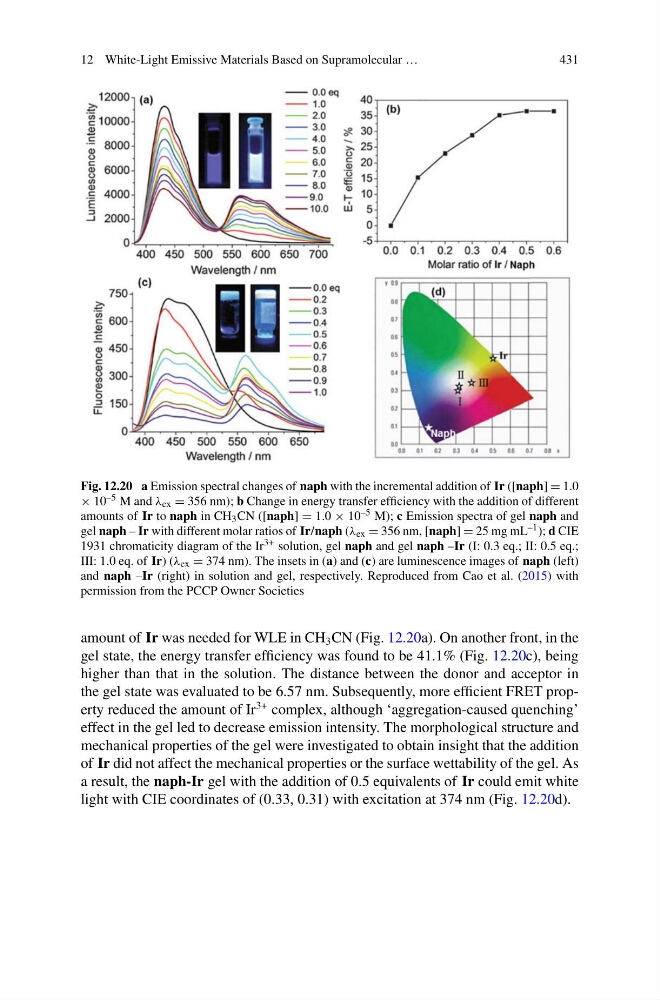
Fig. 12.20 a Emission spectral changes of naph with the incremental addition of Ir ([naph] = 1.0
× 10 –5 M and λ ex = 356 nm); b Change in energy transfer efficiency with the addition of different
amounts of Ir to naph in CH 3 CN ([naph] = 1.0 × 10 –5 M); c Emission spectra of gel naph and
gel naph – Ir with different molar ratios of Ir/naph (λ ex = 356 nm, [naph] = 25 mg mL –1 ); d CIE
1931 chromaticity diagram of the Ir 3+ solution, gel naph and gel naph –Ir (I: 0.3 eq.; II: 0.5 eq.;
III: 1.0 eq. of Ir) (λ ex = 374 nm). The insets in (a) and (c) are luminescence images of naph (left)
and naph –Ir (right) in solution and gel, respectively. Reproduced from Cao et al. (2015) with
permission from the PCCP Owner Societies
amount of Ir was needed for WLE in CH 3 CN (Fig. 12.20a). On another front, in the
gel state, the energy transfer efficiency was found to be 41.1% (Fig. 12.20c), being
higher than that in the solution. The distance between the donor and acceptor in
the gel state was evaluated to be 6.57 nm. Subsequently, more efficient FRET property reduced the amount of Ir
3+ complex, although ‘aggregation-caused quenching’
effect in the gel led to decrease emission intensity. The morphological structure and
mechanical properties of the gel were investigated to obtain insight that the addition
of Ir did not affect the mechanical properties or the surface wettability of the gel. As
a result, the naph-Ir gel with the addition of 0.5 equivalents of Ir could emit white
light with CIE coordinates of (0.33, 0.31) with excitation at 374 nm (Fig. 12.20d).
431
Fig. 12.20 a Emission spectral changes of naph with the incremental addition of Ir ([naph] = 1.0
× 10 –5 M and λ ex = 356 nm); b Change in energy transfer efficiency with the addition of different
amounts of Ir to naph in CH 3 CN ([naph] = 1.0 × 10 –5 M); c Emission spectra of gel naph and
gel naph – Ir with different molar ratios of Ir/naph (λ ex = 356 nm, [naph] = 25 mg mL –1 ); d CIE
1931 chromaticity diagram of the Ir 3+ solution, gel naph and gel naph –Ir (I: 0.3 eq.; II: 0.5 eq.;
III: 1.0 eq. of Ir) (λ ex = 374 nm). The insets in (a) and (c) are luminescence images of naph (left)
and naph –Ir (right) in solution and gel, respectively. Reproduced from Cao et al. (2015) with
permission from the PCCP Owner Societies
amount of Ir was needed for WLE in CH 3 CN (Fig. 12.20a). On another front, in the
gel state, the energy transfer efficiency was found to be 41.1% (Fig. 12.20c), being
higher than that in the solution. The distance between the donor and acceptor in
the gel state was evaluated to be 6.57 nm. Subsequently, more efficient FRET property reduced the amount of Ir
3+ complex, although ‘aggregation-caused quenching’
effect in the gel led to decrease emission intensity. The morphological structure and
mechanical properties of the gel were investigated to obtain insight that the addition
of Ir did not affect the mechanical properties or the surface wettability of the gel. As
a result, the naph-Ir gel with the addition of 0.5 equivalents of Ir could emit white
light with CIE coordinates of (0.33, 0.31) with excitation at 374 nm (Fig. 12.20d).