

12 White-Light Emissive Materials Based on Supramolecular …
421
CB[8] through a stoichiometric 1:1 complexation, showing more redshifted emission
than that of anti-excimer mode. Similarly, addition of 1 equiv. of CB[8] to A3–A5
could enhance emissions at different levels. Also, emissive color-tunable properties
of An took place on the basis of different ratios of monomer and syn-excimer emissions. Further, reversibly tunable emission was investigated by a supramolecular
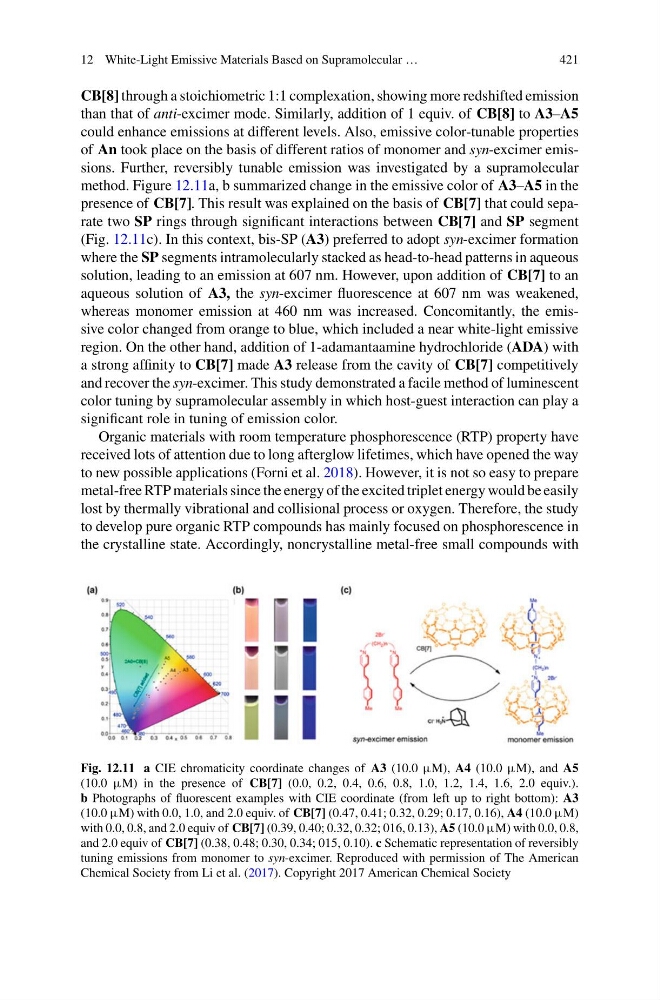
method. Figure 12.11a, b summarized change in the emissive color of A3–A5 in the
presence of CB[7]. This result was explained on the basis of CB[7] that could separate two SP rings through significant interactions between CB[7] and SP segment
(Fig. 12.11c). In this context, bis-SP (A3) preferred to adopt syn-excimer formation
where the SP segments intramolecularly stacked as head-to-head patterns in aqueous
solution, leading to an emission at 607 nm. However, upon addition of CB[7] to an
aqueous solution of A3, the syn-excimer fluorescence at 607 nm was weakened,
whereas monomer emission at 460 nm was increased. Concomitantly, the emissive color changed from orange to blue, which included a near white-light emissive
region. On the other hand, addition of 1-adamantaamine hydrochloride (ADA) with
a strong affinity to CB[7] made A3 release from the cavity of CB[7] competitively
and recover the syn-excimer. This study demonstrated a facile method of luminescent
color tuning by supramolecular assembly in which host-guest interaction can play a
significant role in tuning of emission color.
Organic materials with room temperature phosphorescence (RTP) property have
received lots of attention due to long afterglow lifetimes, which have opened the way
to new possible applications (Forni et al. 2018). However, it is not so easy to prepare
metal-free RTP materials since the energy of the excited triplet energy would be easily
lost by thermally vibrational and collisional process or oxygen. Therefore, the study
to develop pure organic RTP compounds has mainly focused on phosphorescence in
the crystalline state. Accordingly, noncrystalline metal-free small compounds with
Fig. 12.11 a CIE chromaticity coordinate changes of A3 (10.0 μM), A4 (10.0 μM), and A5
(10.0 μM) in the presence of CB[7] (0.0, 0.2, 0.4, 0.6, 0.8, 1.0, 1.2, 1.4, 1.6, 2.0 equiv.).
b Photographs of fluorescent examples with CIE coordinate (from left up to right bottom): A3
(10.0 μM) with 0.0, 1.0, and 2.0 equiv. of CB[7] (0.47, 0.41; 0.32, 0.29; 0.17, 0.16), A4 (10.0 μM)
with 0.0, 0.8, and 2.0 equiv of CB[7] (0.39, 0.40; 0.32, 0.32; 016, 0.13), A5 (10.0 μM) with 0.0, 0.8,
and 2.0 equiv of CB[7] (0.38, 0.48; 0.30, 0.34; 015, 0.10). c Schematic representation of reversibly
tuning emissions from monomer to syn-excimer. Reproduced with permission of The American
Chemical Society from Li et al. (2017). Copyright 2017 American Chemical Society
421
CB[8] through a stoichiometric 1:1 complexation, showing more redshifted emission
than that of anti-excimer mode. Similarly, addition of 1 equiv. of CB[8] to A3–A5
could enhance emissions at different levels. Also, emissive color-tunable properties
of An took place on the basis of different ratios of monomer and syn-excimer emissions. Further, reversibly tunable emission was investigated by a supramolecular
method. Figure 12.11a, b summarized change in the emissive color of A3–A5 in the
presence of CB[7]. This result was explained on the basis of CB[7] that could separate two SP rings through significant interactions between CB[7] and SP segment
(Fig. 12.11c). In this context, bis-SP (A3) preferred to adopt syn-excimer formation
where the SP segments intramolecularly stacked as head-to-head patterns in aqueous
solution, leading to an emission at 607 nm. However, upon addition of CB[7] to an
aqueous solution of A3, the syn-excimer fluorescence at 607 nm was weakened,
whereas monomer emission at 460 nm was increased. Concomitantly, the emissive color changed from orange to blue, which included a near white-light emissive
region. On the other hand, addition of 1-adamantaamine hydrochloride (ADA) with
a strong affinity to CB[7] made A3 release from the cavity of CB[7] competitively
and recover the syn-excimer. This study demonstrated a facile method of luminescent
color tuning by supramolecular assembly in which host-guest interaction can play a
significant role in tuning of emission color.
Organic materials with room temperature phosphorescence (RTP) property have
received lots of attention due to long afterglow lifetimes, which have opened the way
to new possible applications (Forni et al. 2018). However, it is not so easy to prepare
metal-free RTP materials since the energy of the excited triplet energy would be easily
lost by thermally vibrational and collisional process or oxygen. Therefore, the study
to develop pure organic RTP compounds has mainly focused on phosphorescence in
the crystalline state. Accordingly, noncrystalline metal-free small compounds with
Fig. 12.11 a CIE chromaticity coordinate changes of A3 (10.0 μM), A4 (10.0 μM), and A5
(10.0 μM) in the presence of CB[7] (0.0, 0.2, 0.4, 0.6, 0.8, 1.0, 1.2, 1.4, 1.6, 2.0 equiv.).
b Photographs of fluorescent examples with CIE coordinate (from left up to right bottom): A3
(10.0 μM) with 0.0, 1.0, and 2.0 equiv. of CB[7] (0.47, 0.41; 0.32, 0.29; 0.17, 0.16), A4 (10.0 μM)
with 0.0, 0.8, and 2.0 equiv of CB[7] (0.39, 0.40; 0.32, 0.32; 016, 0.13), A5 (10.0 μM) with 0.0, 0.8,
and 2.0 equiv of CB[7] (0.38, 0.48; 0.30, 0.34; 015, 0.10). c Schematic representation of reversibly
tuning emissions from monomer to syn-excimer. Reproduced with permission of The American
Chemical Society from Li et al. (2017). Copyright 2017 American Chemical Society