

422
Y. Kubo
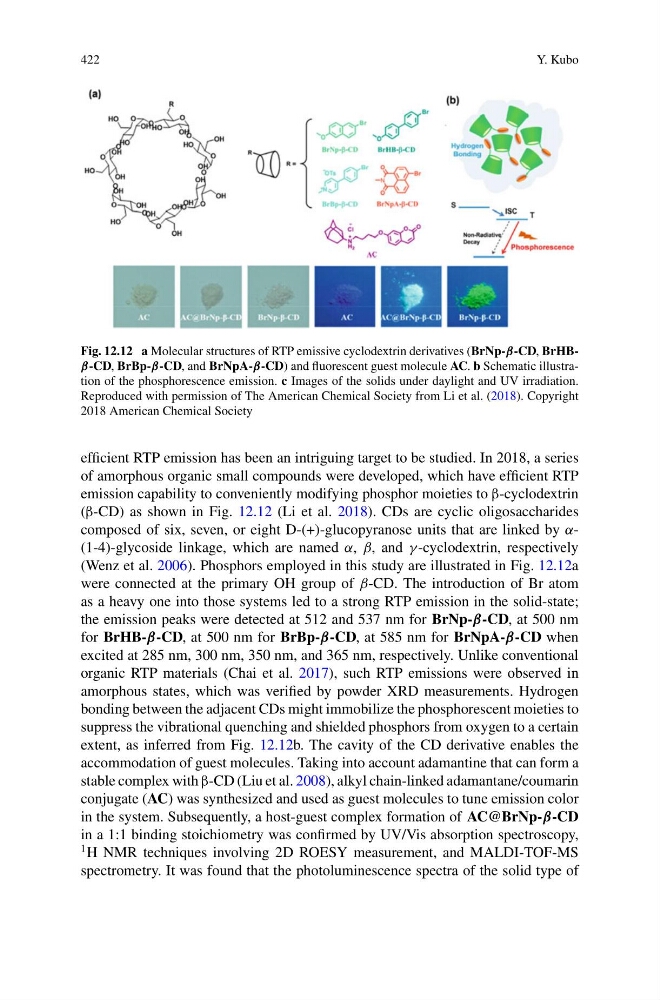
Fig. 12.12 a Molecular structures of RTP emissive cyclodextrin derivatives (BrNp-β-CD, BrHBβ-CD, BrBp-β-CD, and BrNpA-β-CD) and fluorescent guest molecule AC. b Schematic illustration of the phosphorescence emission. c Images of the solids under daylight and UV irradiation.
Reproduced with permission of The American Chemical Society from Li et al. (2018). Copyright
2018 American Chemical Society
efficient RTP emission has been an intriguing target to be studied. In 2018, a series
of amorphous organic small compounds were developed, which have efficient RTP
emission capability to conveniently modifying phosphor moieties to β-cyclodextrin
(β-CD) as shown in Fig. 12.12 (Li et al. 2018). CDs are cyclic oligosaccharides
composed of six, seven, or eight D-(+)-glucopyranose units that are linked by α(1-4)-glycoside linkage, which are named α, β, and γ -cyclodextrin, respectively
(Wenz et al. 2006). Phosphors employed in this study are illustrated in Fig. 12.12a
were connected at the primary OH group of β-CD. The introduction of Br atom
as a heavy one into those systems led to a strong RTP emission in the solid-state;
the emission peaks were detected at 512 and 537 nm for BrNp-β-CD, at 500 nm
for BrHB-β-CD, at 500 nm for BrBp-β-CD, at 585 nm for BrNpA-β-CD when
excited at 285 nm, 300 nm, 350 nm, and 365 nm, respectively. Unlike conventional
organic RTP materials (Chai et al. 2017), such RTP emissions were observed in
amorphous states, which was verified by powder XRD measurements. Hydrogen
bonding between the adjacent CDs might immobilize the phosphorescent moieties to
suppress the vibrational quenching and shielded phosphors from oxygen to a certain
extent, as inferred from Fig. 12.12b. The cavity of the CD derivative enables the
accommodation of guest molecules. Taking into account adamantine that can form a
stable complex with β-CD (Liu et al. 2008), alkyl chain-linked adamantane/coumarin
conjugate (AC) was synthesized and used as guest molecules to tune emission color
in the system. Subsequently, a host-guest complex formation of AC@BrNp-β-CD
in a 1:1 binding stoichiometry was confirmed by UV/Vis absorption spectroscopy,
1 H NMR techniques involving 2D ROESY measurement, and MALDI-TOF-MS
spectrometry. It was found that the photoluminescence spectra of the solid type of
Y. Kubo
Fig. 12.12 a Molecular structures of RTP emissive cyclodextrin derivatives (BrNp-β-CD, BrHBβ-CD, BrBp-β-CD, and BrNpA-β-CD) and fluorescent guest molecule AC. b Schematic illustration of the phosphorescence emission. c Images of the solids under daylight and UV irradiation.
Reproduced with permission of The American Chemical Society from Li et al. (2018). Copyright
2018 American Chemical Society
efficient RTP emission has been an intriguing target to be studied. In 2018, a series
of amorphous organic small compounds were developed, which have efficient RTP
emission capability to conveniently modifying phosphor moieties to β-cyclodextrin
(β-CD) as shown in Fig. 12.12 (Li et al. 2018). CDs are cyclic oligosaccharides
composed of six, seven, or eight D-(+)-glucopyranose units that are linked by α(1-4)-glycoside linkage, which are named α, β, and γ -cyclodextrin, respectively
(Wenz et al. 2006). Phosphors employed in this study are illustrated in Fig. 12.12a
were connected at the primary OH group of β-CD. The introduction of Br atom
as a heavy one into those systems led to a strong RTP emission in the solid-state;
the emission peaks were detected at 512 and 537 nm for BrNp-β-CD, at 500 nm
for BrHB-β-CD, at 500 nm for BrBp-β-CD, at 585 nm for BrNpA-β-CD when
excited at 285 nm, 300 nm, 350 nm, and 365 nm, respectively. Unlike conventional
organic RTP materials (Chai et al. 2017), such RTP emissions were observed in
amorphous states, which was verified by powder XRD measurements. Hydrogen
bonding between the adjacent CDs might immobilize the phosphorescent moieties to
suppress the vibrational quenching and shielded phosphors from oxygen to a certain
extent, as inferred from Fig. 12.12b. The cavity of the CD derivative enables the
accommodation of guest molecules. Taking into account adamantine that can form a
stable complex with β-CD (Liu et al. 2008), alkyl chain-linked adamantane/coumarin
conjugate (AC) was synthesized and used as guest molecules to tune emission color
in the system. Subsequently, a host-guest complex formation of AC@BrNp-β-CD
in a 1:1 binding stoichiometry was confirmed by UV/Vis absorption spectroscopy,
1 H NMR techniques involving 2D ROESY measurement, and MALDI-TOF-MS
spectrometry. It was found that the photoluminescence spectra of the solid type of