

420
Y. Kubo
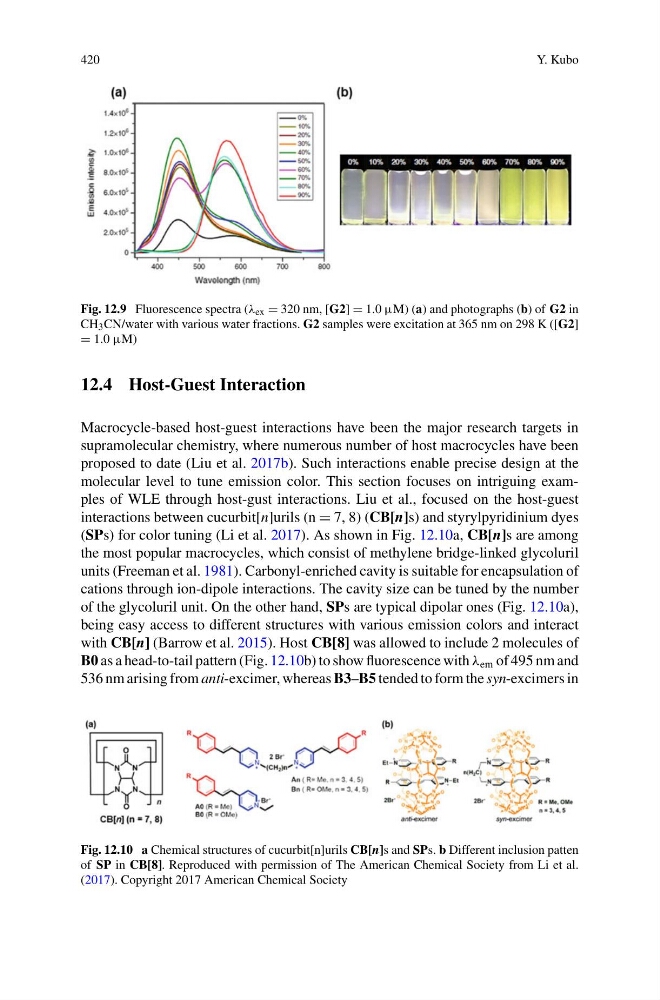
Fig. 12.9 Fluorescence spectra (λ ex = 320 nm, [G2] = 1.0 μM) (a) and photographs (b) of G2 in
CH 3 CN/water with various water fractions. G2 samples were excitation at 365 nm on 298 K ([G2]
= 1.0 μM)
12.4 Host-Guest Interaction
Macrocycle-based host-guest interactions have been the major research targets in
supramolecular chemistry, where numerous number of host macrocycles have been
proposed to date (Liu et al. 2017b). Such interactions enable precise design at the
molecular level to tune emission color. This section focuses on intriguing examples of WLE through host-gust interactions. Liu et al., focused on the host-guest
interactions between cucurbit[n]urils (n = 7, 8) (CB[n]s) and styrylpyridinium dyes
(SPs) for color tuning (Li et al. 2017). As shown in Fig. 12.10a, CB[n]s are among
the most popular macrocycles, which consist of methylene bridge-linked glycoluril
units (Freeman et al. 1981). Carbonyl-enriched cavity is suitable for encapsulation of
cations through ion-dipole interactions. The cavity size can be tuned by the number
of the glycoluril unit. On the other hand, SPs are typical dipolar ones (Fig. 12.10a),
being easy access to different structures with various emission colors and interact
with CB[n] (Barrow et al. 2015). Host CB[8] was allowed to include 2 molecules of
B0 as a head-to-tail pattern (Fig. 12.10b) to show fluorescence with λ em of 495 nm and
536 nm arising from anti-excimer, whereas B3–B5 tended to form the syn-excimers in
Fig. 12.10 a Chemical structures of cucurbit[n]urils CB[n]s and SPs. b Different inclusion patten
of SP in CB[8]. Reproduced with permission of The American Chemical Society from Li et al.
(2017). Copyright 2017 American Chemical Society
Y. Kubo
Fig. 12.9 Fluorescence spectra (λ ex = 320 nm, [G2] = 1.0 μM) (a) and photographs (b) of G2 in
CH 3 CN/water with various water fractions. G2 samples were excitation at 365 nm on 298 K ([G2]
= 1.0 μM)
12.4 Host-Guest Interaction
Macrocycle-based host-guest interactions have been the major research targets in
supramolecular chemistry, where numerous number of host macrocycles have been
proposed to date (Liu et al. 2017b). Such interactions enable precise design at the
molecular level to tune emission color. This section focuses on intriguing examples of WLE through host-gust interactions. Liu et al., focused on the host-guest
interactions between cucurbit[n]urils (n = 7, 8) (CB[n]s) and styrylpyridinium dyes
(SPs) for color tuning (Li et al. 2017). As shown in Fig. 12.10a, CB[n]s are among
the most popular macrocycles, which consist of methylene bridge-linked glycoluril
units (Freeman et al. 1981). Carbonyl-enriched cavity is suitable for encapsulation of
cations through ion-dipole interactions. The cavity size can be tuned by the number
of the glycoluril unit. On the other hand, SPs are typical dipolar ones (Fig. 12.10a),
being easy access to different structures with various emission colors and interact
with CB[n] (Barrow et al. 2015). Host CB[8] was allowed to include 2 molecules of
B0 as a head-to-tail pattern (Fig. 12.10b) to show fluorescence with λ em of 495 nm and
536 nm arising from anti-excimer, whereas B3–B5 tended to form the syn-excimers in
Fig. 12.10 a Chemical structures of cucurbit[n]urils CB[n]s and SPs. b Different inclusion patten
of SP in CB[8]. Reproduced with permission of The American Chemical Society from Li et al.
(2017). Copyright 2017 American Chemical Society