

12 White-Light Emissive Materials Based on Supramolecular …
419
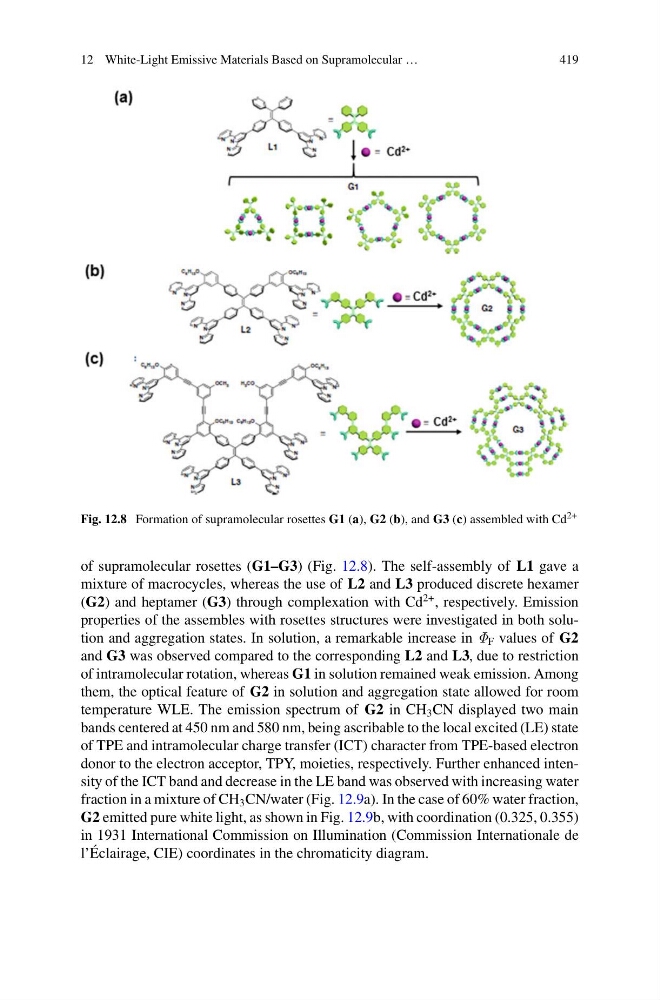
Fig. 12.8 Formation of supramolecular rosettes G1 (a), G2 (b), and G3 (c) assembled with Cd 2+
of supramolecular rosettes (G1–G3) (Fig. 12.8). The self-assembly of L1 gave a
mixture of macrocycles, whereas the use of L2 and L3 produced discrete hexamer
(G2) and heptamer (G3) through complexation with Cd
2+ , respectively. Emission
properties of the assembles with rosettes structures were investigated in both solution and aggregation states. In solution, a remarkable increase in F F values of G2
and G3 was observed compared to the corresponding L2 and L3, due to restriction
of intramolecular rotation, whereas G1 in solution remained weak emission. Among
them, the optical feature of G2 in solution and aggregation state allowed for room
temperature WLE. The emission spectrum of G2 in CH 3 CN displayed two main
bands centered at 450 nm and 580 nm, being ascribable to the local excited (LE) state
of TPE and intramolecular charge transfer (ICT) character from TPE-based electron
donor to the electron acceptor, TPY, moieties, respectively. Further enhanced intensity of the ICT band and decrease in the LE band was observed with increasing water
fraction in a mixture of CH 3 CN/water (Fig. 12.9a). In the case of 60% water fraction,
G2 emitted pure white light, as shown in Fig. 12.9b, with coordination (0.325, 0.355)
in 1931 International Commission on Illumination (Commission Internationale de
l’Éclairage, CIE) coordinates in the chromaticity diagram.
419
Fig. 12.8 Formation of supramolecular rosettes G1 (a), G2 (b), and G3 (c) assembled with Cd 2+
of supramolecular rosettes (G1–G3) (Fig. 12.8). The self-assembly of L1 gave a
mixture of macrocycles, whereas the use of L2 and L3 produced discrete hexamer
(G2) and heptamer (G3) through complexation with Cd
2+ , respectively. Emission
properties of the assembles with rosettes structures were investigated in both solution and aggregation states. In solution, a remarkable increase in F F values of G2
and G3 was observed compared to the corresponding L2 and L3, due to restriction
of intramolecular rotation, whereas G1 in solution remained weak emission. Among
them, the optical feature of G2 in solution and aggregation state allowed for room
temperature WLE. The emission spectrum of G2 in CH 3 CN displayed two main
bands centered at 450 nm and 580 nm, being ascribable to the local excited (LE) state
of TPE and intramolecular charge transfer (ICT) character from TPE-based electron
donor to the electron acceptor, TPY, moieties, respectively. Further enhanced intensity of the ICT band and decrease in the LE band was observed with increasing water
fraction in a mixture of CH 3 CN/water (Fig. 12.9a). In the case of 60% water fraction,
G2 emitted pure white light, as shown in Fig. 12.9b, with coordination (0.325, 0.355)
in 1931 International Commission on Illumination (Commission Internationale de
l’Éclairage, CIE) coordinates in the chromaticity diagram.