

12 White-Light Emissive Materials Based on Supramolecular …
417
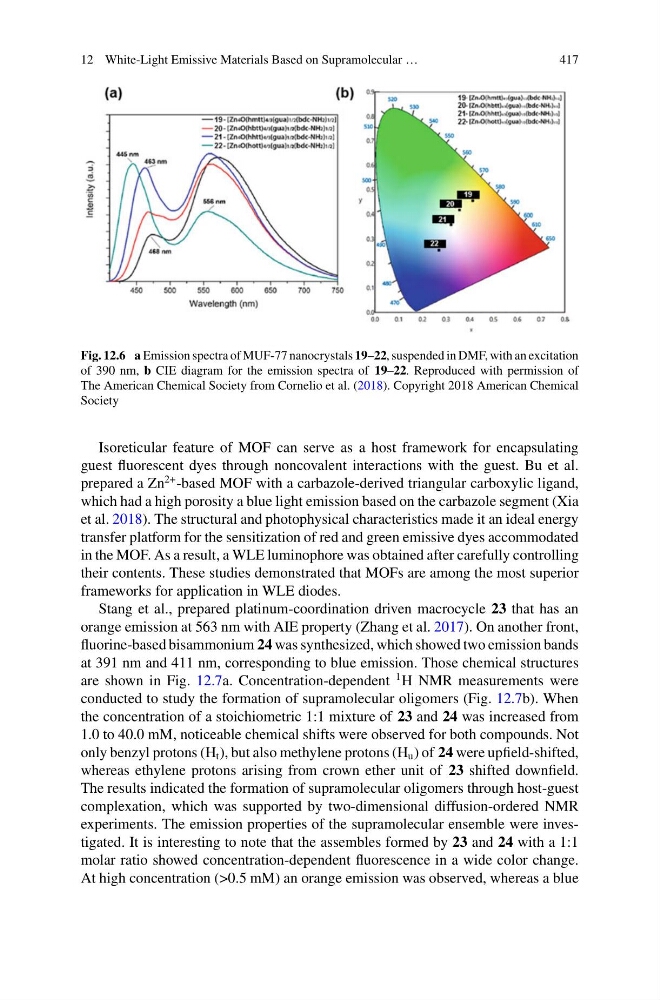
Fig. 12.6 a Emission spectra of MUF-77 nanocrystals 19–22, suspended in DMF, with an excitation
of 390 nm, b CIE diagram for the emission spectra of 19–22. Reproduced with permission of
The American Chemical Society from Cornelio et al. (2018). Copyright 2018 American Chemical
Society
Isoreticular feature of MOF can serve as a host framework for encapsulating
guest fluorescent dyes through noncovalent interactions with the guest. Bu et al.
prepared a Zn
2+ -based MOF with a carbazole-derived triangular carboxylic ligand,
which had a high porosity a blue light emission based on the carbazole segment (Xia
et al. 2018). The structural and photophysical characteristics made it an ideal energy
transfer platform for the sensitization of red and green emissive dyes accommodated
in the MOF. As a result, a WLE luminophore was obtained after carefully controlling
their contents. These studies demonstrated that MOFs are among the most superior
frameworks for application in WLE diodes.
Stang et al., prepared platinum-coordination driven macrocycle 23 that has an
orange emission at 563 nm with AIE property (Zhang et al. 2017). On another front,
fluorine-based bisammonium 24 was synthesized, which showed two emission bands
at 391 nm and 411 nm, corresponding to blue emission. Those chemical structures
are shown in Fig. 12.7a. Concentration-dependent
1 H NMR measurements were
conducted to study the formation of supramolecular oligomers (Fig. 12.7b). When
the concentration of a stoichiometric 1:1 mixture of 23 and 24 was increased from
1.0 to 40.0 mM, noticeable chemical shifts were observed for both compounds. Not
only benzyl protons (H t ), but also methylene protons (H u ) of 24 were upfield-shifted,
whereas ethylene protons arising from crown ether unit of 23 shifted downfield.
The results indicated the formation of supramolecular oligomers through host-guest
complexation, which was supported by two-dimensional diffusion-ordered NMR
experiments. The emission properties of the supramolecular ensemble were investigated. It is interesting to note that the assembles formed by 23 and 24 with a 1:1
molar ratio showed concentration-dependent fluorescence in a wide color change.
At high concentration (>0.5 mM) an orange emission was observed, whereas a blue
417
Fig. 12.6 a Emission spectra of MUF-77 nanocrystals 19–22, suspended in DMF, with an excitation
of 390 nm, b CIE diagram for the emission spectra of 19–22. Reproduced with permission of
The American Chemical Society from Cornelio et al. (2018). Copyright 2018 American Chemical
Society
Isoreticular feature of MOF can serve as a host framework for encapsulating
guest fluorescent dyes through noncovalent interactions with the guest. Bu et al.
prepared a Zn
2+ -based MOF with a carbazole-derived triangular carboxylic ligand,
which had a high porosity a blue light emission based on the carbazole segment (Xia
et al. 2018). The structural and photophysical characteristics made it an ideal energy
transfer platform for the sensitization of red and green emissive dyes accommodated
in the MOF. As a result, a WLE luminophore was obtained after carefully controlling
their contents. These studies demonstrated that MOFs are among the most superior
frameworks for application in WLE diodes.
Stang et al., prepared platinum-coordination driven macrocycle 23 that has an
orange emission at 563 nm with AIE property (Zhang et al. 2017). On another front,
fluorine-based bisammonium 24 was synthesized, which showed two emission bands
at 391 nm and 411 nm, corresponding to blue emission. Those chemical structures
are shown in Fig. 12.7a. Concentration-dependent
1 H NMR measurements were
conducted to study the formation of supramolecular oligomers (Fig. 12.7b). When
the concentration of a stoichiometric 1:1 mixture of 23 and 24 was increased from
1.0 to 40.0 mM, noticeable chemical shifts were observed for both compounds. Not
only benzyl protons (H t ), but also methylene protons (H u ) of 24 were upfield-shifted,
whereas ethylene protons arising from crown ether unit of 23 shifted downfield.
The results indicated the formation of supramolecular oligomers through host-guest
complexation, which was supported by two-dimensional diffusion-ordered NMR
experiments. The emission properties of the supramolecular ensemble were investigated. It is interesting to note that the assembles formed by 23 and 24 with a 1:1
molar ratio showed concentration-dependent fluorescence in a wide color change.
At high concentration (>0.5 mM) an orange emission was observed, whereas a blue