

416
Y. Kubo
emitters using photophysical properties of trivalent lanthanide ions (SeethaLekshmi
et al. 2017).
It is interesting to explore how to functionalize the organic linkers of multicomponent MOFs to manipulate energy transfer interactions between them. Telfer
et al., built up isoreticular multicomponent MOFs to tune the luminescence output
systematically by introducing functional groups to the linkers (Cornelio et al. 2018).
MUF-77 (Massey University Framework-77) (Liu and Telfer 2015) was used, being
a multicomponent system comprising three chemically and geometrically distinct
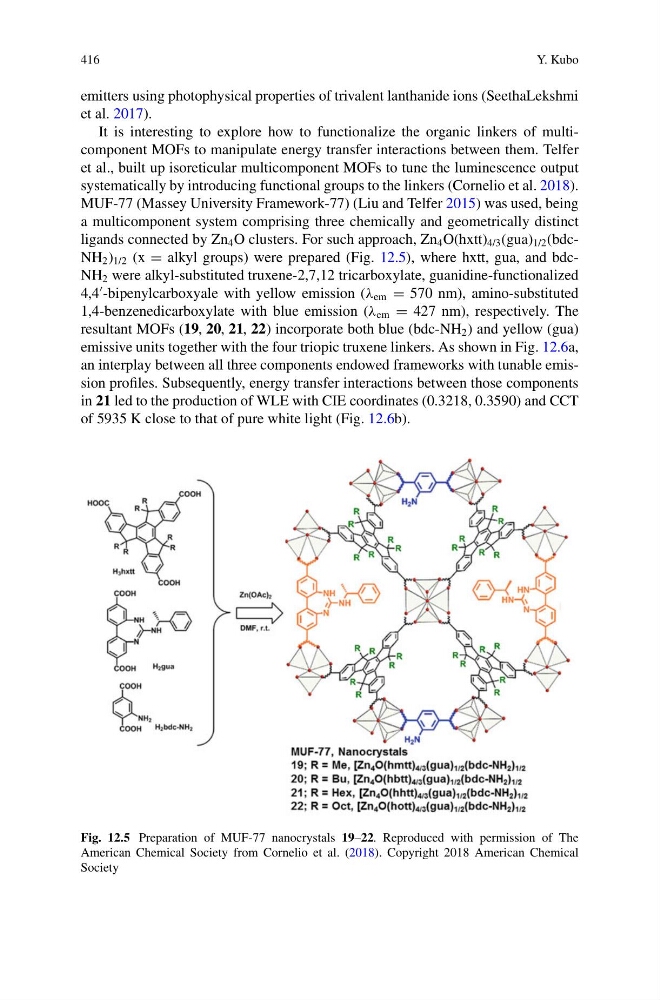
ligands connected by Zn 4 O clusters. For such approach, Zn 4 O(hxtt) 4/3 (gua) 1/2 (bdcNH 2 ) 1/2 (x = alkyl groups) were prepared (Fig. 12.5), where hxtt, gua, and bdcNH 2 were alkyl-substituted truxene-2,7,12 tricarboxylate, guanidine-functionalized
4,4
-bipenylcarboxyale with yellow emission (λ em = 570 nm), amino-substituted
1,4-benzenedicarboxylate with blue emission (λ em = 427 nm), respectively. The
resultant MOFs (19, 20, 21, 22) incorporate both blue (bdc-NH 2 ) and yellow (gua)
emissive units together with the four triopic truxene linkers. As shown in Fig. 12.6a,
an interplay between all three components endowed frameworks with tunable emission profiles. Subsequently, energy transfer interactions between those components
in 21 led to the production of WLE with CIE coordinates (0.3218, 0.3590) and CCT
of 5935 K close to that of pure white light (Fig. 12.6b).
Fig. 12.5 Preparation of MUF-77 nanocrystals 19–22. Reproduced with permission of The
American Chemical Society from Cornelio et al. (2018). Copyright 2018 American Chemical
Society
Y. Kubo
emitters using photophysical properties of trivalent lanthanide ions (SeethaLekshmi
et al. 2017).
It is interesting to explore how to functionalize the organic linkers of multicomponent MOFs to manipulate energy transfer interactions between them. Telfer
et al., built up isoreticular multicomponent MOFs to tune the luminescence output
systematically by introducing functional groups to the linkers (Cornelio et al. 2018).
MUF-77 (Massey University Framework-77) (Liu and Telfer 2015) was used, being
a multicomponent system comprising three chemically and geometrically distinct
ligands connected by Zn 4 O clusters. For such approach, Zn 4 O(hxtt) 4/3 (gua) 1/2 (bdcNH 2 ) 1/2 (x = alkyl groups) were prepared (Fig. 12.5), where hxtt, gua, and bdcNH 2 were alkyl-substituted truxene-2,7,12 tricarboxylate, guanidine-functionalized
4,4
-bipenylcarboxyale with yellow emission (λ em = 570 nm), amino-substituted
1,4-benzenedicarboxylate with blue emission (λ em = 427 nm), respectively. The
resultant MOFs (19, 20, 21, 22) incorporate both blue (bdc-NH 2 ) and yellow (gua)
emissive units together with the four triopic truxene linkers. As shown in Fig. 12.6a,
an interplay between all three components endowed frameworks with tunable emission profiles. Subsequently, energy transfer interactions between those components
in 21 led to the production of WLE with CIE coordinates (0.3218, 0.3590) and CCT
of 5935 K close to that of pure white light (Fig. 12.6b).
Fig. 12.5 Preparation of MUF-77 nanocrystals 19–22. Reproduced with permission of The
American Chemical Society from Cornelio et al. (2018). Copyright 2018 American Chemical
Society