

12 White-Light Emissive Materials Based on Supramolecular …
415
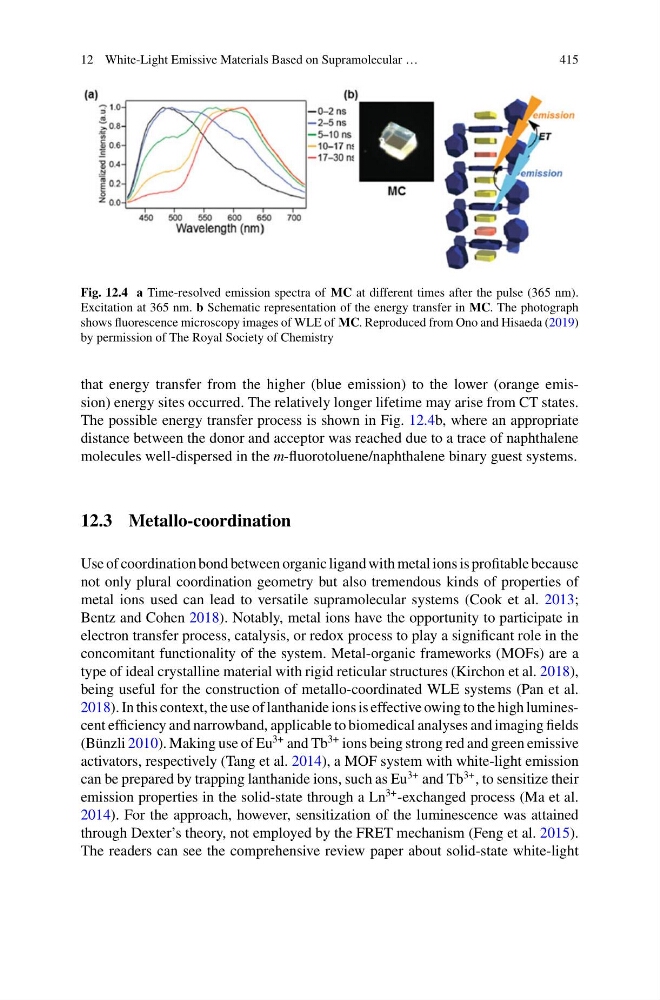
Fig. 12.4 a Time-resolved emission spectra of MC at different times after the pulse (365 nm).
Excitation at 365 nm. b Schematic representation of the energy transfer in MC. The photograph
shows fluorescence microscopy images of WLE of MC. Reproduced from Ono and Hisaeda (2019)
by permission of The Royal Society of Chemistry
that energy transfer from the higher (blue emission) to the lower (orange emission) energy sites occurred. The relatively longer lifetime may arise from CT states.
The possible energy transfer process is shown in Fig. 12.4b, where an appropriate
distance between the donor and acceptor was reached due to a trace of naphthalene
molecules well-dispersed in the m-fluorotoluene/naphthalene binary guest systems.
12.3 Metallo-coordination
Use of coordination bond between organic ligand with metal ions is profitable because
not only plural coordination geometry but also tremendous kinds of properties of
metal ions used can lead to versatile supramolecular systems (Cook et al. 2013;
Bentz and Cohen 2018). Notably, metal ions have the opportunity to participate in
electron transfer process, catalysis, or redox process to play a significant role in the
concomitant functionality of the system. Metal-organic frameworks (MOFs) are a
type of ideal crystalline material with rigid reticular structures (Kirchon et al. 2018),
being useful for the construction of metallo-coordinated WLE systems (Pan et al.
2018). In this context, the use of lanthanide ions is effective owing to the high luminescent efficiency and narrowband, applicable to biomedical analyses and imaging fields
(Bünzli 2010). Making use of Eu
3+ and Tb
3+ ions being strong red and green emissive
activators, respectively (Tang et al. 2014), a MOF system with white-light emission
can be prepared by trapping lanthanide ions, such as Eu
3+ and Tb
3+ , to sensitize their
emission properties in the solid-state through a Ln
3+ -exchanged process (Ma et al.
2014). For the approach, however, sensitization of the luminescence was attained
through Dexter’s theory, not employed by the FRET mechanism (Feng et al. 2015).
The readers can see the comprehensive review paper about solid-state white-light
415
Fig. 12.4 a Time-resolved emission spectra of MC at different times after the pulse (365 nm).
Excitation at 365 nm. b Schematic representation of the energy transfer in MC. The photograph
shows fluorescence microscopy images of WLE of MC. Reproduced from Ono and Hisaeda (2019)
by permission of The Royal Society of Chemistry
that energy transfer from the higher (blue emission) to the lower (orange emission) energy sites occurred. The relatively longer lifetime may arise from CT states.
The possible energy transfer process is shown in Fig. 12.4b, where an appropriate
distance between the donor and acceptor was reached due to a trace of naphthalene
molecules well-dispersed in the m-fluorotoluene/naphthalene binary guest systems.
12.3 Metallo-coordination
Use of coordination bond between organic ligand with metal ions is profitable because
not only plural coordination geometry but also tremendous kinds of properties of
metal ions used can lead to versatile supramolecular systems (Cook et al. 2013;
Bentz and Cohen 2018). Notably, metal ions have the opportunity to participate in
electron transfer process, catalysis, or redox process to play a significant role in the
concomitant functionality of the system. Metal-organic frameworks (MOFs) are a
type of ideal crystalline material with rigid reticular structures (Kirchon et al. 2018),
being useful for the construction of metallo-coordinated WLE systems (Pan et al.
2018). In this context, the use of lanthanide ions is effective owing to the high luminescent efficiency and narrowband, applicable to biomedical analyses and imaging fields
(Bünzli 2010). Making use of Eu
3+ and Tb
3+ ions being strong red and green emissive
activators, respectively (Tang et al. 2014), a MOF system with white-light emission
can be prepared by trapping lanthanide ions, such as Eu
3+ and Tb
3+ , to sensitize their
emission properties in the solid-state through a Ln
3+ -exchanged process (Ma et al.
2014). For the approach, however, sensitization of the luminescence was attained
through Dexter’s theory, not employed by the FRET mechanism (Feng et al. 2015).
The readers can see the comprehensive review paper about solid-state white-light