

396
Y. Niko and S. Watanabe
with π-π* excited states in different spin multiplicity (IUPAC 1997e). That is, the
aldehyde and ketone may induce greater spin–orbit interaction, resulting in intersystem crossing. In the cases of OPA and NDA, the two formyl groups disappear
after the reaction with thiol and primary amine, and larger π-systems due to the
pyrrole ring are formed. This is the photophysical basis for realizing the fluorescent
OFF–ON system in OPA and NDA.
11.4.6 Excimer Emission
When a dye molecule in the ground state is located near another dye in the excited
state, a so-called excited complex might be formed between the two. If this occurs
between two molecules of the same species, the dimer is called an “excimer (excited
dimer)”, and otherwise an “exciplex”. Pyrene, one of the polyaromatic hydrocarbons,
is a representative chromophore that forms excimer with a variation in its fluorescence
color from purplish blue (monomer) to greenish blue (excimer), making it a useful
fluorescent chemosensor.
The excimer must be formed during the lifetime of the dye in the excited state,
therefore it is normally observed in highly concentrated dye solutions, the solid
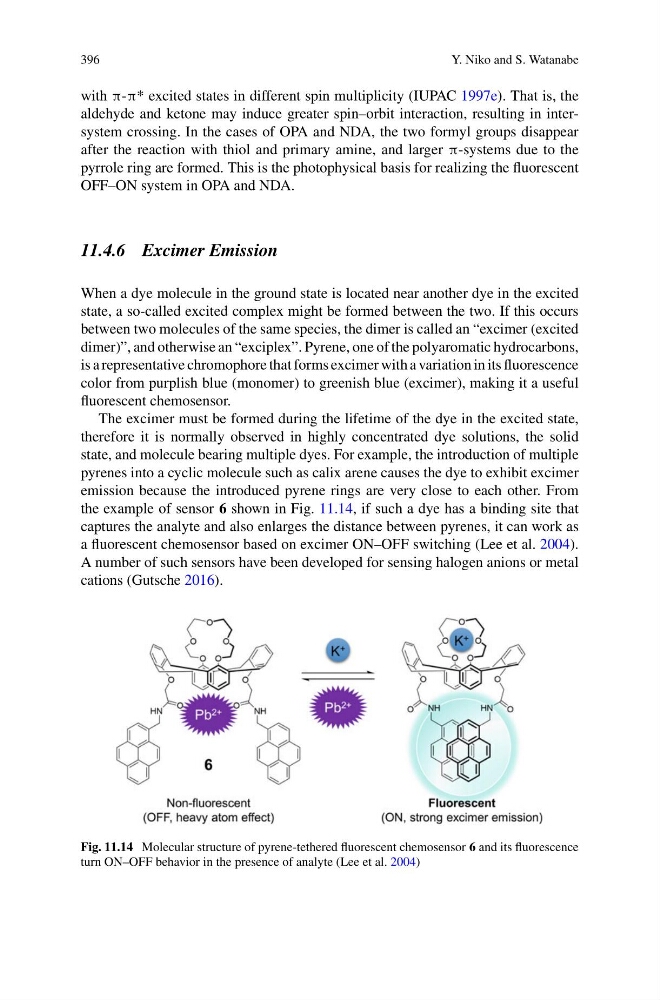
state, and molecule bearing multiple dyes. For example, the introduction of multiple
pyrenes into a cyclic molecule such as calix arene causes the dye to exhibit excimer
emission because the introduced pyrene rings are very close to each other. From
the example of sensor 6 shown in Fig. 11.14, if such a dye has a binding site that
captures the analyte and also enlarges the distance between pyrenes, it can work as
a fluorescent chemosensor based on excimer ON–OFF switching (Lee et al. 2004).
A number of such sensors have been developed for sensing halogen anions or metal
cations (Gutsche 2016).
Fig. 11.14 Molecular structure of pyrene-tethered fluorescent chemosensor 6 and its fluorescence
turn ON–OFF behavior in the presence of analyte (Lee et al. 2004)
Y. Niko and S. Watanabe
with π-π* excited states in different spin multiplicity (IUPAC 1997e). That is, the
aldehyde and ketone may induce greater spin–orbit interaction, resulting in intersystem crossing. In the cases of OPA and NDA, the two formyl groups disappear
after the reaction with thiol and primary amine, and larger π-systems due to the
pyrrole ring are formed. This is the photophysical basis for realizing the fluorescent
OFF–ON system in OPA and NDA.
11.4.6 Excimer Emission
When a dye molecule in the ground state is located near another dye in the excited
state, a so-called excited complex might be formed between the two. If this occurs
between two molecules of the same species, the dimer is called an “excimer (excited
dimer)”, and otherwise an “exciplex”. Pyrene, one of the polyaromatic hydrocarbons,
is a representative chromophore that forms excimer with a variation in its fluorescence
color from purplish blue (monomer) to greenish blue (excimer), making it a useful
fluorescent chemosensor.
The excimer must be formed during the lifetime of the dye in the excited state,
therefore it is normally observed in highly concentrated dye solutions, the solid
state, and molecule bearing multiple dyes. For example, the introduction of multiple
pyrenes into a cyclic molecule such as calix arene causes the dye to exhibit excimer
emission because the introduced pyrene rings are very close to each other. From
the example of sensor 6 shown in Fig. 11.14, if such a dye has a binding site that
captures the analyte and also enlarges the distance between pyrenes, it can work as
a fluorescent chemosensor based on excimer ON–OFF switching (Lee et al. 2004).
A number of such sensors have been developed for sensing halogen anions or metal
cations (Gutsche 2016).
Fig. 11.14 Molecular structure of pyrene-tethered fluorescent chemosensor 6 and its fluorescence
turn ON–OFF behavior in the presence of analyte (Lee et al. 2004)