

11 Fluorescent Chemosensors
395
HOMO/LUMO energies, so that this principle can be hybridized with sensors based
on FRET.
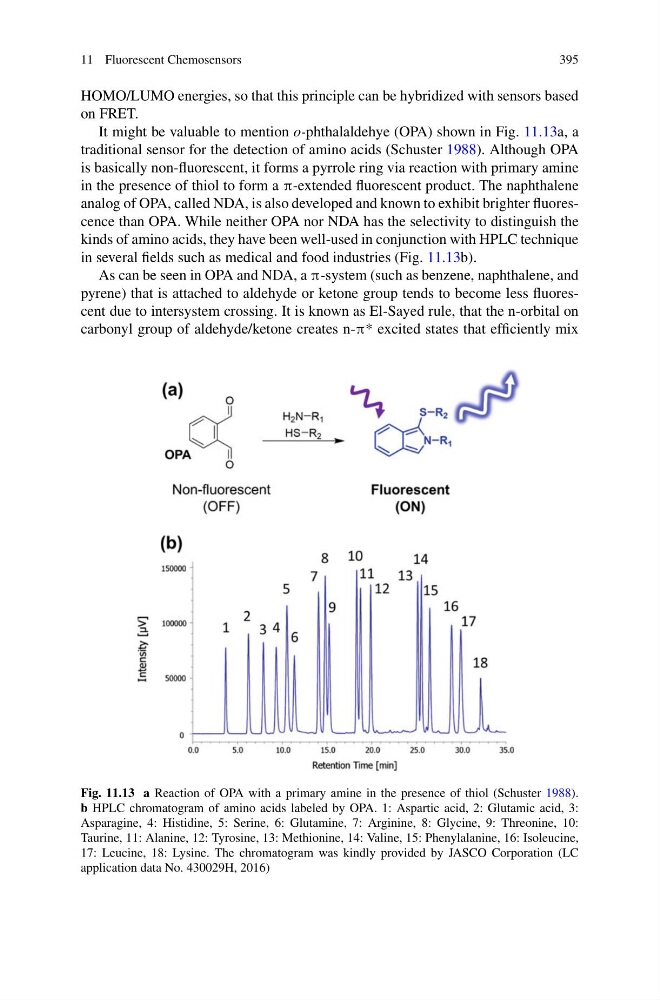
It might be valuable to mention o-phthalaldehye (OPA) shown in Fig. 11.13a, a
traditional sensor for the detection of amino acids (Schuster 1988). Although OPA
is basically non-fluorescent, it forms a pyrrole ring via reaction with primary amine
in the presence of thiol to form a π-extended fluorescent product. The naphthalene
analog of OPA, called NDA, is also developed and known to exhibit brighter fluorescence than OPA. While neither OPA nor NDA has the selectivity to distinguish the
kinds of amino acids, they have been well-used in conjunction with HPLC technique
in several fields such as medical and food industries (Fig. 11.13b).
As can be seen in OPA and NDA, a π-system (such as benzene, naphthalene, and
pyrene) that is attached to aldehyde or ketone group tends to become less fluorescent due to intersystem crossing. It is known as El-Sayed rule, that the n-orbital on
carbonyl group of aldehyde/ketone creates n-π* excited states that efficiently mix
Fig. 11.13 a Reaction of OPA with a primary amine in the presence of thiol (Schuster 1988).
b HPLC chromatogram of amino acids labeled by OPA. 1: Aspartic acid, 2: Glutamic acid, 3:
Asparagine, 4: Histidine, 5: Serine, 6: Glutamine, 7: Arginine, 8: Glycine, 9: Threonine, 10:
Taurine, 11: Alanine, 12: Tyrosine, 13: Methionine, 14: Valine, 15: Phenylalanine, 16: Isoleucine,
17: Leucine, 18: Lysine. The chromatogram was kindly provided by JASCO Corporation (LC
application data No. 430029H, 2016)
395
HOMO/LUMO energies, so that this principle can be hybridized with sensors based
on FRET.
It might be valuable to mention o-phthalaldehye (OPA) shown in Fig. 11.13a, a
traditional sensor for the detection of amino acids (Schuster 1988). Although OPA
is basically non-fluorescent, it forms a pyrrole ring via reaction with primary amine
in the presence of thiol to form a π-extended fluorescent product. The naphthalene
analog of OPA, called NDA, is also developed and known to exhibit brighter fluorescence than OPA. While neither OPA nor NDA has the selectivity to distinguish the
kinds of amino acids, they have been well-used in conjunction with HPLC technique
in several fields such as medical and food industries (Fig. 11.13b).
As can be seen in OPA and NDA, a π-system (such as benzene, naphthalene, and
pyrene) that is attached to aldehyde or ketone group tends to become less fluorescent due to intersystem crossing. It is known as El-Sayed rule, that the n-orbital on
carbonyl group of aldehyde/ketone creates n-π* excited states that efficiently mix
Fig. 11.13 a Reaction of OPA with a primary amine in the presence of thiol (Schuster 1988).
b HPLC chromatogram of amino acids labeled by OPA. 1: Aspartic acid, 2: Glutamic acid, 3:
Asparagine, 4: Histidine, 5: Serine, 6: Glutamine, 7: Arginine, 8: Glycine, 9: Threonine, 10:
Taurine, 11: Alanine, 12: Tyrosine, 13: Methionine, 14: Valine, 15: Phenylalanine, 16: Isoleucine,
17: Leucine, 18: Lysine. The chromatogram was kindly provided by JASCO Corporation (LC
application data No. 430029H, 2016)