

394
Y. Niko and S. Watanabe
quantitative ways to analyze glutathione using fluorescence lifetime imaging and
ratiometric imaging using microscopy.
11.4.5 Formation of Emissive π-System via Chemical
Reaction
The fluorescence properties of organic fluorescent dyes are critically associated with
their π-conjugation structure. Even if the π-system is initially non-fluorescent, it
might be made fluorescent through chemical reactions such as transition metalcatalyzed cross-coupling, Witting reaction, or Knoevenagel condensation, all of
them are used to extend the π-conjugation of aromatic molecules. Here, fluorescent
chemosensors related to their π-conjugation structures will be presented.
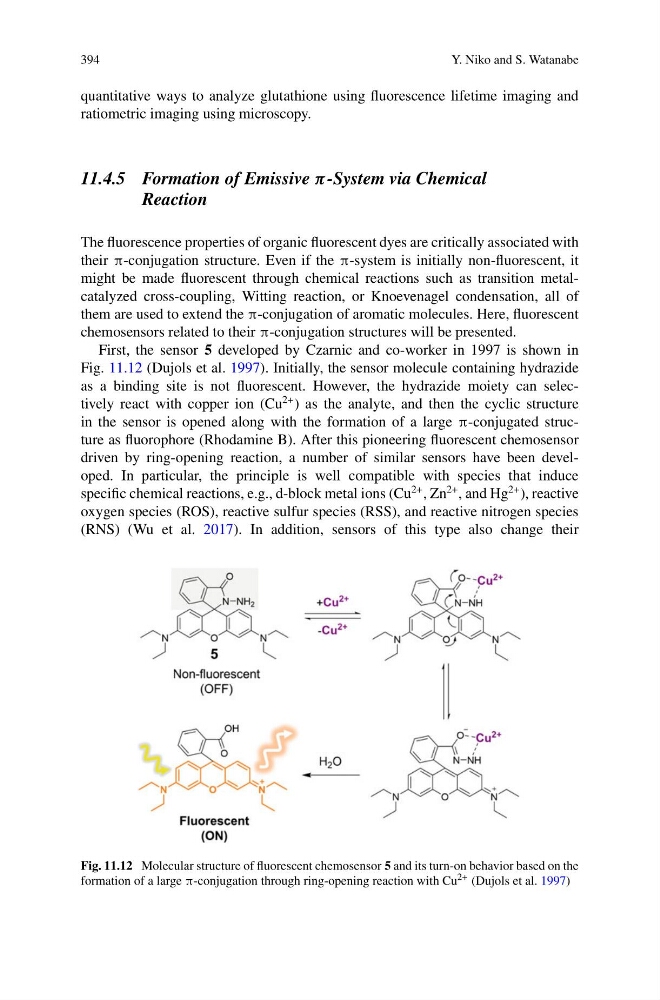
First, the sensor 5 developed by Czarnic and co-worker in 1997 is shown in
Fig. 11.12 (Dujols et al. 1997). Initially, the sensor molecule containing hydrazide
as a binding site is not fluorescent. However, the hydrazide moiety can selectively react with copper ion (Cu
2+ ) as the analyte, and then the cyclic structure
in the sensor is opened along with the formation of a large π-conjugated structure as fluorophore (Rhodamine B). After this pioneering fluorescent chemosensor
driven by ring-opening reaction, a number of similar sensors have been developed. In particular, the principle is well compatible with species that induce
specific chemical reactions, e.g., d-block metal ions (Cu
2+ , Zn
2+ , and Hg
2+ ), reactive
oxygen species (ROS), reactive sulfur species (RSS), and reactive nitrogen species
(RNS) (Wu et al. 2017). In addition, sensors of this type also change their
Fig. 11.12 Molecular structure of fluorescent chemosensor 5 and its turn-on behavior based on the
formation of a large π-conjugation through ring-opening reaction with Cu 2+ (Dujols et al. 1997)
Y. Niko and S. Watanabe
quantitative ways to analyze glutathione using fluorescence lifetime imaging and
ratiometric imaging using microscopy.
11.4.5 Formation of Emissive π-System via Chemical
Reaction
The fluorescence properties of organic fluorescent dyes are critically associated with
their π-conjugation structure. Even if the π-system is initially non-fluorescent, it
might be made fluorescent through chemical reactions such as transition metalcatalyzed cross-coupling, Witting reaction, or Knoevenagel condensation, all of
them are used to extend the π-conjugation of aromatic molecules. Here, fluorescent
chemosensors related to their π-conjugation structures will be presented.
First, the sensor 5 developed by Czarnic and co-worker in 1997 is shown in
Fig. 11.12 (Dujols et al. 1997). Initially, the sensor molecule containing hydrazide
as a binding site is not fluorescent. However, the hydrazide moiety can selectively react with copper ion (Cu
2+ ) as the analyte, and then the cyclic structure
in the sensor is opened along with the formation of a large π-conjugated structure as fluorophore (Rhodamine B). After this pioneering fluorescent chemosensor
driven by ring-opening reaction, a number of similar sensors have been developed. In particular, the principle is well compatible with species that induce
specific chemical reactions, e.g., d-block metal ions (Cu
2+ , Zn
2+ , and Hg
2+ ), reactive
oxygen species (ROS), reactive sulfur species (RSS), and reactive nitrogen species
(RNS) (Wu et al. 2017). In addition, sensors of this type also change their
Fig. 11.12 Molecular structure of fluorescent chemosensor 5 and its turn-on behavior based on the
formation of a large π-conjugation through ring-opening reaction with Cu 2+ (Dujols et al. 1997)