

11 Fluorescent Chemosensors
393
(usually less than 10 nm), the excitation energy of D could transfer to A, therefore
fluorescence from A would be observed. Such FRET process is often explained by
analogy to the resonance observed between a vibrating and a non-vibrating tuning
fork. A large spectral overlap and a shorter distance between D and A result in
highly efficient energy transfer. Thus, if the D and A species are fixed, the efficiency
of FRET is dependent on their distance, which allows the measurement of distance
between two positions in biomolecules where D and A are attached (Sahoo 2011;
Ma et al. 2014). Additionally, the orientation of transition dipole moments between
D and A may also be important. This is because FRET theoretically occurs when the
dipolar oscillation of D in the excited state satisfies the condition to resonate with
that of A in ground state, and so FRET will be forbidden if the two transition dipole
moments are perpendicularly oriented. This orientation factor may cause difficulty
in precisely measuring the distance between D and A bound to macromolecules like
proteins, where the dyes cannot freely rotate and so that the orientation factor is not
averaged.
It should be kept in mind that FRET is based on resonance, which means A does not
absorb the fluorescence of D (i.e., reabsorption). Rather, an energy transfer process
based on light reabsorption is called radiative energy transfer, whereas FRET is called
non-radiative (radiationless) energy transfer. These two cases can be distinguished by
comparing the fluorescence lifetime of a single D molecule (without energy transfer)
to that of D with A (with energy transfer), because the fluorescence lifetime of D
before and after FRET should be different. Such a distinction is sometimes required
for precise fluorescence lifetime imaging.
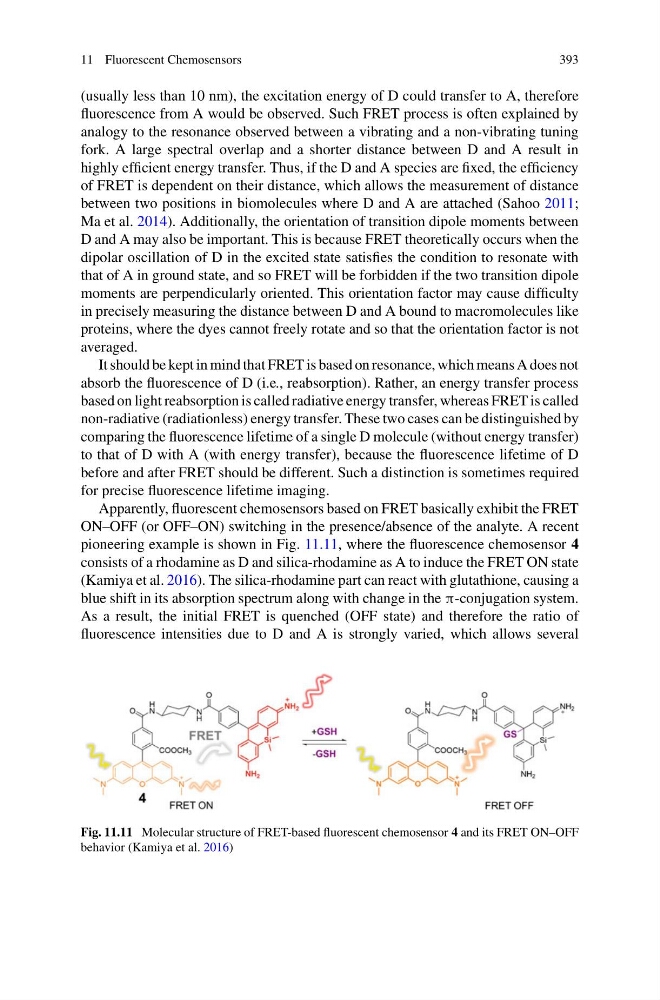
Apparently, fluorescent chemosensors based on FRET basically exhibit the FRET
ON–OFF (or OFF–ON) switching in the presence/absence of the analyte. A recent
pioneering example is shown in Fig. 11.11, where the fluorescence chemosensor 4
consists of a rhodamine as D and silica-rhodamine as A to induce the FRET ON state
(Kamiya et al. 2016). The silica-rhodamine part can react with glutathione, causing a
blue shift in its absorption spectrum along with change in the π-conjugation system.
As a result, the initial FRET is quenched (OFF state) and therefore the ratio of
fluorescence intensities due to D and A is strongly varied, which allows several
Fig. 11.11 Molecular structure of FRET-based fluorescent chemosensor 4 and its FRET ON–OFF
behavior (Kamiya et al. 2016)
393
(usually less than 10 nm), the excitation energy of D could transfer to A, therefore
fluorescence from A would be observed. Such FRET process is often explained by
analogy to the resonance observed between a vibrating and a non-vibrating tuning
fork. A large spectral overlap and a shorter distance between D and A result in
highly efficient energy transfer. Thus, if the D and A species are fixed, the efficiency
of FRET is dependent on their distance, which allows the measurement of distance
between two positions in biomolecules where D and A are attached (Sahoo 2011;
Ma et al. 2014). Additionally, the orientation of transition dipole moments between
D and A may also be important. This is because FRET theoretically occurs when the
dipolar oscillation of D in the excited state satisfies the condition to resonate with
that of A in ground state, and so FRET will be forbidden if the two transition dipole
moments are perpendicularly oriented. This orientation factor may cause difficulty
in precisely measuring the distance between D and A bound to macromolecules like
proteins, where the dyes cannot freely rotate and so that the orientation factor is not
averaged.
It should be kept in mind that FRET is based on resonance, which means A does not
absorb the fluorescence of D (i.e., reabsorption). Rather, an energy transfer process
based on light reabsorption is called radiative energy transfer, whereas FRET is called
non-radiative (radiationless) energy transfer. These two cases can be distinguished by
comparing the fluorescence lifetime of a single D molecule (without energy transfer)
to that of D with A (with energy transfer), because the fluorescence lifetime of D
before and after FRET should be different. Such a distinction is sometimes required
for precise fluorescence lifetime imaging.
Apparently, fluorescent chemosensors based on FRET basically exhibit the FRET
ON–OFF (or OFF–ON) switching in the presence/absence of the analyte. A recent
pioneering example is shown in Fig. 11.11, where the fluorescence chemosensor 4
consists of a rhodamine as D and silica-rhodamine as A to induce the FRET ON state
(Kamiya et al. 2016). The silica-rhodamine part can react with glutathione, causing a
blue shift in its absorption spectrum along with change in the π-conjugation system.
As a result, the initial FRET is quenched (OFF state) and therefore the ratio of
fluorescence intensities due to D and A is strongly varied, which allows several
Fig. 11.11 Molecular structure of FRET-based fluorescent chemosensor 4 and its FRET ON–OFF
behavior (Kamiya et al. 2016)