

11 Fluorescent Chemosensors
397
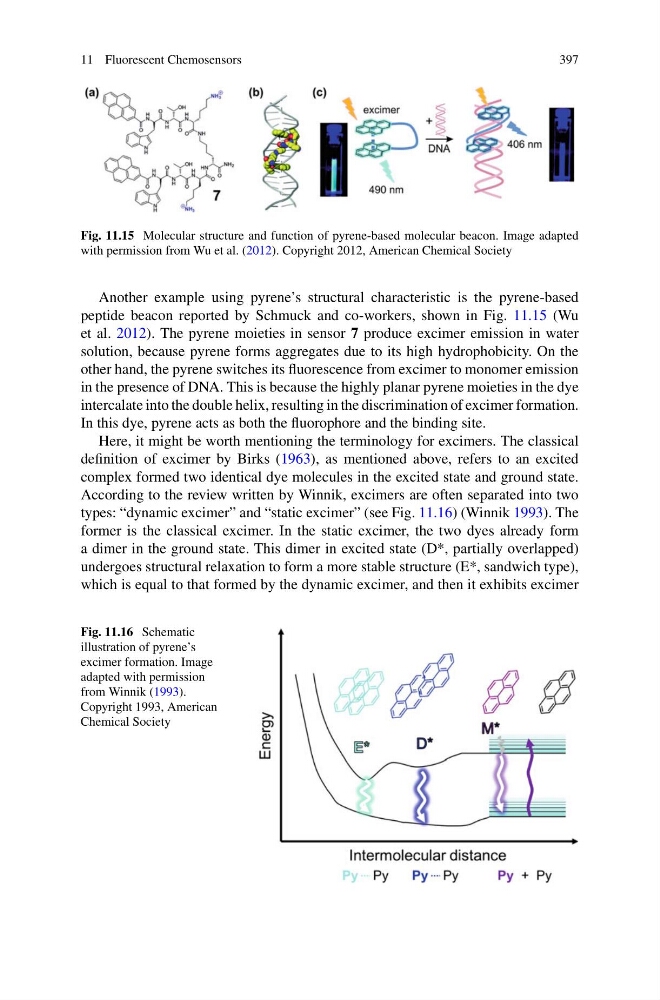
Fig. 11.15 Molecular structure and function of pyrene-based molecular beacon. Image adapted
with permission from Wu et al. (2012). Copyright 2012, American Chemical Society
Another example using pyrene’s structural characteristic is the pyrene-based
peptide beacon reported by Schmuck and co-workers, shown in Fig. 11.15 (Wu
et al. 2012). The pyrene moieties in sensor 7 produce excimer emission in water
solution, because pyrene forms aggregates due to its high hydrophobicity. On the
other hand, the pyrene switches its fluorescence from excimer to monomer emission
in the presence of DNA. This is because the highly planar pyrene moieties in the dye
intercalate into the double helix, resulting in the discrimination of excimer formation.
In this dye, pyrene acts as both the fluorophore and the binding site.
Here, it might be worth mentioning the terminology for excimers. The classical
definition of excimer by Birks (1963), as mentioned above, refers to an excited
complex formed two identical dye molecules in the excited state and ground state.
According to the review written by Winnik, excimers are often separated into two
types: “dynamic excimer” and “static excimer” (see Fig. 11.16) (Winnik 1993). The
former is the classical excimer. In the static excimer, the two dyes already form
a dimer in the ground state. This dimer in excited state (D*, partially overlapped)
undergoes structural relaxation to form a more stable structure (E*, sandwich type),
which is equal to that formed by the dynamic excimer, and then it exhibits excimer
Fig. 11.16 Schematic
illustration of pyrene’s
excimer formation. Image
adapted with permission
from Winnik (1993).
Copyright 1993, American
Chemical Society
397
Fig. 11.15 Molecular structure and function of pyrene-based molecular beacon. Image adapted
with permission from Wu et al. (2012). Copyright 2012, American Chemical Society
Another example using pyrene’s structural characteristic is the pyrene-based
peptide beacon reported by Schmuck and co-workers, shown in Fig. 11.15 (Wu
et al. 2012). The pyrene moieties in sensor 7 produce excimer emission in water
solution, because pyrene forms aggregates due to its high hydrophobicity. On the
other hand, the pyrene switches its fluorescence from excimer to monomer emission
in the presence of DNA. This is because the highly planar pyrene moieties in the dye
intercalate into the double helix, resulting in the discrimination of excimer formation.
In this dye, pyrene acts as both the fluorophore and the binding site.
Here, it might be worth mentioning the terminology for excimers. The classical
definition of excimer by Birks (1963), as mentioned above, refers to an excited
complex formed two identical dye molecules in the excited state and ground state.
According to the review written by Winnik, excimers are often separated into two
types: “dynamic excimer” and “static excimer” (see Fig. 11.16) (Winnik 1993). The
former is the classical excimer. In the static excimer, the two dyes already form
a dimer in the ground state. This dimer in excited state (D*, partially overlapped)
undergoes structural relaxation to form a more stable structure (E*, sandwich type),
which is equal to that formed by the dynamic excimer, and then it exhibits excimer
Fig. 11.16 Schematic
illustration of pyrene’s
excimer formation. Image
adapted with permission
from Winnik (1993).
Copyright 1993, American
Chemical Society