

11 Fluorescent Chemosensors
391
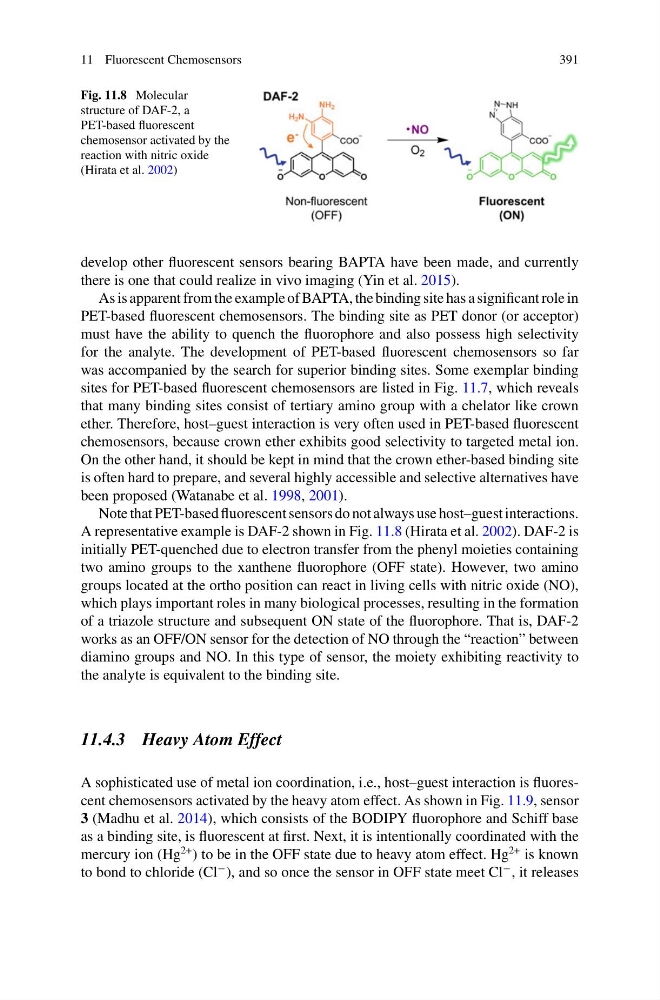
Fig. 11.8 Molecular
structure of DAF-2, a
PET-based fluorescent
chemosensor activated by the
reaction with nitric oxide
(Hirata et al. 2002)
develop other fluorescent sensors bearing BAPTA have been made, and currently
there is one that could realize in vivo imaging (Yin et al. 2015).
As is apparent from the example of BAPTA, the binding site has a significant role in
PET-based fluorescent chemosensors. The binding site as PET donor (or acceptor)
must have the ability to quench the fluorophore and also possess high selectivity
for the analyte. The development of PET-based fluorescent chemosensors so far
was accompanied by the search for superior binding sites. Some exemplar binding
sites for PET-based fluorescent chemosensors are listed in Fig. 11.7, which reveals
that many binding sites consist of tertiary amino group with a chelator like crown
ether. Therefore, host–guest interaction is very often used in PET-based fluorescent
chemosensors, because crown ether exhibits good selectivity to targeted metal ion.
On the other hand, it should be kept in mind that the crown ether-based binding site
is often hard to prepare, and several highly accessible and selective alternatives have
been proposed (Watanabe et al. 1998, 2001).
Note that PET-based fluorescent sensors do not always use host–guest interactions.
A representative example is DAF-2 shown in Fig. 11.8 (Hirata et al. 2002). DAF-2 is
initially PET-quenched due to electron transfer from the phenyl moieties containing
two amino groups to the xanthene fluorophore (OFF state). However, two amino
groups located at the ortho position can react in living cells with nitric oxide (NO),
which plays important roles in many biological processes, resulting in the formation
of a triazole structure and subsequent ON state of the fluorophore. That is, DAF-2
works as an OFF/ON sensor for the detection of NO through the “reaction” between
diamino groups and NO. In this type of sensor, the moiety exhibiting reactivity to
the analyte is equivalent to the binding site.
11.4.3 Heavy Atom Effect
A sophisticated use of metal ion coordination, i.e., host–guest interaction is fluorescent chemosensors activated by the heavy atom effect. As shown in Fig. 11.9, sensor
3 (Madhu et al. 2014), which consists of the BODIPY fluorophore and Schiff base
as a binding site, is fluorescent at first. Next, it is intentionally coordinated with the
mercury ion (Hg
2+ ) to be in the OFF state due to heavy atom effect. Hg
2+ is known
to bond to chloride (Cl
− ), and so once the sensor in OFF state meet Cl
− , it releases
391
Fig. 11.8 Molecular
structure of DAF-2, a
PET-based fluorescent
chemosensor activated by the
reaction with nitric oxide
(Hirata et al. 2002)
develop other fluorescent sensors bearing BAPTA have been made, and currently
there is one that could realize in vivo imaging (Yin et al. 2015).
As is apparent from the example of BAPTA, the binding site has a significant role in
PET-based fluorescent chemosensors. The binding site as PET donor (or acceptor)
must have the ability to quench the fluorophore and also possess high selectivity
for the analyte. The development of PET-based fluorescent chemosensors so far
was accompanied by the search for superior binding sites. Some exemplar binding
sites for PET-based fluorescent chemosensors are listed in Fig. 11.7, which reveals
that many binding sites consist of tertiary amino group with a chelator like crown
ether. Therefore, host–guest interaction is very often used in PET-based fluorescent
chemosensors, because crown ether exhibits good selectivity to targeted metal ion.
On the other hand, it should be kept in mind that the crown ether-based binding site
is often hard to prepare, and several highly accessible and selective alternatives have
been proposed (Watanabe et al. 1998, 2001).
Note that PET-based fluorescent sensors do not always use host–guest interactions.
A representative example is DAF-2 shown in Fig. 11.8 (Hirata et al. 2002). DAF-2 is
initially PET-quenched due to electron transfer from the phenyl moieties containing
two amino groups to the xanthene fluorophore (OFF state). However, two amino
groups located at the ortho position can react in living cells with nitric oxide (NO),
which plays important roles in many biological processes, resulting in the formation
of a triazole structure and subsequent ON state of the fluorophore. That is, DAF-2
works as an OFF/ON sensor for the detection of NO through the “reaction” between
diamino groups and NO. In this type of sensor, the moiety exhibiting reactivity to
the analyte is equivalent to the binding site.
11.4.3 Heavy Atom Effect
A sophisticated use of metal ion coordination, i.e., host–guest interaction is fluorescent chemosensors activated by the heavy atom effect. As shown in Fig. 11.9, sensor
3 (Madhu et al. 2014), which consists of the BODIPY fluorophore and Schiff base
as a binding site, is fluorescent at first. Next, it is intentionally coordinated with the
mercury ion (Hg
2+ ) to be in the OFF state due to heavy atom effect. Hg
2+ is known
to bond to chloride (Cl
− ), and so once the sensor in OFF state meet Cl
− , it releases