

390
Y. Niko and S. Watanabe
SOMO of the dye to the lowest unoccupied molecular orbital (LUMO) of an electron
acceptor molecule (i.e., PET acceptor) is also possible and called oxidative electron
transfer. These phenomena are collectively called PET, which causes fluorescence
quenching of the dye (PET quenching).
In the developed fluorescent chemosensors based on PET mechanism, the fluorophore is initially connected to the PET donor or acceptor molecule so that it
is temporarily non-fluorescent (OFF state). Typically, the PET donor or acceptor
moiety also acts as a binding site. Specifically, when the PET donor as a binding site
captures the analyte, its HOMO level would be significantly decreased. This results in
the suppression of PET quenching, i.e., enhanced fluorescence intensity of the fluorophore (ON state). Thus, PET-based fluorescent chemosensors enable quantitative
analysis by switching their fluorescence to OFF/ON states in the absence/presence
of the analyte.
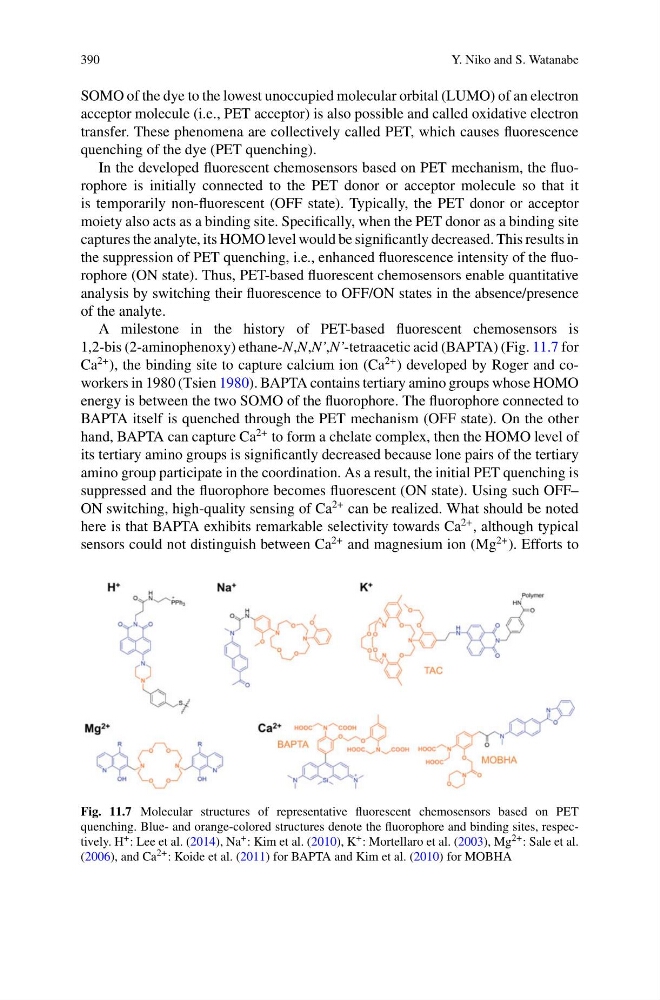
A milestone in the history of PET-based fluorescent chemosensors is
1,2-bis (2-aminophenoxy) ethane-N,N,N’,N’-tetraacetic acid (BAPTA) (Fig. 11.7 for
Ca
2+ ), the binding site to capture calcium ion (Ca
2+ ) developed by Roger and coworkers in 1980 (Tsien 1980). BAPTA contains tertiary amino groups whose HOMO
energy is between the two SOMO of the fluorophore. The fluorophore connected to
BAPTA itself is quenched through the PET mechanism (OFF state). On the other
hand, BAPTA can capture Ca
2+ to form a chelate complex, then the HOMO level of
its tertiary amino groups is significantly decreased because lone pairs of the tertiary
amino group participate in the coordination. As a result, the initial PET quenching is
suppressed and the fluorophore becomes fluorescent (ON state). Using such OFF–
ON switching, high-quality sensing of Ca
2+ can be realized. What should be noted
here is that BAPTA exhibits remarkable selectivity towards Ca
2+ , although typical
sensors could not distinguish between Ca
2+ and magnesium ion (Mg
2+ ). Efforts to
Fig. 11.7 Molecular structures of representative fluorescent chemosensors based on PET
quenching. Blue- and orange-colored structures denote the fluorophore and binding sites, respectively. H + : Lee et al. (2014), Na + : Kim et al. (2010), K + : Mortellaro et al. (2003), Mg 2+ : Sale et al.
(2006), and Ca 2+ : Koide et al. (2011) for BAPTA and Kim et al. (2010) for MOBHA
Y. Niko and S. Watanabe
SOMO of the dye to the lowest unoccupied molecular orbital (LUMO) of an electron
acceptor molecule (i.e., PET acceptor) is also possible and called oxidative electron
transfer. These phenomena are collectively called PET, which causes fluorescence
quenching of the dye (PET quenching).
In the developed fluorescent chemosensors based on PET mechanism, the fluorophore is initially connected to the PET donor or acceptor molecule so that it
is temporarily non-fluorescent (OFF state). Typically, the PET donor or acceptor
moiety also acts as a binding site. Specifically, when the PET donor as a binding site
captures the analyte, its HOMO level would be significantly decreased. This results in
the suppression of PET quenching, i.e., enhanced fluorescence intensity of the fluorophore (ON state). Thus, PET-based fluorescent chemosensors enable quantitative
analysis by switching their fluorescence to OFF/ON states in the absence/presence
of the analyte.
A milestone in the history of PET-based fluorescent chemosensors is
1,2-bis (2-aminophenoxy) ethane-N,N,N’,N’-tetraacetic acid (BAPTA) (Fig. 11.7 for
Ca
2+ ), the binding site to capture calcium ion (Ca
2+ ) developed by Roger and coworkers in 1980 (Tsien 1980). BAPTA contains tertiary amino groups whose HOMO
energy is between the two SOMO of the fluorophore. The fluorophore connected to
BAPTA itself is quenched through the PET mechanism (OFF state). On the other
hand, BAPTA can capture Ca
2+ to form a chelate complex, then the HOMO level of
its tertiary amino groups is significantly decreased because lone pairs of the tertiary
amino group participate in the coordination. As a result, the initial PET quenching is
suppressed and the fluorophore becomes fluorescent (ON state). Using such OFF–
ON switching, high-quality sensing of Ca
2+ can be realized. What should be noted
here is that BAPTA exhibits remarkable selectivity towards Ca
2+ , although typical
sensors could not distinguish between Ca
2+ and magnesium ion (Mg
2+ ). Efforts to
Fig. 11.7 Molecular structures of representative fluorescent chemosensors based on PET
quenching. Blue- and orange-colored structures denote the fluorophore and binding sites, respectively. H + : Lee et al. (2014), Na + : Kim et al. (2010), K + : Mortellaro et al. (2003), Mg 2+ : Sale et al.
(2006), and Ca 2+ : Koide et al. (2011) for BAPTA and Kim et al. (2010) for MOBHA