

11 Fluorescent Chemosensors
389
(K
+ ), rubidium (Rb
+ ), or cesium (Ce
+ ) ions. The successful design of 1 and 2 definitely implies that host–guest interaction would be useful for developing fluorescent
chemosensors.
In the host–guest-based metal ion sensor, the metal coordination itself may affect
the photophysical properties of fluorophore in several ways (Rice et al. 2002). For
instance, the rigidity of the sensor molecule might be increased along with metal
ion coordination, resulting in decreased thermal deactivation of the excited fluorophore, i.e., an increase in the fluorescence quantum yield. In addition, the energy
difference between excited first singlet state and its adjacent excited triplet state
of the fluorophore would change upon coordination, leading to significant change
in the efficiency of intersystem crossing (the transition from excited singlet state to
triplet state). Moreover, metal ion coordination may provoke the “heavy atom effect”
(IUPAC 1997c), which is known to facilitate intersystem crossing by enhancing the
spin–orbit interaction. Thus, the observed change in fluorescence intensity of 1 and
2 upon complexation might result from one or more of the abovementioned effects.
In later research, host–guest interaction has been used much more strategically, and
the representative approaches will be described in Sects. 11.4.2 and 11.4.3.
11.4.2 Photo-Induced Electron Transfer
Among fluorescent chemosensors based on host–guest chemistry, recently the most
powerful and frequently used operation principle is “photo-induced electron transfer
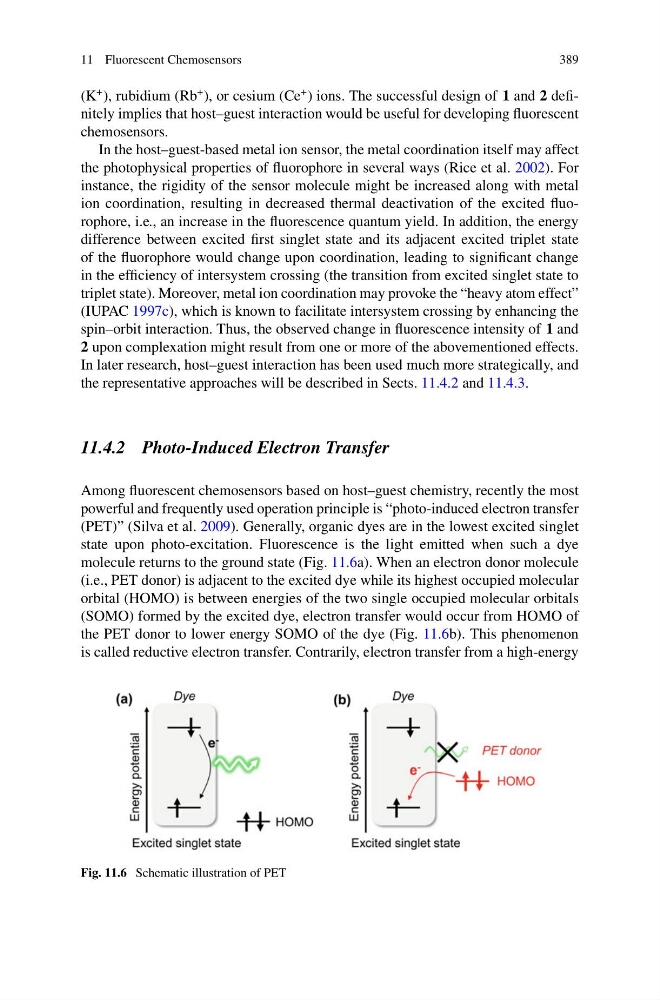
(PET)” (Silva et al. 2009). Generally, organic dyes are in the lowest excited singlet
state upon photo-excitation. Fluorescence is the light emitted when such a dye
molecule returns to the ground state (Fig. 11.6a). When an electron donor molecule
(i.e., PET donor) is adjacent to the excited dye while its highest occupied molecular
orbital (HOMO) is between energies of the two single occupied molecular orbitals
(SOMO) formed by the excited dye, electron transfer would occur from HOMO of
the PET donor to lower energy SOMO of the dye (Fig. 11.6b). This phenomenon
is called reductive electron transfer. Contrarily, electron transfer from a high-energy
Fig. 11.6 Schematic illustration of PET
389
(K
+ ), rubidium (Rb
+ ), or cesium (Ce
+ ) ions. The successful design of 1 and 2 definitely implies that host–guest interaction would be useful for developing fluorescent
chemosensors.
In the host–guest-based metal ion sensor, the metal coordination itself may affect
the photophysical properties of fluorophore in several ways (Rice et al. 2002). For
instance, the rigidity of the sensor molecule might be increased along with metal
ion coordination, resulting in decreased thermal deactivation of the excited fluorophore, i.e., an increase in the fluorescence quantum yield. In addition, the energy
difference between excited first singlet state and its adjacent excited triplet state
of the fluorophore would change upon coordination, leading to significant change
in the efficiency of intersystem crossing (the transition from excited singlet state to
triplet state). Moreover, metal ion coordination may provoke the “heavy atom effect”
(IUPAC 1997c), which is known to facilitate intersystem crossing by enhancing the
spin–orbit interaction. Thus, the observed change in fluorescence intensity of 1 and
2 upon complexation might result from one or more of the abovementioned effects.
In later research, host–guest interaction has been used much more strategically, and
the representative approaches will be described in Sects. 11.4.2 and 11.4.3.
11.4.2 Photo-Induced Electron Transfer
Among fluorescent chemosensors based on host–guest chemistry, recently the most
powerful and frequently used operation principle is “photo-induced electron transfer
(PET)” (Silva et al. 2009). Generally, organic dyes are in the lowest excited singlet
state upon photo-excitation. Fluorescence is the light emitted when such a dye
molecule returns to the ground state (Fig. 11.6a). When an electron donor molecule
(i.e., PET donor) is adjacent to the excited dye while its highest occupied molecular
orbital (HOMO) is between energies of the two single occupied molecular orbitals
(SOMO) formed by the excited dye, electron transfer would occur from HOMO of
the PET donor to lower energy SOMO of the dye (Fig. 11.6b). This phenomenon
is called reductive electron transfer. Contrarily, electron transfer from a high-energy
Fig. 11.6 Schematic illustration of PET