

388
Y. Niko and S. Watanabe
site is used to simply capture a specific analyte, the fluorescent chemosensor may
vary its fluorescence properties via certain mechanisms (vide infra, see Sect. 11.4.7).
Unfortunately, details about the significance of the detection of each analyte and the
underlying theoretical basis (e.g., equations to calculate the kinetic constants such
as the association/disassociation rate constants) are skipped due to limitation in the
length. The reader is referred to the corresponding references.
11.4.1 “Primordial” Fluorescent Chemosensors Based
on Host–Guest Chemistry
First of all, the primordial fluorescent chemosensors developed by Sousa and coworker should be introduced (Sousa and Larson 1977), because these sensors opened
the door to today’s intensive development of fluorescent chemosensors based on
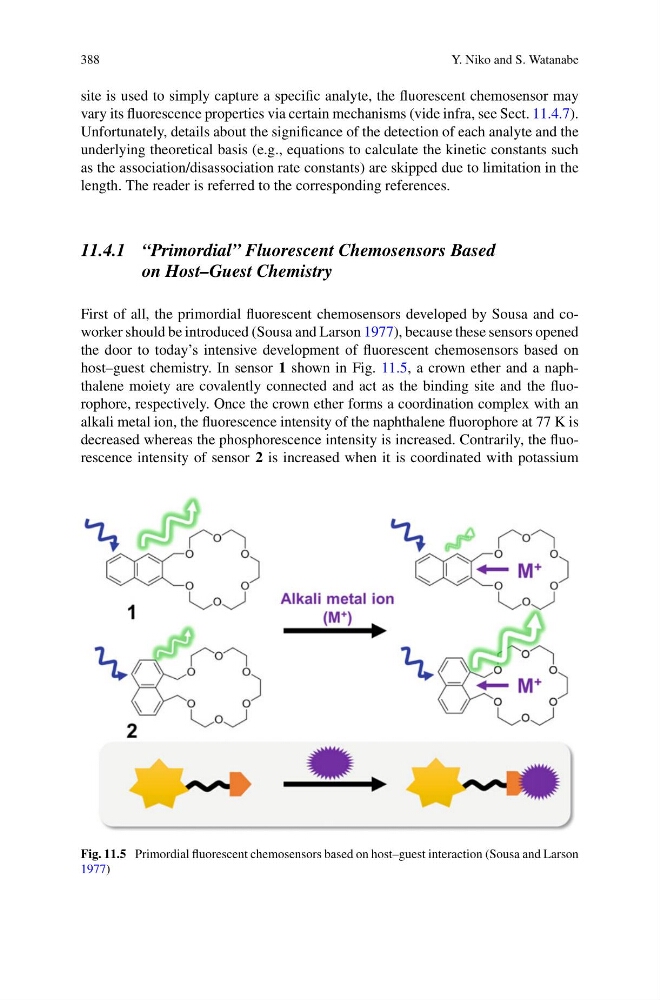
host–guest chemistry. In sensor 1 shown in Fig. 11.5, a crown ether and a naphthalene moiety are covalently connected and act as the binding site and the fluorophore, respectively. Once the crown ether forms a coordination complex with an
alkali metal ion, the fluorescence intensity of the naphthalene fluorophore at 77 K is
decreased whereas the phosphorescence intensity is increased. Contrarily, the fluorescence intensity of sensor 2 is increased when it is coordinated with potassium
Fig. 11.5 Primordial fluorescent chemosensors based on host–guest interaction (Sousa and Larson
1977)
Y. Niko and S. Watanabe
site is used to simply capture a specific analyte, the fluorescent chemosensor may
vary its fluorescence properties via certain mechanisms (vide infra, see Sect. 11.4.7).
Unfortunately, details about the significance of the detection of each analyte and the
underlying theoretical basis (e.g., equations to calculate the kinetic constants such
as the association/disassociation rate constants) are skipped due to limitation in the
length. The reader is referred to the corresponding references.
11.4.1 “Primordial” Fluorescent Chemosensors Based
on Host–Guest Chemistry
First of all, the primordial fluorescent chemosensors developed by Sousa and coworker should be introduced (Sousa and Larson 1977), because these sensors opened
the door to today’s intensive development of fluorescent chemosensors based on
host–guest chemistry. In sensor 1 shown in Fig. 11.5, a crown ether and a naphthalene moiety are covalently connected and act as the binding site and the fluorophore, respectively. Once the crown ether forms a coordination complex with an
alkali metal ion, the fluorescence intensity of the naphthalene fluorophore at 77 K is
decreased whereas the phosphorescence intensity is increased. Contrarily, the fluorescence intensity of sensor 2 is increased when it is coordinated with potassium
Fig. 11.5 Primordial fluorescent chemosensors based on host–guest interaction (Sousa and Larson
1977)