

2 Squaraine Dyes
33
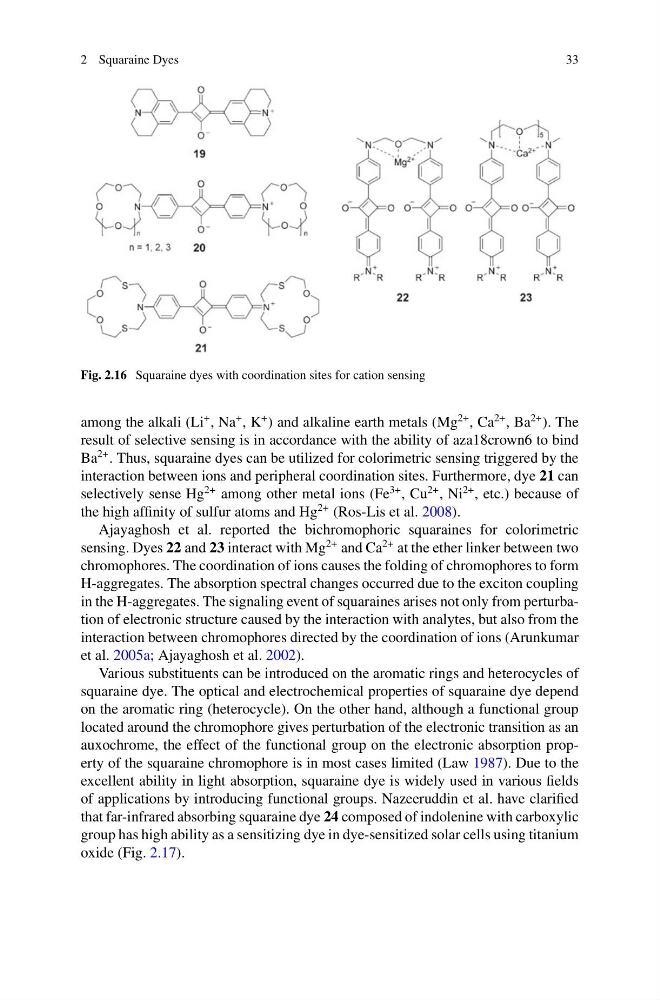
Fig. 2.16 Squaraine dyes with coordination sites for cation sensing
among the alkali (Li
+ , Na
+ , K
+ ) and alkaline earth metals (Mg
2+ , Ca
2+ , Ba
2+ ). The
result of selective sensing is in accordance with the ability of aza18crown6 to bind
Ba
2+ . Thus, squaraine dyes can be utilized for colorimetric sensing triggered by the
interaction between ions and peripheral coordination sites. Furthermore, dye 21 can
selectively sense Hg
2+ among other metal ions (Fe
3+ , Cu
2+ , Ni
2+ , etc.) because of
the high affinity of sulfur atoms and Hg
2+ (Ros-Lis et al. 2008).
Ajayaghosh et al. reported the bichromophoric squaraines for colorimetric
sensing. Dyes 22 and 23 interact with Mg
2+ and Ca
2+ at the ether linker between two
chromophores. The coordination of ions causes the folding of chromophores to form
H-aggregates. The absorption spectral changes occurred due to the exciton coupling
in the H-aggregates. The signaling event of squaraines arises not only from perturbation of electronic structure caused by the interaction with analytes, but also from the
interaction between chromophores directed by the coordination of ions (Arunkumar
et al. 2005a; Ajayaghosh et al. 2002).
Various substituents can be introduced on the aromatic rings and heterocycles of
squaraine dye. The optical and electrochemical properties of squaraine dye depend
on the aromatic ring (heterocycle). On the other hand, although a functional group
located around the chromophore gives perturbation of the electronic transition as an
auxochrome, the effect of the functional group on the electronic absorption property of the squaraine chromophore is in most cases limited (Law 1987). Due to the
excellent ability in light absorption, squaraine dye is widely used in various fields
of applications by introducing functional groups. Nazeeruddin et al. have clarified
that far-infrared absorbing squaraine dye 24 composed of indolenine with carboxylic
group has high ability as a sensitizing dye in dye-sensitized solar cells using titanium
oxide (Fig. 2.17).
33
Fig. 2.16 Squaraine dyes with coordination sites for cation sensing
among the alkali (Li
+ , Na
+ , K
+ ) and alkaline earth metals (Mg
2+ , Ca
2+ , Ba
2+ ). The
result of selective sensing is in accordance with the ability of aza18crown6 to bind
Ba
2+ . Thus, squaraine dyes can be utilized for colorimetric sensing triggered by the
interaction between ions and peripheral coordination sites. Furthermore, dye 21 can
selectively sense Hg
2+ among other metal ions (Fe
3+ , Cu
2+ , Ni
2+ , etc.) because of
the high affinity of sulfur atoms and Hg
2+ (Ros-Lis et al. 2008).
Ajayaghosh et al. reported the bichromophoric squaraines for colorimetric
sensing. Dyes 22 and 23 interact with Mg
2+ and Ca
2+ at the ether linker between two
chromophores. The coordination of ions causes the folding of chromophores to form
H-aggregates. The absorption spectral changes occurred due to the exciton coupling
in the H-aggregates. The signaling event of squaraines arises not only from perturbation of electronic structure caused by the interaction with analytes, but also from the
interaction between chromophores directed by the coordination of ions (Arunkumar
et al. 2005a; Ajayaghosh et al. 2002).
Various substituents can be introduced on the aromatic rings and heterocycles of
squaraine dye. The optical and electrochemical properties of squaraine dye depend
on the aromatic ring (heterocycle). On the other hand, although a functional group
located around the chromophore gives perturbation of the electronic transition as an
auxochrome, the effect of the functional group on the electronic absorption property of the squaraine chromophore is in most cases limited (Law 1987). Due to the
excellent ability in light absorption, squaraine dye is widely used in various fields
of applications by introducing functional groups. Nazeeruddin et al. have clarified
that far-infrared absorbing squaraine dye 24 composed of indolenine with carboxylic
group has high ability as a sensitizing dye in dye-sensitized solar cells using titanium
oxide (Fig. 2.17).