

32
T. Maeda
group by forming borate salt and forms complex with 1,2-diol, squaraine dye with
boronic acid group 15 has been developed. It was shown that this dye can be applied to
the analysis of bacteria and sialic acid, utilizing signal changes in electronic absorption/fluorescence properties caused by the formation of aggregates in aqueous solvent
and the extinction of chromophore aggregates due to the interaction with 1,2-diol in
the sugar skeleton (Saito et al. 2012; Ouchi et al. 2015).
As mentioned above, hydrophobic squaraine chromophores are not completely
soluble but dispersed in aqueous solvents and form dye aggregates. The low solubility
in water is the obstacle for the biocompatibility needed for bioimaging. To manage
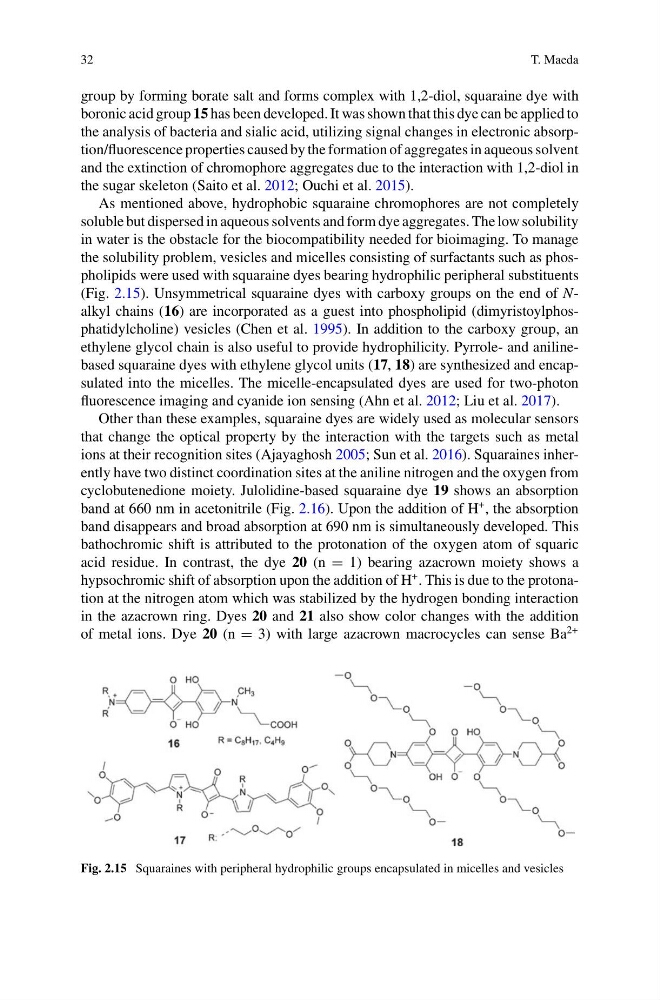
the solubility problem, vesicles and micelles consisting of surfactants such as phospholipids were used with squaraine dyes bearing hydrophilic peripheral substituents
(Fig. 2.15). Unsymmetrical squaraine dyes with carboxy groups on the end of Nalkyl chains (16) are incorporated as a guest into phospholipid (dimyristoylphosphatidylcholine) vesicles (Chen et al. 1995). In addition to the carboxy group, an
ethylene glycol chain is also useful to provide hydrophilicity. Pyrrole- and anilinebased squaraine dyes with ethylene glycol units (17, 18) are synthesized and encapsulated into the micelles. The micelle-encapsulated dyes are used for two-photon
fluorescence imaging and cyanide ion sensing (Ahn et al. 2012; Liu et al. 2017).
Other than these examples, squaraine dyes are widely used as molecular sensors
that change the optical property by the interaction with the targets such as metal
ions at their recognition sites (Ajayaghosh 2005; Sun et al. 2016). Squaraines inherently have two distinct coordination sites at the aniline nitrogen and the oxygen from
cyclobutenedione moiety. Julolidine-based squaraine dye 19 shows an absorption
band at 660 nm in acetonitrile (Fig. 2.16). Upon the addition of H
+ , the absorption
band disappears and broad absorption at 690 nm is simultaneously developed. This
bathochromic shift is attributed to the protonation of the oxygen atom of squaric
acid residue. In contrast, the dye 20 (n = 1) bearing azacrown moiety shows a
hypsochromic shift of absorption upon the addition of H
+ . This is due to the protonation at the nitrogen atom which was stabilized by the hydrogen bonding interaction
in the azacrown ring. Dyes 20 and 21 also show color changes with the addition
of metal ions. Dye 20 (n = 3) with large azacrown macrocycles can sense Ba
2+
Fig. 2.15 Squaraines with peripheral hydrophilic groups encapsulated in micelles and vesicles
T. Maeda
group by forming borate salt and forms complex with 1,2-diol, squaraine dye with
boronic acid group 15 has been developed. It was shown that this dye can be applied to
the analysis of bacteria and sialic acid, utilizing signal changes in electronic absorption/fluorescence properties caused by the formation of aggregates in aqueous solvent
and the extinction of chromophore aggregates due to the interaction with 1,2-diol in
the sugar skeleton (Saito et al. 2012; Ouchi et al. 2015).
As mentioned above, hydrophobic squaraine chromophores are not completely
soluble but dispersed in aqueous solvents and form dye aggregates. The low solubility
in water is the obstacle for the biocompatibility needed for bioimaging. To manage
the solubility problem, vesicles and micelles consisting of surfactants such as phospholipids were used with squaraine dyes bearing hydrophilic peripheral substituents
(Fig. 2.15). Unsymmetrical squaraine dyes with carboxy groups on the end of Nalkyl chains (16) are incorporated as a guest into phospholipid (dimyristoylphosphatidylcholine) vesicles (Chen et al. 1995). In addition to the carboxy group, an
ethylene glycol chain is also useful to provide hydrophilicity. Pyrrole- and anilinebased squaraine dyes with ethylene glycol units (17, 18) are synthesized and encapsulated into the micelles. The micelle-encapsulated dyes are used for two-photon
fluorescence imaging and cyanide ion sensing (Ahn et al. 2012; Liu et al. 2017).
Other than these examples, squaraine dyes are widely used as molecular sensors
that change the optical property by the interaction with the targets such as metal
ions at their recognition sites (Ajayaghosh 2005; Sun et al. 2016). Squaraines inherently have two distinct coordination sites at the aniline nitrogen and the oxygen from
cyclobutenedione moiety. Julolidine-based squaraine dye 19 shows an absorption
band at 660 nm in acetonitrile (Fig. 2.16). Upon the addition of H
+ , the absorption
band disappears and broad absorption at 690 nm is simultaneously developed. This
bathochromic shift is attributed to the protonation of the oxygen atom of squaric
acid residue. In contrast, the dye 20 (n = 1) bearing azacrown moiety shows a
hypsochromic shift of absorption upon the addition of H
+ . This is due to the protonation at the nitrogen atom which was stabilized by the hydrogen bonding interaction
in the azacrown ring. Dyes 20 and 21 also show color changes with the addition
of metal ions. Dye 20 (n = 3) with large azacrown macrocycles can sense Ba
2+
Fig. 2.15 Squaraines with peripheral hydrophilic groups encapsulated in micelles and vesicles