

2 Squaraine Dyes
31
862 nm and 940 nm, respectively. This result indicates that the electronic absorption remarkably shifts to the longer side by connecting squaraine chromophores.
From these results, it was revealed that if the catalytic cross-coupling using stannyl
cyclobutenedione derivatives as a substrate is utilized, cyclobutenedione skeleton can
be introduced into the position that has been difficult to introduce by conventional
condensation reactions.
2.5 Functionalization of Squaraine Dyes
Since squaraine dye has a rigid π-conjugation system, its solubility itself is low.
When alkyl groups are introduced in aromatic rings and heterocyclic components
of squaraine dye, its solubility would be secured. Furthermore, in order to make
squaraine dye be soluble or dispersed in an aqueous solvent, hydrophilic groups
such as carboxylic acid are generally introduced. Hydrophilic squaraine dye is used
as a fluorescent labeling agent in the analysis of protein and biological tissues and
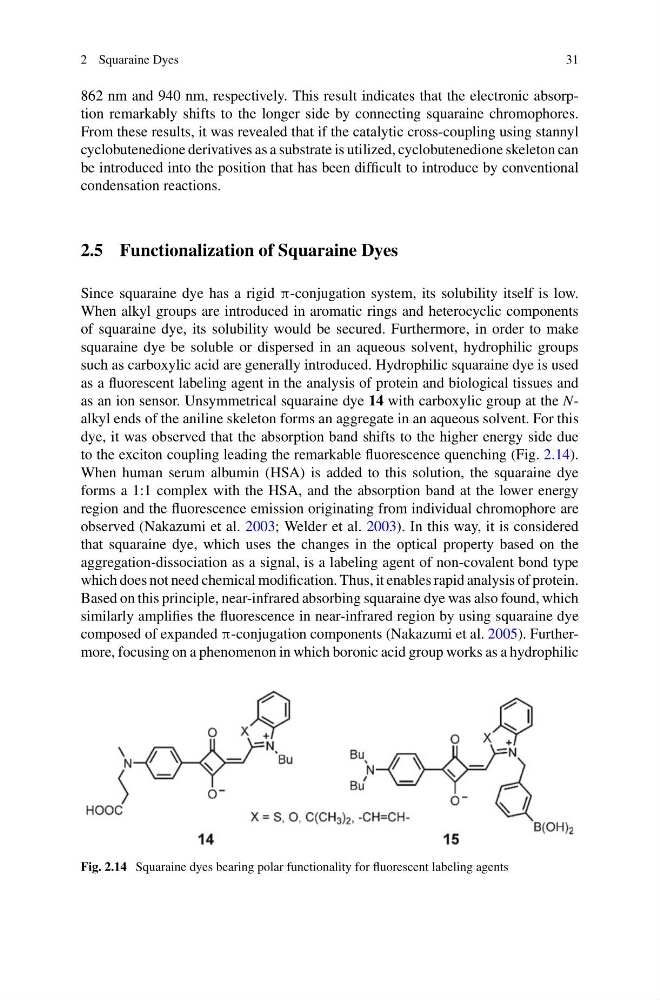
as an ion sensor. Unsymmetrical squaraine dye 14 with carboxylic group at the Nalkyl ends of the aniline skeleton forms an aggregate in an aqueous solvent. For this
dye, it was observed that the absorption band shifts to the higher energy side due
to the exciton coupling leading the remarkable fluorescence quenching (Fig. 2.14).
When human serum albumin (HSA) is added to this solution, the squaraine dye
forms a 1:1 complex with the HSA, and the absorption band at the lower energy
region and the fluorescence emission originating from individual chromophore are
observed (Nakazumi et al. 2003; Welder et al. 2003). In this way, it is considered
that squaraine dye, which uses the changes in the optical property based on the
aggregation-dissociation as a signal, is a labeling agent of non-covalent bond type
which does not need chemical modification. Thus, it enables rapid analysis of protein.
Based on this principle, near-infrared absorbing squaraine dye was also found, which
similarly amplifies the fluorescence in near-infrared region by using squaraine dye
composed of expanded π-conjugation components (Nakazumi et al. 2005). Furthermore, focusing on a phenomenon in which boronic acid group works as a hydrophilic
Fig. 2.14 Squaraine dyes bearing polar functionality for fluorescent labeling agents
31
862 nm and 940 nm, respectively. This result indicates that the electronic absorption remarkably shifts to the longer side by connecting squaraine chromophores.
From these results, it was revealed that if the catalytic cross-coupling using stannyl
cyclobutenedione derivatives as a substrate is utilized, cyclobutenedione skeleton can
be introduced into the position that has been difficult to introduce by conventional
condensation reactions.
2.5 Functionalization of Squaraine Dyes
Since squaraine dye has a rigid π-conjugation system, its solubility itself is low.
When alkyl groups are introduced in aromatic rings and heterocyclic components
of squaraine dye, its solubility would be secured. Furthermore, in order to make
squaraine dye be soluble or dispersed in an aqueous solvent, hydrophilic groups
such as carboxylic acid are generally introduced. Hydrophilic squaraine dye is used
as a fluorescent labeling agent in the analysis of protein and biological tissues and
as an ion sensor. Unsymmetrical squaraine dye 14 with carboxylic group at the Nalkyl ends of the aniline skeleton forms an aggregate in an aqueous solvent. For this
dye, it was observed that the absorption band shifts to the higher energy side due
to the exciton coupling leading the remarkable fluorescence quenching (Fig. 2.14).
When human serum albumin (HSA) is added to this solution, the squaraine dye
forms a 1:1 complex with the HSA, and the absorption band at the lower energy
region and the fluorescence emission originating from individual chromophore are
observed (Nakazumi et al. 2003; Welder et al. 2003). In this way, it is considered
that squaraine dye, which uses the changes in the optical property based on the
aggregation-dissociation as a signal, is a labeling agent of non-covalent bond type
which does not need chemical modification. Thus, it enables rapid analysis of protein.
Based on this principle, near-infrared absorbing squaraine dye was also found, which
similarly amplifies the fluorescence in near-infrared region by using squaraine dye
composed of expanded π-conjugation components (Nakazumi et al. 2005). Furthermore, focusing on a phenomenon in which boronic acid group works as a hydrophilic
Fig. 2.14 Squaraine dyes bearing polar functionality for fluorescent labeling agents