

382
Y. Niko and S. Watanabe
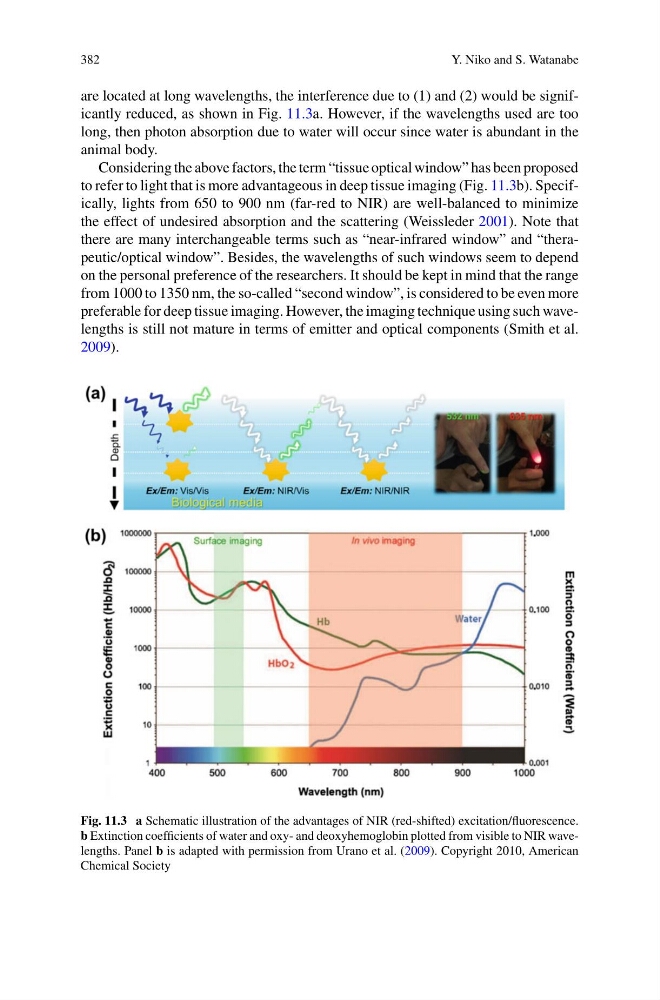
are located at long wavelengths, the interference due to (1) and (2) would be significantly reduced, as shown in Fig. 11.3a. However, if the wavelengths used are too
long, then photon absorption due to water will occur since water is abundant in the
animal body.
Considering the above factors, the term “tissue optical window” has been proposed
to refer to light that is more advantageous in deep tissue imaging (Fig. 11.3b). Specifically, lights from 650 to 900 nm (far-red to NIR) are well-balanced to minimize
the effect of undesired absorption and the scattering (Weissleder 2001). Note that
there are many interchangeable terms such as “near-infrared window” and “therapeutic/optical window”. Besides, the wavelengths of such windows seem to depend
on the personal preference of the researchers. It should be kept in mind that the range
from 1000 to 1350 nm, the so-called “second window”, is considered to be even more
preferable for deep tissue imaging. However, the imaging technique using such wavelengths is still not mature in terms of emitter and optical components (Smith et al.
2009).
Fig. 11.3 a Schematic illustration of the advantages of NIR (red-shifted) excitation/fluorescence.
b Extinction coefficients of water and oxy- and deoxyhemoglobin plotted from visible to NIR wavelengths. Panel b is adapted with permission from Urano et al. (2009). Copyright 2010, American
Chemical Society
Y. Niko and S. Watanabe
are located at long wavelengths, the interference due to (1) and (2) would be significantly reduced, as shown in Fig. 11.3a. However, if the wavelengths used are too
long, then photon absorption due to water will occur since water is abundant in the
animal body.
Considering the above factors, the term “tissue optical window” has been proposed
to refer to light that is more advantageous in deep tissue imaging (Fig. 11.3b). Specifically, lights from 650 to 900 nm (far-red to NIR) are well-balanced to minimize
the effect of undesired absorption and the scattering (Weissleder 2001). Note that
there are many interchangeable terms such as “near-infrared window” and “therapeutic/optical window”. Besides, the wavelengths of such windows seem to depend
on the personal preference of the researchers. It should be kept in mind that the range
from 1000 to 1350 nm, the so-called “second window”, is considered to be even more
preferable for deep tissue imaging. However, the imaging technique using such wavelengths is still not mature in terms of emitter and optical components (Smith et al.
2009).
Fig. 11.3 a Schematic illustration of the advantages of NIR (red-shifted) excitation/fluorescence.
b Extinction coefficients of water and oxy- and deoxyhemoglobin plotted from visible to NIR wavelengths. Panel b is adapted with permission from Urano et al. (2009). Copyright 2010, American
Chemical Society