

11 Fluorescent Chemosensors
383
High-performance liquid chromatography (HPLC) coupled with fluorescence
detection is often used for the detection, characterization, and analysis of trace
substances (vide infra, see Sect. 11.4.5) (Schuster 1988). Such detectors usually use
the UV/Vis region, therefore dyes with absorption/fluorescence around these wavelengths are available as fluorophores. Similarly, when fluorescence spectroscopy is
the main instrument, dyes that work in the UV/Vis region might be required. This
is because spectrofluorometers that can function from the UV/Vis to NIR region are
relatively expensive.
11.3.2 Brightness
Many researchers previously seemed to regard the fluorescence quantum yield as
the emitting ability of the dye. However, considering that fluorescence occurs upon
photon excitation of the dye, the product of fluorescence quantum yield and molar
extinction coefficient (Φε) should be a more practical parameter to represent the dye’s
ability to emit. This parameter is called “theoretical brightness”, and its values for
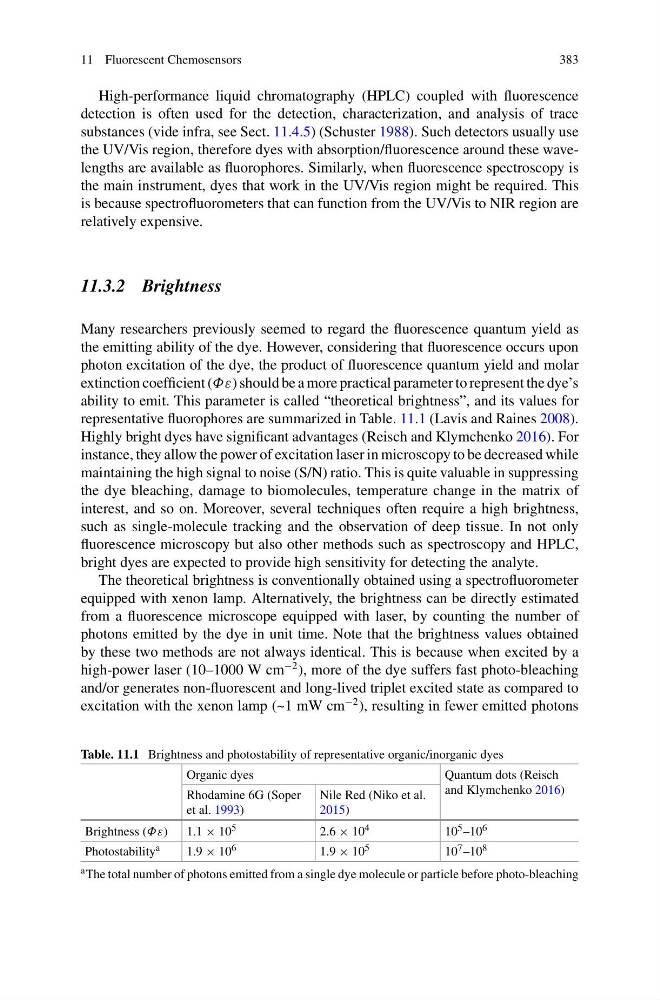
representative fluorophores are summarized in Table. 11.1 (Lavis and Raines 2008).
Highly bright dyes have significant advantages (Reisch and Klymchenko 2016). For
instance, they allow the power of excitation laser in microscopy to be decreased while
maintaining the high signal to noise (S/N) ratio. This is quite valuable in suppressing
the dye bleaching, damage to biomolecules, temperature change in the matrix of
interest, and so on. Moreover, several techniques often require a high brightness,
such as single-molecule tracking and the observation of deep tissue. In not only
fluorescence microscopy but also other methods such as spectroscopy and HPLC,
bright dyes are expected to provide high sensitivity for detecting the analyte.
The theoretical brightness is conventionally obtained using a spectrofluorometer
equipped with xenon lamp. Alternatively, the brightness can be directly estimated
from a fluorescence microscope equipped with laser, by counting the number of
photons emitted by the dye in unit time. Note that the brightness values obtained
by these two methods are not always identical. This is because when excited by a
high-power laser (10–1000 W cm
−2 ), more of the dye suffers fast photo-bleaching
and/or generates non-fluorescent and long-lived triplet excited state as compared to
excitation with the xenon lamp (~1 mW cm
−2 ), resulting in fewer emitted photons
Table. 11.1 Brightness and photostability of representative organic/inorganic dyes
Organic dyes
Quantum dots (Reisch
and Klymchenko 2016)
Rhodamine 6G (Soper
et al. 1993)
Nile Red (Niko et al.
2015)
Brightness (Φε) 1.1 × 10 5
2.6 × 10 4
10 5 –10 6
Photostability a
1.9 × 10 6
1.9 × 10 5
10 7 –10 8
a The total number of photons emitted from a single dye molecule or particle before photo-bleaching
383
High-performance liquid chromatography (HPLC) coupled with fluorescence
detection is often used for the detection, characterization, and analysis of trace
substances (vide infra, see Sect. 11.4.5) (Schuster 1988). Such detectors usually use
the UV/Vis region, therefore dyes with absorption/fluorescence around these wavelengths are available as fluorophores. Similarly, when fluorescence spectroscopy is
the main instrument, dyes that work in the UV/Vis region might be required. This
is because spectrofluorometers that can function from the UV/Vis to NIR region are
relatively expensive.
11.3.2 Brightness
Many researchers previously seemed to regard the fluorescence quantum yield as
the emitting ability of the dye. However, considering that fluorescence occurs upon
photon excitation of the dye, the product of fluorescence quantum yield and molar
extinction coefficient (Φε) should be a more practical parameter to represent the dye’s
ability to emit. This parameter is called “theoretical brightness”, and its values for
representative fluorophores are summarized in Table. 11.1 (Lavis and Raines 2008).
Highly bright dyes have significant advantages (Reisch and Klymchenko 2016). For
instance, they allow the power of excitation laser in microscopy to be decreased while
maintaining the high signal to noise (S/N) ratio. This is quite valuable in suppressing
the dye bleaching, damage to biomolecules, temperature change in the matrix of
interest, and so on. Moreover, several techniques often require a high brightness,
such as single-molecule tracking and the observation of deep tissue. In not only
fluorescence microscopy but also other methods such as spectroscopy and HPLC,
bright dyes are expected to provide high sensitivity for detecting the analyte.
The theoretical brightness is conventionally obtained using a spectrofluorometer
equipped with xenon lamp. Alternatively, the brightness can be directly estimated
from a fluorescence microscope equipped with laser, by counting the number of
photons emitted by the dye in unit time. Note that the brightness values obtained
by these two methods are not always identical. This is because when excited by a
high-power laser (10–1000 W cm
−2 ), more of the dye suffers fast photo-bleaching
and/or generates non-fluorescent and long-lived triplet excited state as compared to
excitation with the xenon lamp (~1 mW cm
−2 ), resulting in fewer emitted photons
Table. 11.1 Brightness and photostability of representative organic/inorganic dyes
Organic dyes
Quantum dots (Reisch
and Klymchenko 2016)
Rhodamine 6G (Soper
et al. 1993)
Nile Red (Niko et al.
2015)
Brightness (Φε) 1.1 × 10 5
2.6 × 10 4
10 5 –10 6
Photostability a
1.9 × 10 6
1.9 × 10 5
10 7 –10 8
a The total number of photons emitted from a single dye molecule or particle before photo-bleaching