

332
K. Tanaka et al.
flexibility. By introducing various substituents, emission color was altered in the
visible region. Furthermore, similarly to boron ketoiminates, alternating polymers
with AIE properties were obtained. In the polymer film, color tuning was accomplished by modulating the electron-donating/accepting ability of the substituents into
the boron diiminate unit as well as the comonomer units. These data represent that
film-type luminescent materials with property tunability can be obtained, and boron
diiminate is also an AIE-inducible element-block.
In the case of boron diiminates, drastic emission color variation was observed.
Yellow emission was observed from the pristine complex, while red emission from
the amine-modified complex (Yoshii et al. 2014d). These data mean that the electronic properties of boron diiminate can be readily tuned by the substitution effect.
Indeed, the alternating copolymers composed of boron diiminates were prepared, and
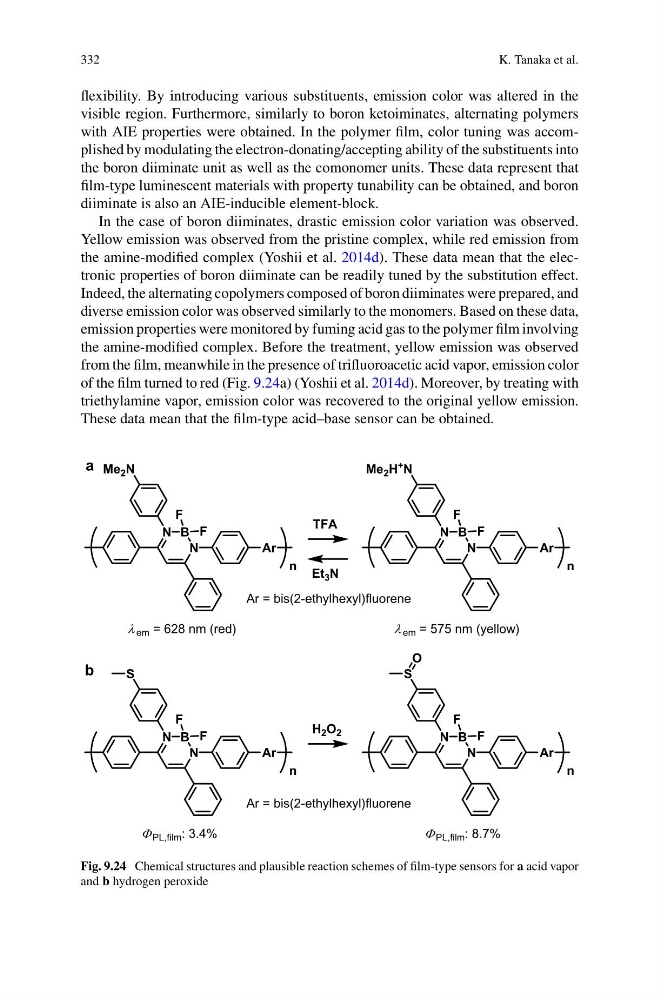
diverse emission color was observed similarly to the monomers. Based on these data,
emission properties were monitored by fuming acid gas to the polymer film involving
the amine-modified complex. Before the treatment, yellow emission was observed
from the film, meanwhile in the presence of trifluoroacetic acid vapor, emission color
of the film turned to red (Fig. 9.24a) (Yoshii et al. 2014d). Moreover, by treating with
triethylamine vapor, emission color was recovered to the original yellow emission.
These data mean that the film-type acid–base sensor can be obtained.
N
N
B
F
F
Ar
Me 2 N
n
N
N
B
F
F
Ar
Me 2 H
+ N
n
TFA
Et 3 N
em = 628 nm (red)
em = 575 nm (yellow)
Ar = bis(2-ethylhexyl)fluorene
a
N
N
B
F
F
Ar
S
n
N
N
B
F
F
Ar
S
n
H 2 O 2
PL,film : 3.4%
PL,film : 8.7%
Ar = bis(2-ethylhexyl)fluorene
b
O
Fig. 9.24 Chemical structures and plausible reaction schemes of film-type sensors for a acid vapor
and b hydrogen peroxide
K. Tanaka et al.
flexibility. By introducing various substituents, emission color was altered in the
visible region. Furthermore, similarly to boron ketoiminates, alternating polymers
with AIE properties were obtained. In the polymer film, color tuning was accomplished by modulating the electron-donating/accepting ability of the substituents into
the boron diiminate unit as well as the comonomer units. These data represent that
film-type luminescent materials with property tunability can be obtained, and boron
diiminate is also an AIE-inducible element-block.
In the case of boron diiminates, drastic emission color variation was observed.
Yellow emission was observed from the pristine complex, while red emission from
the amine-modified complex (Yoshii et al. 2014d). These data mean that the electronic properties of boron diiminate can be readily tuned by the substitution effect.
Indeed, the alternating copolymers composed of boron diiminates were prepared, and
diverse emission color was observed similarly to the monomers. Based on these data,
emission properties were monitored by fuming acid gas to the polymer film involving
the amine-modified complex. Before the treatment, yellow emission was observed
from the film, meanwhile in the presence of trifluoroacetic acid vapor, emission color
of the film turned to red (Fig. 9.24a) (Yoshii et al. 2014d). Moreover, by treating with
triethylamine vapor, emission color was recovered to the original yellow emission.
These data mean that the film-type acid–base sensor can be obtained.
N
N
B
F
F
Ar
Me 2 N
n
N
N
B
F
F
Ar
Me 2 H
+ N
n
TFA
Et 3 N
em = 628 nm (red)
em = 575 nm (yellow)
Ar = bis(2-ethylhexyl)fluorene
a
N
N
B
F
F
Ar
S
n
N
N
B
F
F
Ar
S
n
H 2 O 2
PL,film : 3.4%
PL,film : 8.7%
Ar = bis(2-ethylhexyl)fluorene
b
O
Fig. 9.24 Chemical structures and plausible reaction schemes of film-type sensors for a acid vapor
and b hydrogen peroxide