

9 Molecular Designs for Solid-State Luminescent Properties …
333
To induce the changes in luminescent properties of the film, the polymers having
the methyl sulfide group as the side group were reported (Fig. 9.24b) (Hirose et al.
2015). The methyl sulfide group can be smoothly oxidized by various oxidizers,
and the electron-donating property is oppositely converted to the electron-accepting
nature. In order to utilize this reaction for modulating electronic properties, followed
by emission characters, the methyl sulfide-modified polymer at the boron complex
was synthesized, and their photophysical properties were monitored during oxidation. The film showed weak emission before the treatment with hydrogen peroxide
which is the biomolecules concerning metabolism and carcinogenesis. Emission
intensity gradually increased during soaking the film into the hydrogen peroxide
solution. By soaking, the methyl sulfide group should be oxidized. Finally, enhanced
emission was observed. The electronic property of the substituent was contrary
changed from electron donating to accepting one. Therefore, emission intensity was
enhanced. The film-type sensor for the bio-significant molecule was accomplished
based on oxidation-induced AIE.
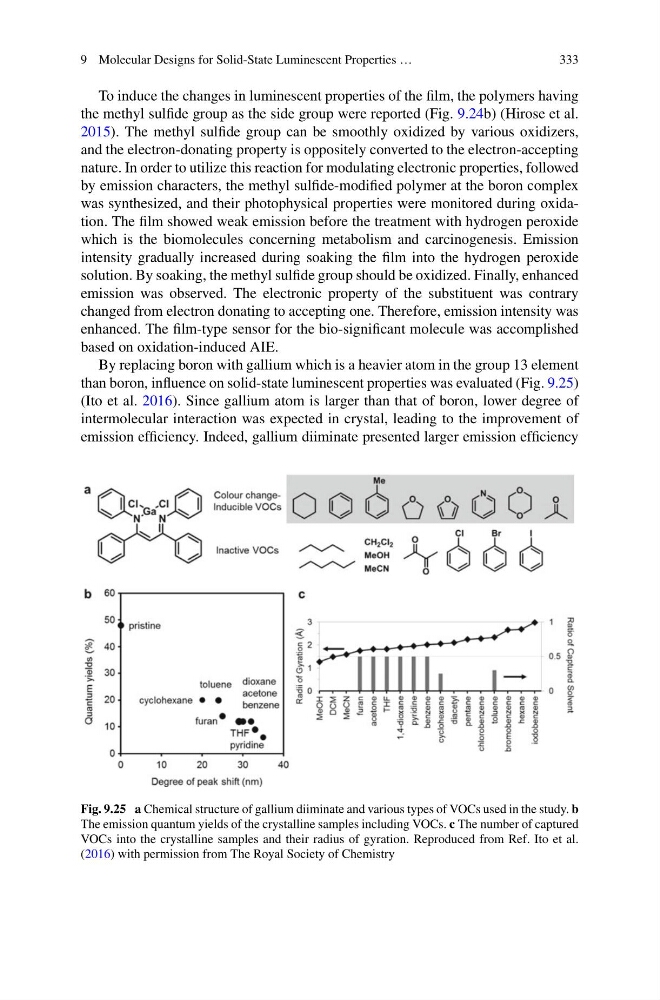
By replacing boron with gallium which is a heavier atom in the group 13 element
than boron, influence on solid-state luminescent properties was evaluated (Fig. 9.25)
(Ito et al. 2016). Since gallium atom is larger than that of boron, lower degree of
intermolecular interaction was expected in crystal, leading to the improvement of
emission efficiency. Indeed, gallium diiminate presented larger emission efficiency
Fig. 9.25 a Chemical structure of gallium diiminate and various types of VOCs used in the study. b
The emission quantum yields of the crystalline samples including VOCs. c The number of captured
VOCs into the crystalline samples and their radius of gyration. Reproduced from Ref. Ito et al.
(2016) with permission from The Royal Society of Chemistry
333
To induce the changes in luminescent properties of the film, the polymers having
the methyl sulfide group as the side group were reported (Fig. 9.24b) (Hirose et al.
2015). The methyl sulfide group can be smoothly oxidized by various oxidizers,
and the electron-donating property is oppositely converted to the electron-accepting
nature. In order to utilize this reaction for modulating electronic properties, followed
by emission characters, the methyl sulfide-modified polymer at the boron complex
was synthesized, and their photophysical properties were monitored during oxidation. The film showed weak emission before the treatment with hydrogen peroxide
which is the biomolecules concerning metabolism and carcinogenesis. Emission
intensity gradually increased during soaking the film into the hydrogen peroxide
solution. By soaking, the methyl sulfide group should be oxidized. Finally, enhanced
emission was observed. The electronic property of the substituent was contrary
changed from electron donating to accepting one. Therefore, emission intensity was
enhanced. The film-type sensor for the bio-significant molecule was accomplished
based on oxidation-induced AIE.
By replacing boron with gallium which is a heavier atom in the group 13 element
than boron, influence on solid-state luminescent properties was evaluated (Fig. 9.25)
(Ito et al. 2016). Since gallium atom is larger than that of boron, lower degree of
intermolecular interaction was expected in crystal, leading to the improvement of
emission efficiency. Indeed, gallium diiminate presented larger emission efficiency
Fig. 9.25 a Chemical structure of gallium diiminate and various types of VOCs used in the study. b
The emission quantum yields of the crystalline samples including VOCs. c The number of captured
VOCs into the crystalline samples and their radius of gyration. Reproduced from Ref. Ito et al.
(2016) with permission from The Royal Society of Chemistry