

330
K. Tanaka et al.
R
N
O
B
S
S
O B
N
R
F
F
F
F
C 12 H 25
C 12 H 25
R = H ( crystal = 647 nm, amorphous = 619 nm)
R = F ( crystal = 660 nm, amorphous = 626 nm)
R = Cl ( crystal = 570 nm, amorphous = 635 nm)
R = CN ( crystal = 664 nm, amorphous = 664 nm)
R = Br ( crystal = 562 nm, amorphous = 639 nm)
R = I ( crystal = 561 nm, amorphous = 656 nm)
R = NMe 2 ( crystal = 661 nm, amorphous = 671 nm)
R = TMS ( crystal = 598 nm, amorphous = 619 nm)
Size of R
Mechanical stress
Small R
Large R
Stronger - interaction
(Red)
Weaker - interaction
(Yellow)
Stronger - interaction
(Red)
Weaker - interaction
(Yellow)
Crystal
Amorphous
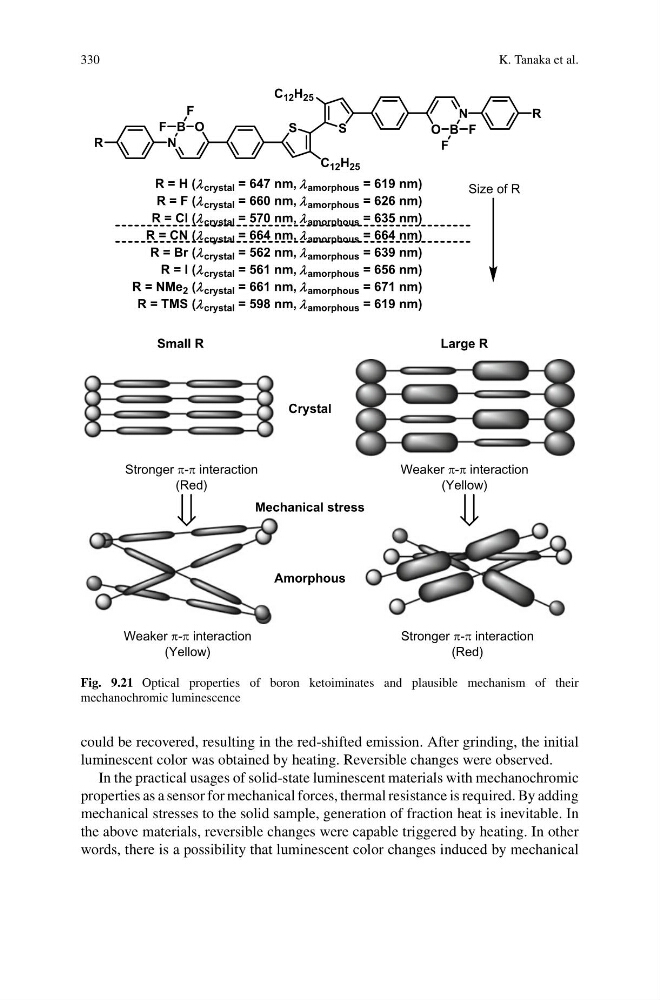
Fig. 9.21 Optical properties of boron ketoiminates and plausible mechanism of their
mechanochromic luminescence
could be recovered, resulting in the red-shifted emission. After grinding, the initial
luminescent color was obtained by heating. Reversible changes were observed.
In the practical usages of solid-state luminescent materials with mechanochromic
properties as a sensor for mechanical forces, thermal resistance is required. By adding
mechanical stresses to the solid sample, generation of fraction heat is inevitable. In
the above materials, reversible changes were capable triggered by heating. In other
words, there is a possibility that luminescent color changes induced by mechanical
K. Tanaka et al.
R
N
O
B
S
S
O B
N
R
F
F
F
F
C 12 H 25
C 12 H 25
R = H ( crystal = 647 nm, amorphous = 619 nm)
R = F ( crystal = 660 nm, amorphous = 626 nm)
R = Cl ( crystal = 570 nm, amorphous = 635 nm)
R = CN ( crystal = 664 nm, amorphous = 664 nm)
R = Br ( crystal = 562 nm, amorphous = 639 nm)
R = I ( crystal = 561 nm, amorphous = 656 nm)
R = NMe 2 ( crystal = 661 nm, amorphous = 671 nm)
R = TMS ( crystal = 598 nm, amorphous = 619 nm)
Size of R
Mechanical stress
Small R
Large R
Stronger - interaction
(Red)
Weaker - interaction
(Yellow)
Stronger - interaction
(Red)
Weaker - interaction
(Yellow)
Crystal
Amorphous
Fig. 9.21 Optical properties of boron ketoiminates and plausible mechanism of their
mechanochromic luminescence
could be recovered, resulting in the red-shifted emission. After grinding, the initial
luminescent color was obtained by heating. Reversible changes were observed.
In the practical usages of solid-state luminescent materials with mechanochromic
properties as a sensor for mechanical forces, thermal resistance is required. By adding
mechanical stresses to the solid sample, generation of fraction heat is inevitable. In
the above materials, reversible changes were capable triggered by heating. In other
words, there is a possibility that luminescent color changes induced by mechanical