

9 Molecular Designs for Solid-State Luminescent Properties …
329
N
O
B
F
F
R
R
N
O
B
F
F
R
R
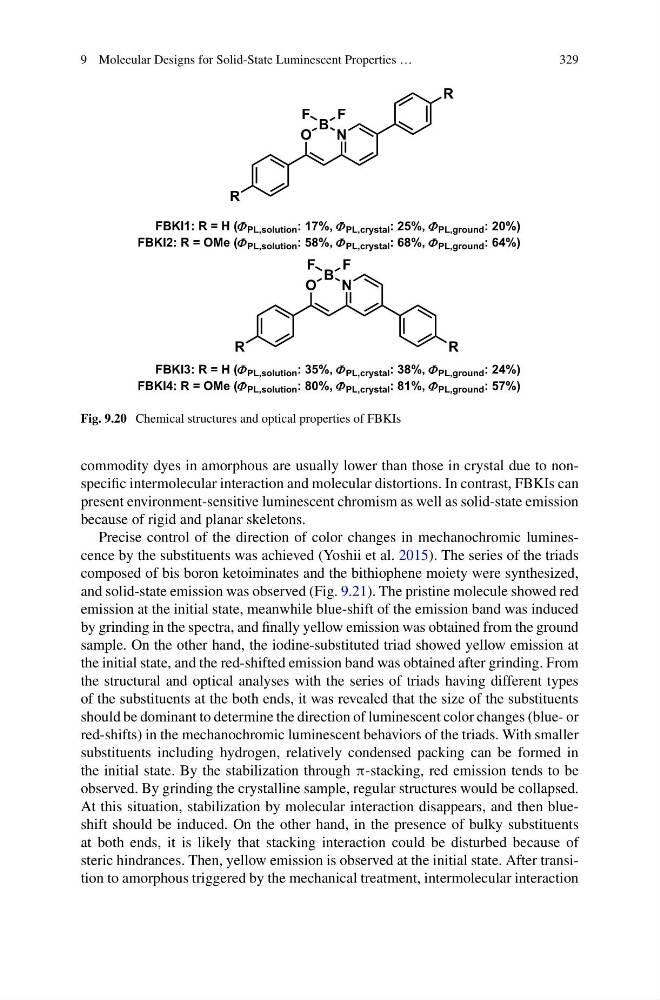
FBKI1: R = H ( PL,solution : 17%, PL,crystal : 25%, PL,ground : 20%)
FBKI2: R = OMe ( PL,solution : 58%, PL,crystal : 68%, PL,ground : 64%)
FBKI3: R = H ( PL,solution : 35%, PL,crystal : 38%, PL,ground : 24%)
FBKI4: R = OMe ( PL,solution : 80%, PL,crystal : 81%, PL,ground : 57%)
Fig. 9.20 Chemical structures and optical properties of FBKIs
commodity dyes in amorphous are usually lower than those in crystal due to nonspecific intermolecular interaction and molecular distortions. In contrast, FBKIs can
present environment-sensitive luminescent chromism as well as solid-state emission
because of rigid and planar skeletons.
Precise control of the direction of color changes in mechanochromic luminescence by the substituents was achieved (Yoshii et al. 2015). The series of the triads
composed of bis boron ketoiminates and the bithiophene moiety were synthesized,
and solid-state emission was observed (Fig. 9.21). The pristine molecule showed red
emission at the initial state, meanwhile blue-shift of the emission band was induced
by grinding in the spectra, and finally yellow emission was obtained from the ground
sample. On the other hand, the iodine-substituted triad showed yellow emission at
the initial state, and the red-shifted emission band was obtained after grinding. From
the structural and optical analyses with the series of triads having different types
of the substituents at the both ends, it was revealed that the size of the substituents
should be dominant to determine the direction of luminescent color changes (blue- or
red-shifts) in the mechanochromic luminescent behaviors of the triads. With smaller
substituents including hydrogen, relatively condensed packing can be formed in
the initial state. By the stabilization through π-stacking, red emission tends to be
observed. By grinding the crystalline sample, regular structures would be collapsed.
At this situation, stabilization by molecular interaction disappears, and then blueshift should be induced. On the other hand, in the presence of bulky substituents
at both ends, it is likely that stacking interaction could be disturbed because of
steric hindrances. Then, yellow emission is observed at the initial state. After transition to amorphous triggered by the mechanical treatment, intermolecular interaction
329
N
O
B
F
F
R
R
N
O
B
F
F
R
R
FBKI1: R = H ( PL,solution : 17%, PL,crystal : 25%, PL,ground : 20%)
FBKI2: R = OMe ( PL,solution : 58%, PL,crystal : 68%, PL,ground : 64%)
FBKI3: R = H ( PL,solution : 35%, PL,crystal : 38%, PL,ground : 24%)
FBKI4: R = OMe ( PL,solution : 80%, PL,crystal : 81%, PL,ground : 57%)
Fig. 9.20 Chemical structures and optical properties of FBKIs
commodity dyes in amorphous are usually lower than those in crystal due to nonspecific intermolecular interaction and molecular distortions. In contrast, FBKIs can
present environment-sensitive luminescent chromism as well as solid-state emission
because of rigid and planar skeletons.
Precise control of the direction of color changes in mechanochromic luminescence by the substituents was achieved (Yoshii et al. 2015). The series of the triads
composed of bis boron ketoiminates and the bithiophene moiety were synthesized,
and solid-state emission was observed (Fig. 9.21). The pristine molecule showed red
emission at the initial state, meanwhile blue-shift of the emission band was induced
by grinding in the spectra, and finally yellow emission was obtained from the ground
sample. On the other hand, the iodine-substituted triad showed yellow emission at
the initial state, and the red-shifted emission band was obtained after grinding. From
the structural and optical analyses with the series of triads having different types
of the substituents at the both ends, it was revealed that the size of the substituents
should be dominant to determine the direction of luminescent color changes (blue- or
red-shifts) in the mechanochromic luminescent behaviors of the triads. With smaller
substituents including hydrogen, relatively condensed packing can be formed in
the initial state. By the stabilization through π-stacking, red emission tends to be
observed. By grinding the crystalline sample, regular structures would be collapsed.
At this situation, stabilization by molecular interaction disappears, and then blueshift should be induced. On the other hand, in the presence of bulky substituents
at both ends, it is likely that stacking interaction could be disturbed because of
steric hindrances. Then, yellow emission is observed at the initial state. After transition to amorphous triggered by the mechanical treatment, intermolecular interaction