

328
K. Tanaka et al.
replacing the one of oxygen atoms dating from boron to nitrogen, emission annihilation could be induced by molecular motions in the solution state. Additionally, molecular symmetry was lowered by the replacement. Overlapping of electron orbitals in
the condensed state might be disturbed.
By utilizing the boron ketoiminate skeleton as an AIE-inducible element-block, a
wide variety of luminescent materials have been developed. By changing comonomer
units in the above polymers, color tuning of AIE was accomplished (Fig. 9.17) (Yoshii
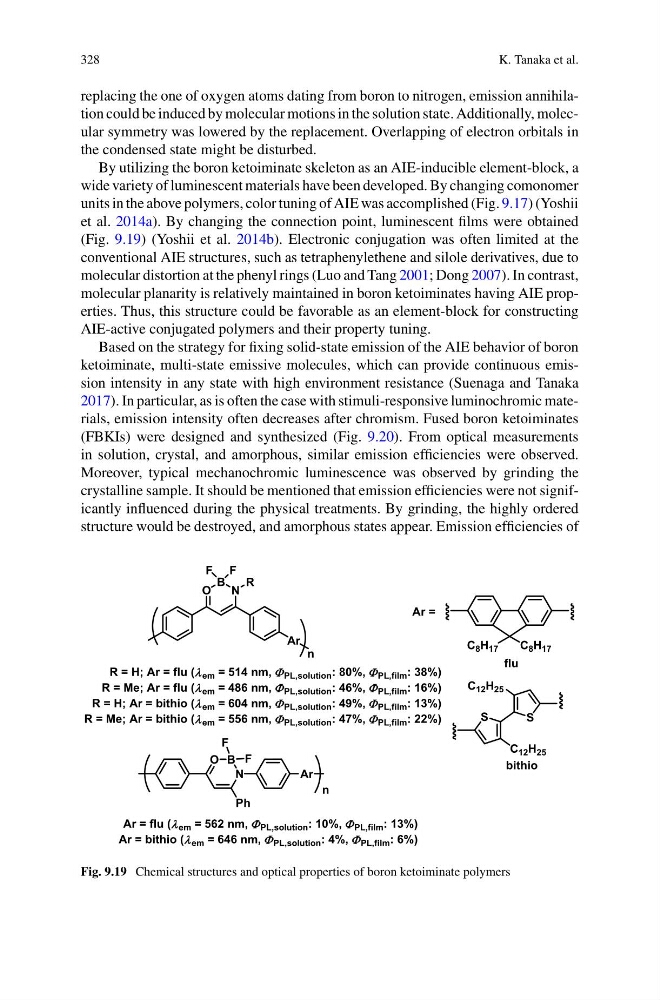
et al. 2014a). By changing the connection point, luminescent films were obtained
(Fig. 9.19) (Yoshii et al. 2014b). Electronic conjugation was often limited at the
conventional AIE structures, such as tetraphenylethene and silole derivatives, due to
molecular distortion at the phenyl rings (Luo and Tang 2001; Dong 2007). In contrast,
molecular planarity is relatively maintained in boron ketoiminates having AIE properties. Thus, this structure could be favorable as an element-block for constructing
AIE-active conjugated polymers and their property tuning.
Based on the strategy for fixing solid-state emission of the AIE behavior of boron
ketoiminate, multi-state emissive molecules, which can provide continuous emission intensity in any state with high environment resistance (Suenaga and Tanaka
2017). In particular, as is often the case with stimuli-responsive luminochromic materials, emission intensity often decreases after chromism. Fused boron ketoiminates
(FBKIs) were designed and synthesized (Fig. 9.20). From optical measurements
in solution, crystal, and amorphous, similar emission efficiencies were observed.
Moreover, typical mechanochromic luminescence was observed by grinding the
crystalline sample. It should be mentioned that emission efficiencies were not significantly influenced during the physical treatments. By grinding, the highly ordered
structure would be destroyed, and amorphous states appear. Emission efficiencies of
O
Ph
N
B
F
F
Ar
n
C 8 H 17
C 8 H 17
flu
Ar =
S
S
C 12 H 25
C 12 H 25
bithio
Ar = flu ( em = 562 nm, PL,solution : 10%, PL,film : 13%)
Ar = bithio ( em = 646 nm, PL,solution : 4%, PL,film : 6%)
O
N
B
F F
R
Ar
n
R = H; Ar = flu ( em = 514 nm, PL,solution : 80%, PL,film : 38%)
R = Me; Ar = flu ( em = 486 nm, PL,solution : 46%, PL,film : 16%)
R = H; Ar = bithio ( em = 604 nm, PL,solution : 49%, PL,film : 13%)
R = Me; Ar = bithio ( em = 556 nm, PL,solution : 47%, PL,film : 22%)
Fig. 9.19 Chemical structures and optical properties of boron ketoiminate polymers
K. Tanaka et al.
replacing the one of oxygen atoms dating from boron to nitrogen, emission annihilation could be induced by molecular motions in the solution state. Additionally, molecular symmetry was lowered by the replacement. Overlapping of electron orbitals in
the condensed state might be disturbed.
By utilizing the boron ketoiminate skeleton as an AIE-inducible element-block, a
wide variety of luminescent materials have been developed. By changing comonomer
units in the above polymers, color tuning of AIE was accomplished (Fig. 9.17) (Yoshii
et al. 2014a). By changing the connection point, luminescent films were obtained
(Fig. 9.19) (Yoshii et al. 2014b). Electronic conjugation was often limited at the
conventional AIE structures, such as tetraphenylethene and silole derivatives, due to
molecular distortion at the phenyl rings (Luo and Tang 2001; Dong 2007). In contrast,
molecular planarity is relatively maintained in boron ketoiminates having AIE properties. Thus, this structure could be favorable as an element-block for constructing
AIE-active conjugated polymers and their property tuning.
Based on the strategy for fixing solid-state emission of the AIE behavior of boron
ketoiminate, multi-state emissive molecules, which can provide continuous emission intensity in any state with high environment resistance (Suenaga and Tanaka
2017). In particular, as is often the case with stimuli-responsive luminochromic materials, emission intensity often decreases after chromism. Fused boron ketoiminates
(FBKIs) were designed and synthesized (Fig. 9.20). From optical measurements
in solution, crystal, and amorphous, similar emission efficiencies were observed.
Moreover, typical mechanochromic luminescence was observed by grinding the
crystalline sample. It should be mentioned that emission efficiencies were not significantly influenced during the physical treatments. By grinding, the highly ordered
structure would be destroyed, and amorphous states appear. Emission efficiencies of
O
Ph
N
B
F
F
Ar
n
C 8 H 17
C 8 H 17
flu
Ar =
S
S
C 12 H 25
C 12 H 25
bithio
Ar = flu ( em = 562 nm, PL,solution : 10%, PL,film : 13%)
Ar = bithio ( em = 646 nm, PL,solution : 4%, PL,film : 6%)
O
N
B
F F
R
Ar
n
R = H; Ar = flu ( em = 514 nm, PL,solution : 80%, PL,film : 38%)
R = Me; Ar = flu ( em = 486 nm, PL,solution : 46%, PL,film : 16%)
R = H; Ar = bithio ( em = 604 nm, PL,solution : 49%, PL,film : 13%)
R = Me; Ar = bithio ( em = 556 nm, PL,solution : 47%, PL,film : 22%)
Fig. 9.19 Chemical structures and optical properties of boron ketoiminate polymers