

9 Molecular Designs for Solid-State Luminescent Properties …
327
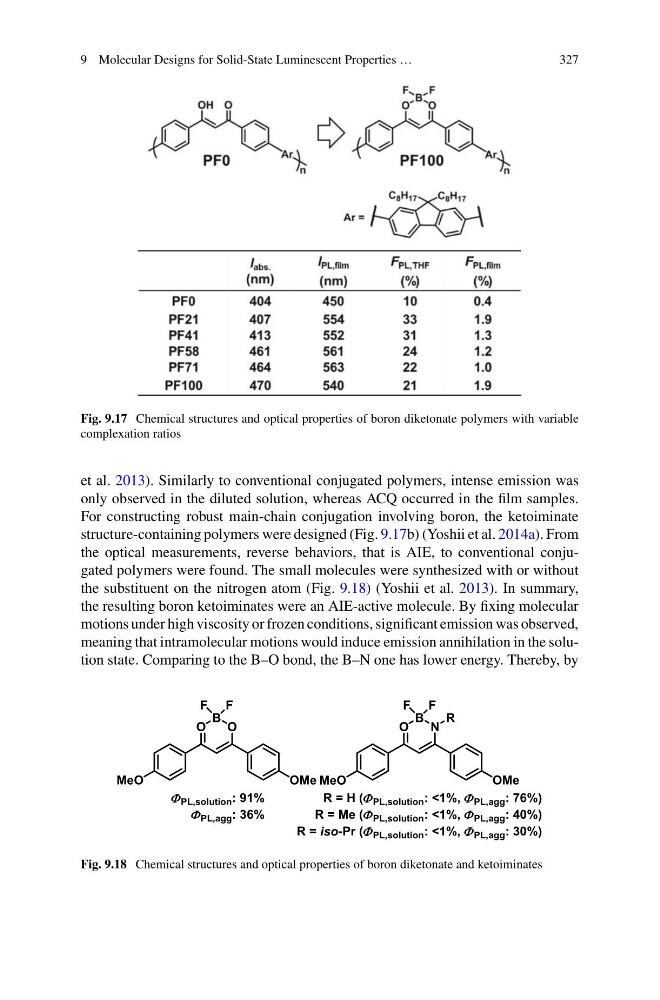
Fig. 9.17 Chemical structures and optical properties of boron diketonate polymers with variable
complexation ratios
et al. 2013). Similarly to conventional conjugated polymers, intense emission was
only observed in the diluted solution, whereas ACQ occurred in the film samples.
For constructing robust main-chain conjugation involving boron, the ketoiminate
structure-containing polymers were designed (Fig. 9.17b) (Yoshii et al. 2014a). From
the optical measurements, reverse behaviors, that is AIE, to conventional conjugated polymers were found. The small molecules were synthesized with or without
the substituent on the nitrogen atom (Fig. 9.18) (Yoshii et al. 2013). In summary,
the resulting boron ketoiminates were an AIE-active molecule. By fixing molecular
motions under high viscosity or frozen conditions, significant emission was observed,
meaning that intramolecular motions would induce emission annihilation in the solution state. Comparing to the B–O bond, the B–N one has lower energy. Thereby, by
O
O
B
F F
O
N
B
F F
R
PL,solution : 91%
PL,agg : 36%
R = H ( PL,solution : <1%, PL,agg : 76%)
R = Me ( PL,solution : <1%, PL,agg : 40%)
R = iso-Pr ( PL,solution : <1%, PL,agg : 30%)
MeO
OMe MeO
OMe
Fig. 9.18 Chemical structures and optical properties of boron diketonate and ketoiminates
327
Fig. 9.17 Chemical structures and optical properties of boron diketonate polymers with variable
complexation ratios
et al. 2013). Similarly to conventional conjugated polymers, intense emission was
only observed in the diluted solution, whereas ACQ occurred in the film samples.
For constructing robust main-chain conjugation involving boron, the ketoiminate
structure-containing polymers were designed (Fig. 9.17b) (Yoshii et al. 2014a). From
the optical measurements, reverse behaviors, that is AIE, to conventional conjugated polymers were found. The small molecules were synthesized with or without
the substituent on the nitrogen atom (Fig. 9.18) (Yoshii et al. 2013). In summary,
the resulting boron ketoiminates were an AIE-active molecule. By fixing molecular
motions under high viscosity or frozen conditions, significant emission was observed,
meaning that intramolecular motions would induce emission annihilation in the solution state. Comparing to the B–O bond, the B–N one has lower energy. Thereby, by
O
O
B
F F
O
N
B
F F
R
PL,solution : 91%
PL,agg : 36%
R = H ( PL,solution : <1%, PL,agg : 76%)
R = Me ( PL,solution : <1%, PL,agg : 40%)
R = iso-Pr ( PL,solution : <1%, PL,agg : 30%)
MeO
OMe MeO
OMe
Fig. 9.18 Chemical structures and optical properties of boron diketonate and ketoiminates