

326
K. Tanaka et al.
acridine—o-carborane dyad with the ethynyl spacer. The previous pyrene-modified
o-carborane showed excimer emission only at 77 K in the crystalline state, meanwhile
the acridine-modified molecule presented excimer emission with high efficiency
(23%) in crystalline state at room temperature. From the structural analysis with
the single crystal through X-ray crystallography, it was shown that two acridine
moieties were stacked and the third acridine molecule was out of alignment. This
packing mode could restrict exciton splitting over the columnar packing structure.
Moreover, molecular interactions through the nitrogen atom in the acridine moiety
and the hydrogen atom in the o-carborane unit has possibility to suppress molecular
motions. From these results, improvement of emission efficiency was implied. The
results in this study support the claim that the ethynyl—o-carborane skeleton should
work as the excimer-inducible component in the solid state.
9.4.2 Boron Complex
The solid-state luminescent properties of the class of boron complexes with
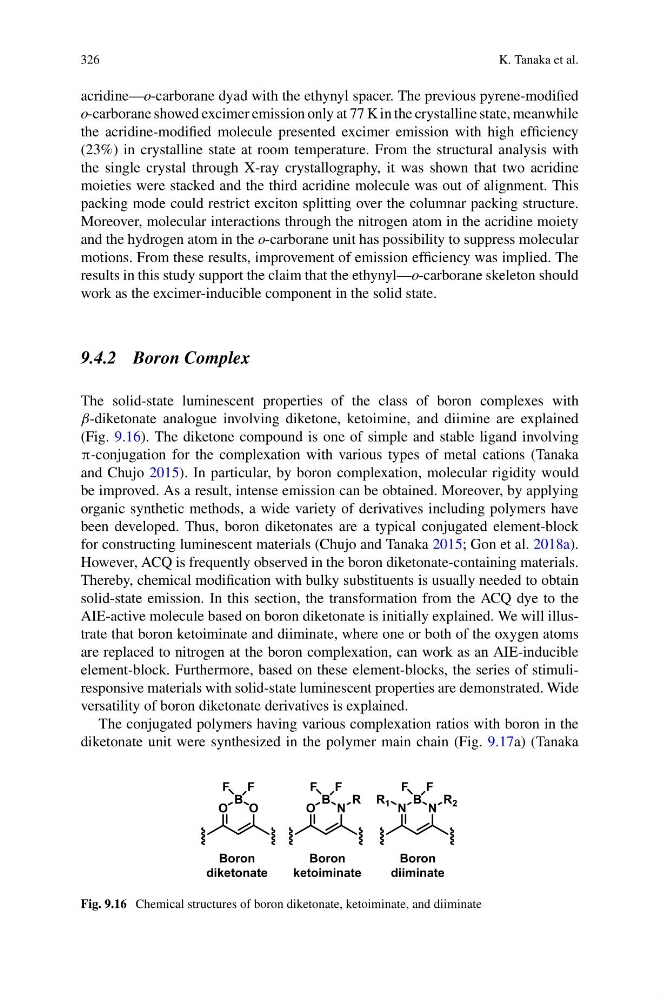
β-diketonate analogue involving diketone, ketoimine, and diimine are explained
(Fig. 9.16). The diketone compound is one of simple and stable ligand involving
π-conjugation for the complexation with various types of metal cations (Tanaka
and Chujo 2015). In particular, by boron complexation, molecular rigidity would
be improved. As a result, intense emission can be obtained. Moreover, by applying
organic synthetic methods, a wide variety of derivatives including polymers have
been developed. Thus, boron diketonates are a typical conjugated element-block
for constructing luminescent materials (Chujo and Tanaka 2015; Gon et al. 2018a).
However, ACQ is frequently observed in the boron diketonate-containing materials.
Thereby, chemical modification with bulky substituents is usually needed to obtain
solid-state emission. In this section, the transformation from the ACQ dye to the
AIE-active molecule based on boron diketonate is initially explained. We will illustrate that boron ketoiminate and diiminate, where one or both of the oxygen atoms
are replaced to nitrogen at the boron complexation, can work as an AIE-inducible
element-block. Furthermore, based on these element-blocks, the series of stimuliresponsive materials with solid-state luminescent properties are demonstrated. Wide
versatility of boron diketonate derivatives is explained.
The conjugated polymers having various complexation ratios with boron in the
diketonate unit were synthesized in the polymer main chain (Fig. 9.17a) (Tanaka
O
O
B
F F
O
N
B
F F
N
N
B
F F
R R 1
R 2
Boron
diketonate
Boron
ketoiminate
Boron
diiminate
Fig. 9.16 Chemical structures of boron diketonate, ketoiminate, and diiminate
K. Tanaka et al.
acridine—o-carborane dyad with the ethynyl spacer. The previous pyrene-modified
o-carborane showed excimer emission only at 77 K in the crystalline state, meanwhile
the acridine-modified molecule presented excimer emission with high efficiency
(23%) in crystalline state at room temperature. From the structural analysis with
the single crystal through X-ray crystallography, it was shown that two acridine
moieties were stacked and the third acridine molecule was out of alignment. This
packing mode could restrict exciton splitting over the columnar packing structure.
Moreover, molecular interactions through the nitrogen atom in the acridine moiety
and the hydrogen atom in the o-carborane unit has possibility to suppress molecular
motions. From these results, improvement of emission efficiency was implied. The
results in this study support the claim that the ethynyl—o-carborane skeleton should
work as the excimer-inducible component in the solid state.
9.4.2 Boron Complex
The solid-state luminescent properties of the class of boron complexes with
β-diketonate analogue involving diketone, ketoimine, and diimine are explained
(Fig. 9.16). The diketone compound is one of simple and stable ligand involving
π-conjugation for the complexation with various types of metal cations (Tanaka
and Chujo 2015). In particular, by boron complexation, molecular rigidity would
be improved. As a result, intense emission can be obtained. Moreover, by applying
organic synthetic methods, a wide variety of derivatives including polymers have
been developed. Thus, boron diketonates are a typical conjugated element-block
for constructing luminescent materials (Chujo and Tanaka 2015; Gon et al. 2018a).
However, ACQ is frequently observed in the boron diketonate-containing materials.
Thereby, chemical modification with bulky substituents is usually needed to obtain
solid-state emission. In this section, the transformation from the ACQ dye to the
AIE-active molecule based on boron diketonate is initially explained. We will illustrate that boron ketoiminate and diiminate, where one or both of the oxygen atoms
are replaced to nitrogen at the boron complexation, can work as an AIE-inducible
element-block. Furthermore, based on these element-blocks, the series of stimuliresponsive materials with solid-state luminescent properties are demonstrated. Wide
versatility of boron diketonate derivatives is explained.
The conjugated polymers having various complexation ratios with boron in the
diketonate unit were synthesized in the polymer main chain (Fig. 9.17a) (Tanaka
O
O
B
F F
O
N
B
F F
N
N
B
F F
R R 1
R 2
Boron
diketonate
Boron
ketoiminate
Boron
diiminate
Fig. 9.16 Chemical structures of boron diketonate, ketoiminate, and diiminate