

9 Molecular Designs for Solid-State Luminescent Properties …
323
o-carborane should be responsible for preventing ACQ by inhibiting intermolecular
interaction and be the solid-state emission-inducible element-block. Corresponding
to increase of the number of benzene ring in the acene moiety, emission color was
shifted to the longer wavelength region. Finally, the near-infrared (NIR) emission was
detected from the tetracene derivative. One of the problems for practical usages of the
NIR-emissive dyes is low photostability, while the tetracene derivative showed high
resistance under UV light irradiation. It was clearly indicated that the o-carborane
substituents can also play a significant role in the improvement of stability. These
molecules are promised to be applied as a robust luminescent material in optical
devices.
The above researches indicated that introduction of multiple o-carboranes should
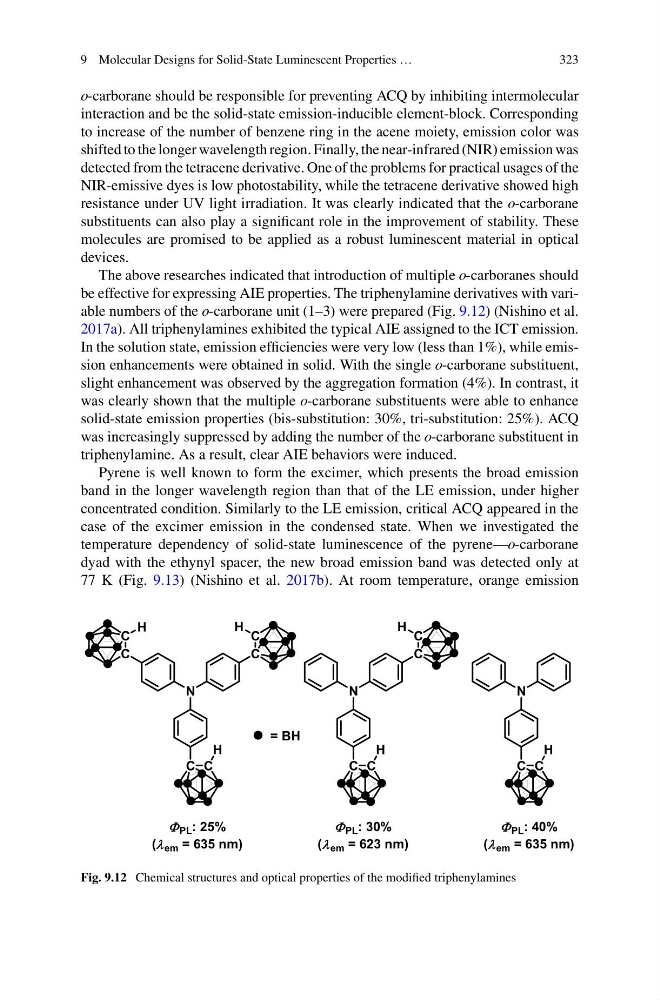
be effective for expressing AIE properties. The triphenylamine derivatives with variable numbers of the o-carborane unit (1–3) were prepared (Fig. 9.12) (Nishino et al.
2017a). All triphenylamines exhibited the typical AIE assigned to the ICT emission.
In the solution state, emission efficiencies were very low (less than 1%), while emission enhancements were obtained in solid. With the single o-carborane substituent,
slight enhancement was observed by the aggregation formation (4%). In contrast, it
was clearly shown that the multiple o-carborane substituents were able to enhance
solid-state emission properties (bis-substitution: 30%, tri-substitution: 25%). ACQ
was increasingly suppressed by adding the number of the o-carborane substituent in
triphenylamine. As a result, clear AIE behaviors were induced.
Pyrene is well known to form the excimer, which presents the broad emission
band in the longer wavelength region than that of the LE emission, under higher
concentrated condition. Similarly to the LE emission, critical ACQ appeared in the
case of the excimer emission in the condensed state. When we investigated the
temperature dependency of solid-state luminescence of the pyrene—o-carborane
dyad with the ethynyl spacer, the new broad emission band was detected only at
77 K (Fig. 9.13) (Nishino et al. 2017b). At room temperature, orange emission
N
C C
H
C
C
C
C
H
H
N
C C
H
C
C
H
N
C C
H
= BH
PL : 25%
( em = 635 nm)
PL : 30%
( em = 623 nm)
PL : 40%
( em = 635 nm)
Fig. 9.12 Chemical structures and optical properties of the modified triphenylamines
323
o-carborane should be responsible for preventing ACQ by inhibiting intermolecular
interaction and be the solid-state emission-inducible element-block. Corresponding
to increase of the number of benzene ring in the acene moiety, emission color was
shifted to the longer wavelength region. Finally, the near-infrared (NIR) emission was
detected from the tetracene derivative. One of the problems for practical usages of the
NIR-emissive dyes is low photostability, while the tetracene derivative showed high
resistance under UV light irradiation. It was clearly indicated that the o-carborane
substituents can also play a significant role in the improvement of stability. These
molecules are promised to be applied as a robust luminescent material in optical
devices.
The above researches indicated that introduction of multiple o-carboranes should
be effective for expressing AIE properties. The triphenylamine derivatives with variable numbers of the o-carborane unit (1–3) were prepared (Fig. 9.12) (Nishino et al.
2017a). All triphenylamines exhibited the typical AIE assigned to the ICT emission.
In the solution state, emission efficiencies were very low (less than 1%), while emission enhancements were obtained in solid. With the single o-carborane substituent,
slight enhancement was observed by the aggregation formation (4%). In contrast, it
was clearly shown that the multiple o-carborane substituents were able to enhance
solid-state emission properties (bis-substitution: 30%, tri-substitution: 25%). ACQ
was increasingly suppressed by adding the number of the o-carborane substituent in
triphenylamine. As a result, clear AIE behaviors were induced.
Pyrene is well known to form the excimer, which presents the broad emission
band in the longer wavelength region than that of the LE emission, under higher
concentrated condition. Similarly to the LE emission, critical ACQ appeared in the
case of the excimer emission in the condensed state. When we investigated the
temperature dependency of solid-state luminescence of the pyrene—o-carborane
dyad with the ethynyl spacer, the new broad emission band was detected only at
77 K (Fig. 9.13) (Nishino et al. 2017b). At room temperature, orange emission
N
C C
H
C
C
C
C
H
H
N
C C
H
C
C
H
N
C C
H
= BH
PL : 25%
( em = 635 nm)
PL : 30%
( em = 623 nm)
PL : 40%
( em = 635 nm)
Fig. 9.12 Chemical structures and optical properties of the modified triphenylamines