

324
K. Tanaka et al.
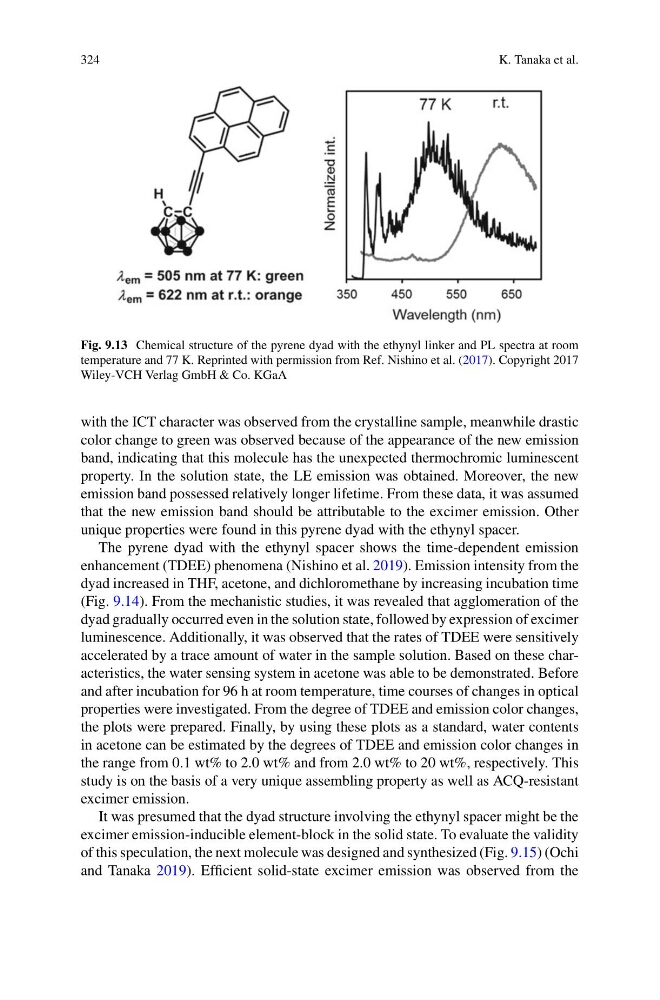
Fig. 9.13 Chemical structure of the pyrene dyad with the ethynyl linker and PL spectra at room
temperature and 77 K. Reprinted with permission from Ref. Nishino et al. (2017). Copyright 2017
Wiley-VCH Verlag GmbH & Co. KGaA
with the ICT character was observed from the crystalline sample, meanwhile drastic
color change to green was observed because of the appearance of the new emission
band, indicating that this molecule has the unexpected thermochromic luminescent
property. In the solution state, the LE emission was obtained. Moreover, the new
emission band possessed relatively longer lifetime. From these data, it was assumed
that the new emission band should be attributable to the excimer emission. Other
unique properties were found in this pyrene dyad with the ethynyl spacer.
The pyrene dyad with the ethynyl spacer shows the time-dependent emission
enhancement (TDEE) phenomena (Nishino et al. 2019). Emission intensity from the
dyad increased in THF, acetone, and dichloromethane by increasing incubation time
(Fig. 9.14). From the mechanistic studies, it was revealed that agglomeration of the
dyad gradually occurred even in the solution state, followed by expression of excimer
luminescence. Additionally, it was observed that the rates of TDEE were sensitively
accelerated by a trace amount of water in the sample solution. Based on these characteristics, the water sensing system in acetone was able to be demonstrated. Before
and after incubation for 96 h at room temperature, time courses of changes in optical
properties were investigated. From the degree of TDEE and emission color changes,
the plots were prepared. Finally, by using these plots as a standard, water contents
in acetone can be estimated by the degrees of TDEE and emission color changes in
the range from 0.1 wt% to 2.0 wt% and from 2.0 wt% to 20 wt%, respectively. This
study is on the basis of a very unique assembling property as well as ACQ-resistant
excimer emission.
It was presumed that the dyad structure involving the ethynyl spacer might be the
excimer emission-inducible element-block in the solid state. To evaluate the validity
of this speculation, the next molecule was designed and synthesized (Fig. 9.15) (Ochi
and Tanaka 2019). Efficient solid-state excimer emission was observed from the
K. Tanaka et al.
Fig. 9.13 Chemical structure of the pyrene dyad with the ethynyl linker and PL spectra at room
temperature and 77 K. Reprinted with permission from Ref. Nishino et al. (2017). Copyright 2017
Wiley-VCH Verlag GmbH & Co. KGaA
with the ICT character was observed from the crystalline sample, meanwhile drastic
color change to green was observed because of the appearance of the new emission
band, indicating that this molecule has the unexpected thermochromic luminescent
property. In the solution state, the LE emission was obtained. Moreover, the new
emission band possessed relatively longer lifetime. From these data, it was assumed
that the new emission band should be attributable to the excimer emission. Other
unique properties were found in this pyrene dyad with the ethynyl spacer.
The pyrene dyad with the ethynyl spacer shows the time-dependent emission
enhancement (TDEE) phenomena (Nishino et al. 2019). Emission intensity from the
dyad increased in THF, acetone, and dichloromethane by increasing incubation time
(Fig. 9.14). From the mechanistic studies, it was revealed that agglomeration of the
dyad gradually occurred even in the solution state, followed by expression of excimer
luminescence. Additionally, it was observed that the rates of TDEE were sensitively
accelerated by a trace amount of water in the sample solution. Based on these characteristics, the water sensing system in acetone was able to be demonstrated. Before
and after incubation for 96 h at room temperature, time courses of changes in optical
properties were investigated. From the degree of TDEE and emission color changes,
the plots were prepared. Finally, by using these plots as a standard, water contents
in acetone can be estimated by the degrees of TDEE and emission color changes in
the range from 0.1 wt% to 2.0 wt% and from 2.0 wt% to 20 wt%, respectively. This
study is on the basis of a very unique assembling property as well as ACQ-resistant
excimer emission.
It was presumed that the dyad structure involving the ethynyl spacer might be the
excimer emission-inducible element-block in the solid state. To evaluate the validity
of this speculation, the next molecule was designed and synthesized (Fig. 9.15) (Ochi
and Tanaka 2019). Efficient solid-state excimer emission was observed from the