

322
K. Tanaka et al.
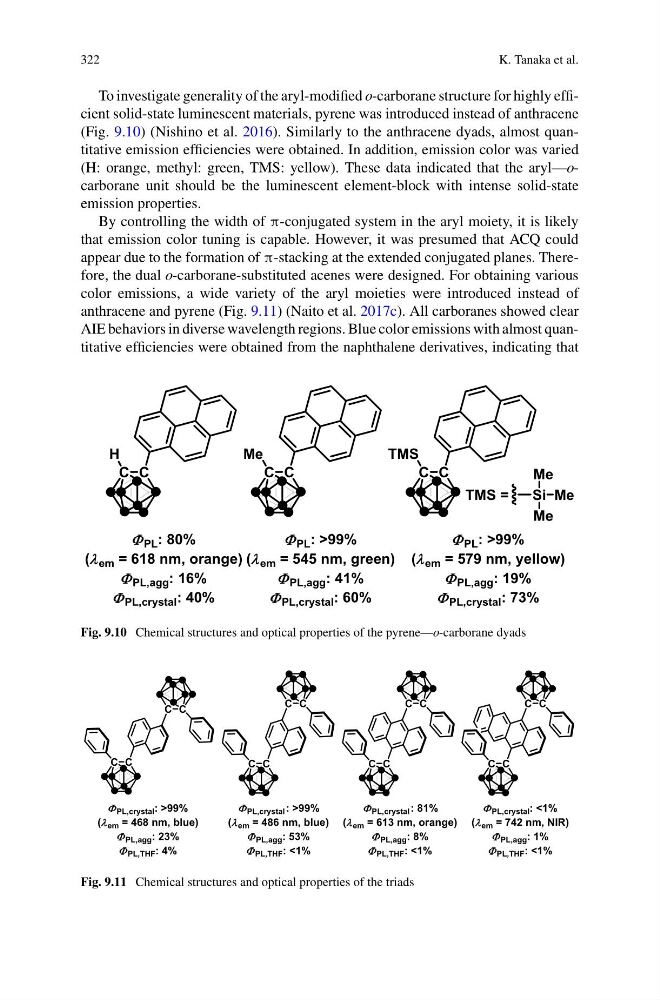
To investigate generality of the aryl-modified o-carborane structure for highly efficient solid-state luminescent materials, pyrene was introduced instead of anthracene
(Fig. 9.10) (Nishino et al. 2016). Similarly to the anthracene dyads, almost quantitative emission efficiencies were obtained. In addition, emission color was varied
(H: orange, methyl: green, TMS: yellow). These data indicated that the aryl—ocarborane unit should be the luminescent element-block with intense solid-state
emission properties.
By controlling the width of π-conjugated system in the aryl moiety, it is likely
that emission color tuning is capable. However, it was presumed that ACQ could
appear due to the formation of π-stacking at the extended conjugated planes. Therefore, the dual o-carborane-substituted acenes were designed. For obtaining various
color emissions, a wide variety of the aryl moieties were introduced instead of
anthracene and pyrene (Fig. 9.11) (Naito et al. 2017c). All carboranes showed clear
AIE behaviors in diverse wavelength regions. Blue color emissions with almost quantitative efficiencies were obtained from the naphthalene derivatives, indicating that
C C
Me
C C
TMS
Si
Me
Me
Me
PL : >99%
( em = 579 nm, yellow)
PL,agg : 19%
PL,crystal : 73%
PL : >99%
( em = 545 nm, green)
PL,agg : 41%
PL,crystal : 60%
C C
H
PL : 80%
( em = 618 nm, orange)
PL,agg : 16%
PL,crystal : 40%
TMS =
Fig. 9.10 Chemical structures and optical properties of the pyrene—o-carborane dyads
C
C
C C
C
C
C C
C
C
C C
C
C
C C
PL,crystal : 81%
( em = 613 nm, orange)
PL,agg : 8%
PL,THF : <1%
PL,crystal : >99%
( em = 486 nm, blue)
PL,agg : 53%
PL,THF : <1%
PL,crystal : >99%
( em = 468 nm, blue)
PL,agg : 23%
PL,THF : 4%
PL,crystal : <1%
( em = 742 nm, NIR)
PL,agg : 1%
PL,THF : <1%
Fig. 9.11 Chemical structures and optical properties of the triads
K. Tanaka et al.
To investigate generality of the aryl-modified o-carborane structure for highly efficient solid-state luminescent materials, pyrene was introduced instead of anthracene
(Fig. 9.10) (Nishino et al. 2016). Similarly to the anthracene dyads, almost quantitative emission efficiencies were obtained. In addition, emission color was varied
(H: orange, methyl: green, TMS: yellow). These data indicated that the aryl—ocarborane unit should be the luminescent element-block with intense solid-state
emission properties.
By controlling the width of π-conjugated system in the aryl moiety, it is likely
that emission color tuning is capable. However, it was presumed that ACQ could
appear due to the formation of π-stacking at the extended conjugated planes. Therefore, the dual o-carborane-substituted acenes were designed. For obtaining various
color emissions, a wide variety of the aryl moieties were introduced instead of
anthracene and pyrene (Fig. 9.11) (Naito et al. 2017c). All carboranes showed clear
AIE behaviors in diverse wavelength regions. Blue color emissions with almost quantitative efficiencies were obtained from the naphthalene derivatives, indicating that
C C
Me
C C
TMS
Si
Me
Me
Me
PL : >99%
( em = 579 nm, yellow)
PL,agg : 19%
PL,crystal : 73%
PL : >99%
( em = 545 nm, green)
PL,agg : 41%
PL,crystal : 60%
C C
H
PL : 80%
( em = 618 nm, orange)
PL,agg : 16%
PL,crystal : 40%
TMS =
Fig. 9.10 Chemical structures and optical properties of the pyrene—o-carborane dyads
C
C
C C
C
C
C C
C
C
C C
C
C
C C
PL,crystal : 81%
( em = 613 nm, orange)
PL,agg : 8%
PL,THF : <1%
PL,crystal : >99%
( em = 486 nm, blue)
PL,agg : 53%
PL,THF : <1%
PL,crystal : >99%
( em = 468 nm, blue)
PL,agg : 23%
PL,THF : 4%
PL,crystal : <1%
( em = 742 nm, NIR)
PL,agg : 1%
PL,THF : <1%
Fig. 9.11 Chemical structures and optical properties of the triads