

9 Molecular Designs for Solid-State Luminescent Properties …
321
C C
C C
Si
Me
Me
Me
PL :97%
( em = 604 nm)
PL : 81%
( em = 582 nm)
C C
PL : 38%
( em = 606 nm)
TMS =
H
Ph
TMS
C C
PL : >99%
( em = 563 nm)
Me
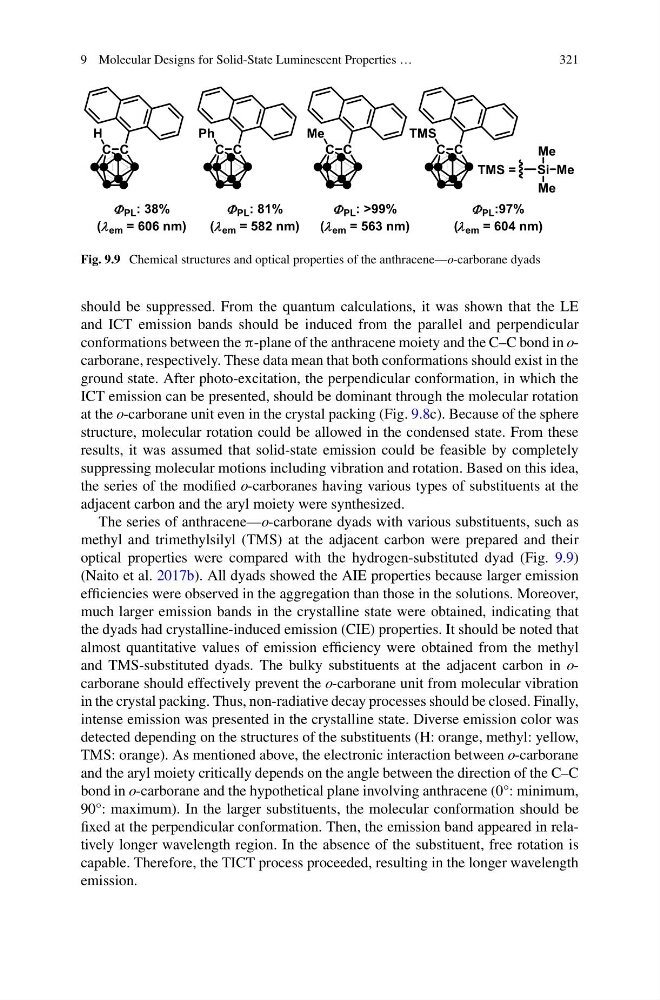
Fig. 9.9 Chemical structures and optical properties of the anthracene—o-carborane dyads
should be suppressed. From the quantum calculations, it was shown that the LE
and ICT emission bands should be induced from the parallel and perpendicular
conformations between the π-plane of the anthracene moiety and the C–C bond in ocarborane, respectively. These data mean that both conformations should exist in the
ground state. After photo-excitation, the perpendicular conformation, in which the
ICT emission can be presented, should be dominant through the molecular rotation
at the o-carborane unit even in the crystal packing (Fig. 9.8c). Because of the sphere
structure, molecular rotation could be allowed in the condensed state. From these
results, it was assumed that solid-state emission could be feasible by completely
suppressing molecular motions including vibration and rotation. Based on this idea,
the series of the modified o-carboranes having various types of substituents at the
adjacent carbon and the aryl moiety were synthesized.
The series of anthracene—o-carborane dyads with various substituents, such as
methyl and trimethylsilyl (TMS) at the adjacent carbon were prepared and their
optical properties were compared with the hydrogen-substituted dyad (Fig. 9.9)
(Naito et al. 2017b). All dyads showed the AIE properties because larger emission
efficiencies were observed in the aggregation than those in the solutions. Moreover,
much larger emission bands in the crystalline state were obtained, indicating that
the dyads had crystalline-induced emission (CIE) properties. It should be noted that
almost quantitative values of emission efficiency were obtained from the methyl
and TMS-substituted dyads. The bulky substituents at the adjacent carbon in ocarborane should effectively prevent the o-carborane unit from molecular vibration
in the crystal packing. Thus, non-radiative decay processes should be closed. Finally,
intense emission was presented in the crystalline state. Diverse emission color was
detected depending on the structures of the substituents (H: orange, methyl: yellow,
TMS: orange). As mentioned above, the electronic interaction between o-carborane
and the aryl moiety critically depends on the angle between the direction of the C–C
bond in o-carborane and the hypothetical plane involving anthracene (0°: minimum,
90°: maximum). In the larger substituents, the molecular conformation should be
fixed at the perpendicular conformation. Then, the emission band appeared in relatively longer wavelength region. In the absence of the substituent, free rotation is
capable. Therefore, the TICT process proceeded, resulting in the longer wavelength
emission.
321
C C
C C
Si
Me
Me
Me
PL :97%
( em = 604 nm)
PL : 81%
( em = 582 nm)
C C
PL : 38%
( em = 606 nm)
TMS =
H
Ph
TMS
C C
PL : >99%
( em = 563 nm)
Me
Fig. 9.9 Chemical structures and optical properties of the anthracene—o-carborane dyads
should be suppressed. From the quantum calculations, it was shown that the LE
and ICT emission bands should be induced from the parallel and perpendicular
conformations between the π-plane of the anthracene moiety and the C–C bond in ocarborane, respectively. These data mean that both conformations should exist in the
ground state. After photo-excitation, the perpendicular conformation, in which the
ICT emission can be presented, should be dominant through the molecular rotation
at the o-carborane unit even in the crystal packing (Fig. 9.8c). Because of the sphere
structure, molecular rotation could be allowed in the condensed state. From these
results, it was assumed that solid-state emission could be feasible by completely
suppressing molecular motions including vibration and rotation. Based on this idea,
the series of the modified o-carboranes having various types of substituents at the
adjacent carbon and the aryl moiety were synthesized.
The series of anthracene—o-carborane dyads with various substituents, such as
methyl and trimethylsilyl (TMS) at the adjacent carbon were prepared and their
optical properties were compared with the hydrogen-substituted dyad (Fig. 9.9)
(Naito et al. 2017b). All dyads showed the AIE properties because larger emission
efficiencies were observed in the aggregation than those in the solutions. Moreover,
much larger emission bands in the crystalline state were obtained, indicating that
the dyads had crystalline-induced emission (CIE) properties. It should be noted that
almost quantitative values of emission efficiency were obtained from the methyl
and TMS-substituted dyads. The bulky substituents at the adjacent carbon in ocarborane should effectively prevent the o-carborane unit from molecular vibration
in the crystal packing. Thus, non-radiative decay processes should be closed. Finally,
intense emission was presented in the crystalline state. Diverse emission color was
detected depending on the structures of the substituents (H: orange, methyl: yellow,
TMS: orange). As mentioned above, the electronic interaction between o-carborane
and the aryl moiety critically depends on the angle between the direction of the C–C
bond in o-carborane and the hypothetical plane involving anthracene (0°: minimum,
90°: maximum). In the larger substituents, the molecular conformation should be
fixed at the perpendicular conformation. Then, the emission band appeared in relatively longer wavelength region. In the absence of the substituent, free rotation is
capable. Therefore, the TICT process proceeded, resulting in the longer wavelength
emission.