

320
K. Tanaka et al.
through molecular vibration at the C–C bond in o-carborane, while the emission band
attributable to the transition from the ICT state should be exhibited in the aggregation state by restricting energy-consumable molecular motions (Tanaka and Chujo
2017). Owing to steric hindrances around the o-carborane unit, ACQ could be also
suppressed.
After this finding, another unique mechanical motion in the excited state was found
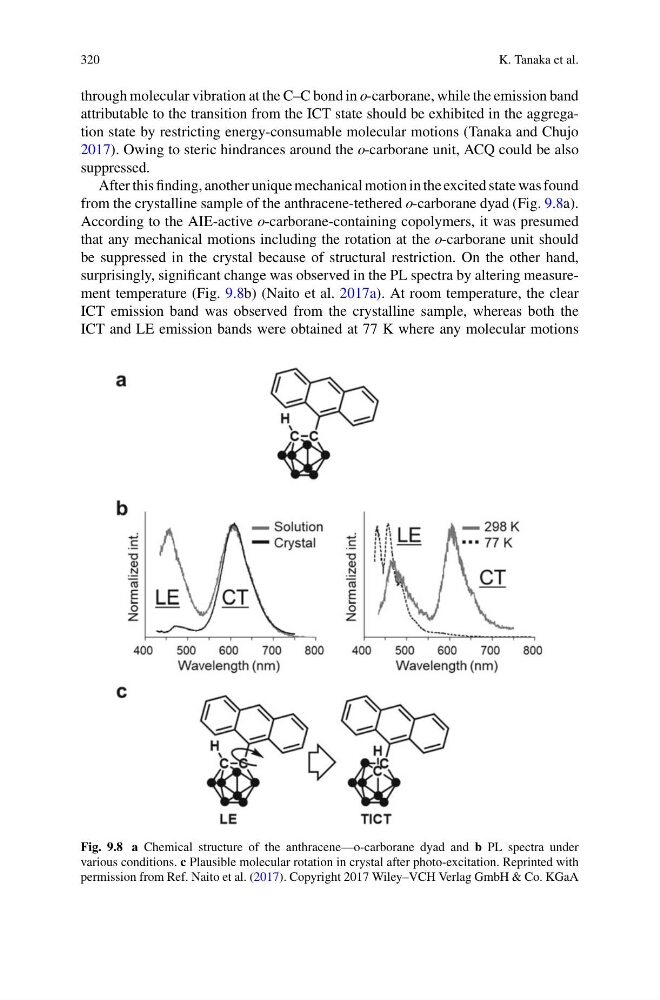
from the crystalline sample of the anthracene-tethered o-carborane dyad (Fig. 9.8a).
According to the AIE-active o-carborane-containing copolymers, it was presumed
that any mechanical motions including the rotation at the o-carborane unit should
be suppressed in the crystal because of structural restriction. On the other hand,
surprisingly, significant change was observed in the PL spectra by altering measurement temperature (Fig. 9.8b) (Naito et al. 2017a). At room temperature, the clear
ICT emission band was observed from the crystalline sample, whereas both the
ICT and LE emission bands were obtained at 77 K where any molecular motions
Fig. 9.8 a Chemical structure of the anthracene—o-carborane dyad and b PL spectra under
various conditions. c Plausible molecular rotation in crystal after photo-excitation. Reprinted with
permission from Ref. Naito et al. (2017). Copyright 2017 Wiley–VCH Verlag GmbH & Co. KGaA
K. Tanaka et al.
through molecular vibration at the C–C bond in o-carborane, while the emission band
attributable to the transition from the ICT state should be exhibited in the aggregation state by restricting energy-consumable molecular motions (Tanaka and Chujo
2017). Owing to steric hindrances around the o-carborane unit, ACQ could be also
suppressed.
After this finding, another unique mechanical motion in the excited state was found
from the crystalline sample of the anthracene-tethered o-carborane dyad (Fig. 9.8a).
According to the AIE-active o-carborane-containing copolymers, it was presumed
that any mechanical motions including the rotation at the o-carborane unit should
be suppressed in the crystal because of structural restriction. On the other hand,
surprisingly, significant change was observed in the PL spectra by altering measurement temperature (Fig. 9.8b) (Naito et al. 2017a). At room temperature, the clear
ICT emission band was observed from the crystalline sample, whereas both the
ICT and LE emission bands were obtained at 77 K where any molecular motions
Fig. 9.8 a Chemical structure of the anthracene—o-carborane dyad and b PL spectra under
various conditions. c Plausible molecular rotation in crystal after photo-excitation. Reprinted with
permission from Ref. Naito et al. (2017). Copyright 2017 Wiley–VCH Verlag GmbH & Co. KGaA