

9 Molecular Designs for Solid-State Luminescent Properties …
319
9.4.1 o-Carborane Materials
o-Carborane (B 10 C 2 H 12 ) is an icosahedral cluster consists of three-center twoelectron bonds. Because of intrinsic electron-deficiency, o-carborane can work as
a strong electron-accepting unit when bonded with the π-conjugated moiety at
the carbon atom in the cluster. Subsequently, significant emission bands from the
intramolecular charge transfer (ICT) state can be observed from the aryl-modified
o-carborane derivatives. Particularly, it should be emphasized that o-carborane can
play a critical role in suppressing ACQ. It is likely that the steric structure could be
favorable for disturbing intermolecular interaction in crystals and aggregates, leading
to preservation of intense luminescence. In 2009, it was discovered that o-carborane
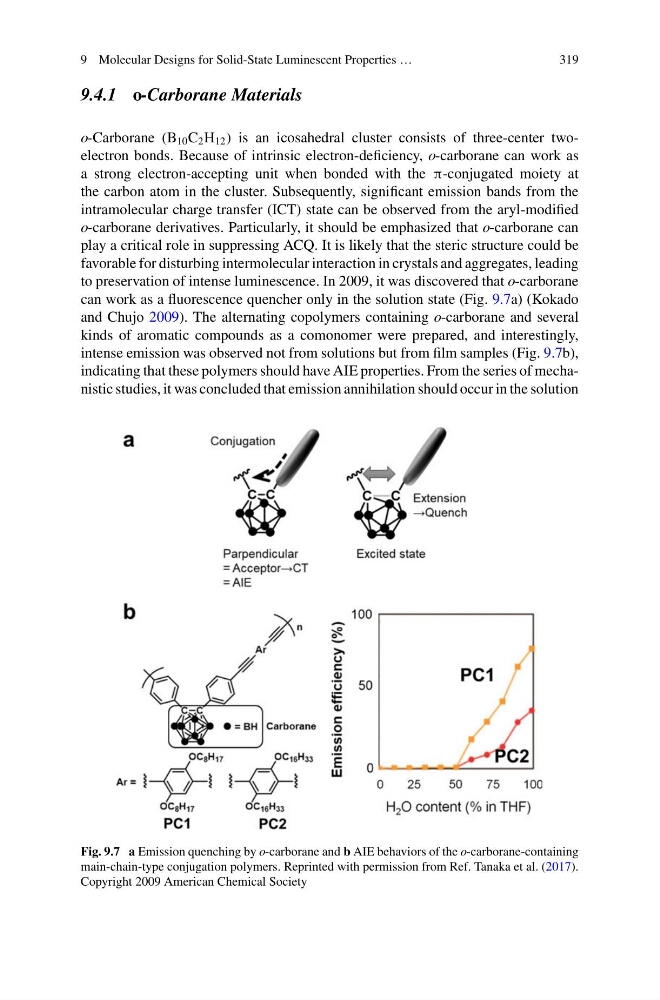
can work as a fluorescence quencher only in the solution state (Fig. 9.7a) (Kokado
and Chujo 2009). The alternating copolymers containing o-carborane and several
kinds of aromatic compounds as a comonomer were prepared, and interestingly,
intense emission was observed not from solutions but from film samples (Fig. 9.7b),
indicating that these polymers should have AIE properties. From the series of mechanistic studies, it was concluded that emission annihilation should occur in the solution
Fig. 9.7 a Emission quenching by o-carborane and b AIE behaviors of the o-carborane-containing
main-chain-type conjugation polymers. Reprinted with permission from Ref. Tanaka et al. (2017).
Copyright 2009 American Chemical Society
319
9.4.1 o-Carborane Materials
o-Carborane (B 10 C 2 H 12 ) is an icosahedral cluster consists of three-center twoelectron bonds. Because of intrinsic electron-deficiency, o-carborane can work as
a strong electron-accepting unit when bonded with the π-conjugated moiety at
the carbon atom in the cluster. Subsequently, significant emission bands from the
intramolecular charge transfer (ICT) state can be observed from the aryl-modified
o-carborane derivatives. Particularly, it should be emphasized that o-carborane can
play a critical role in suppressing ACQ. It is likely that the steric structure could be
favorable for disturbing intermolecular interaction in crystals and aggregates, leading
to preservation of intense luminescence. In 2009, it was discovered that o-carborane
can work as a fluorescence quencher only in the solution state (Fig. 9.7a) (Kokado
and Chujo 2009). The alternating copolymers containing o-carborane and several
kinds of aromatic compounds as a comonomer were prepared, and interestingly,
intense emission was observed not from solutions but from film samples (Fig. 9.7b),
indicating that these polymers should have AIE properties. From the series of mechanistic studies, it was concluded that emission annihilation should occur in the solution
Fig. 9.7 a Emission quenching by o-carborane and b AIE behaviors of the o-carborane-containing
main-chain-type conjugation polymers. Reprinted with permission from Ref. Tanaka et al. (2017).
Copyright 2009 American Chemical Society