

318
K. Tanaka et al.
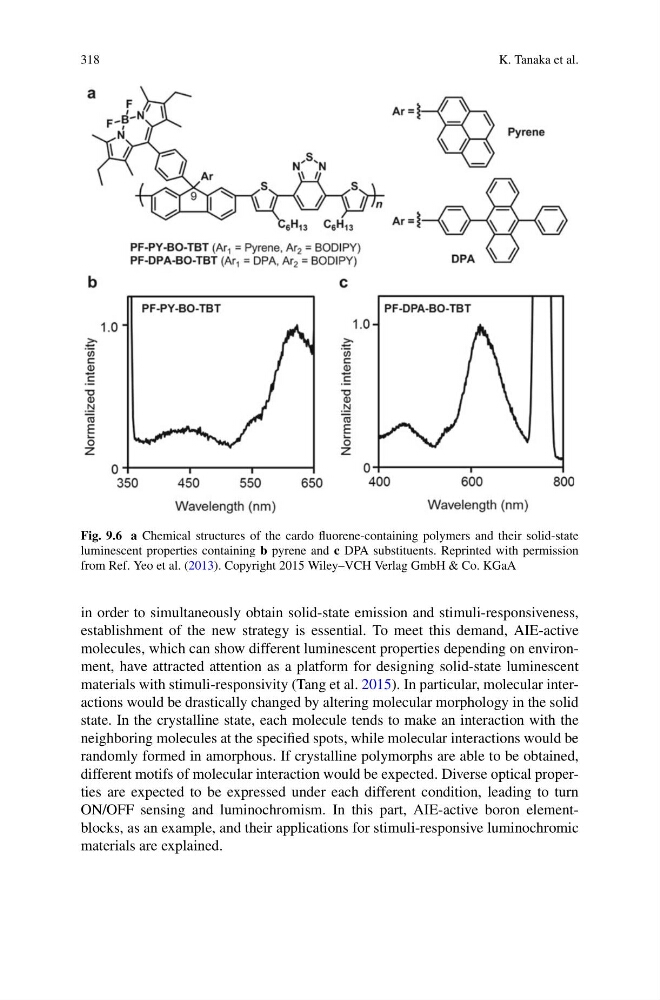
Fig. 9.6 a Chemical structures of the cardo fluorene-containing polymers and their solid-state
luminescent properties containing b pyrene and c DPA substituents. Reprinted with permission
from Ref. Yeo et al. (2013). Copyright 2015 Wiley–VCH Verlag GmbH & Co. KGaA
in order to simultaneously obtain solid-state emission and stimuli-responsiveness,
establishment of the new strategy is essential. To meet this demand, AIE-active
molecules, which can show different luminescent properties depending on environment, have attracted attention as a platform for designing solid-state luminescent
materials with stimuli-responsivity (Tang et al. 2015). In particular, molecular interactions would be drastically changed by altering molecular morphology in the solid
state. In the crystalline state, each molecule tends to make an interaction with the
neighboring molecules at the specified spots, while molecular interactions would be
randomly formed in amorphous. If crystalline polymorphs are able to be obtained,
different motifs of molecular interaction would be expected. Diverse optical properties are expected to be expressed under each different condition, leading to turn
ON/OFF sensing and luminochromism. In this part, AIE-active boron elementblocks, as an example, and their applications for stimuli-responsive luminochromic
materials are explained.
K. Tanaka et al.
Fig. 9.6 a Chemical structures of the cardo fluorene-containing polymers and their solid-state
luminescent properties containing b pyrene and c DPA substituents. Reprinted with permission
from Ref. Yeo et al. (2013). Copyright 2015 Wiley–VCH Verlag GmbH & Co. KGaA
in order to simultaneously obtain solid-state emission and stimuli-responsiveness,
establishment of the new strategy is essential. To meet this demand, AIE-active
molecules, which can show different luminescent properties depending on environment, have attracted attention as a platform for designing solid-state luminescent
materials with stimuli-responsivity (Tang et al. 2015). In particular, molecular interactions would be drastically changed by altering molecular morphology in the solid
state. In the crystalline state, each molecule tends to make an interaction with the
neighboring molecules at the specified spots, while molecular interactions would be
randomly formed in amorphous. If crystalline polymorphs are able to be obtained,
different motifs of molecular interaction would be expected. Diverse optical properties are expected to be expressed under each different condition, leading to turn
ON/OFF sensing and luminochromism. In this part, AIE-active boron elementblocks, as an example, and their applications for stimuli-responsive luminochromic
materials are explained.