

9 Molecular Designs for Solid-State Luminescent Properties …
317
O
O
R 1
R 2
n
R 1 = R 2 = POSS: em = 485 nm
R 1 = POSS, R 2 = C 12 H 25 : em = 493 nm
R 1 = R 2 = C 12 H 25 : em = 507 nm
POSS =
Si
O
Si O Si
O
Si
O
Si
O
Si
Si
O
Si
O
O
O
O
O
O
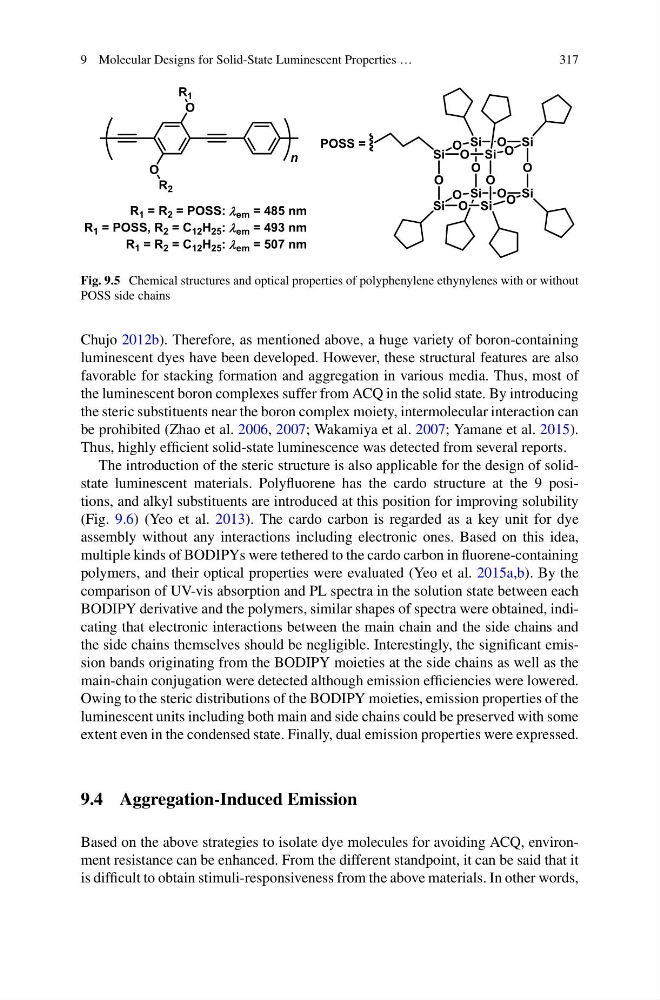
Fig. 9.5 Chemical structures and optical properties of polyphenylene ethynylenes with or without
POSS side chains
Chujo 2012b). Therefore, as mentioned above, a huge variety of boron-containing
luminescent dyes have been developed. However, these structural features are also
favorable for stacking formation and aggregation in various media. Thus, most of
the luminescent boron complexes suffer from ACQ in the solid state. By introducing
the steric substituents near the boron complex moiety, intermolecular interaction can
be prohibited (Zhao et al. 2006, 2007; Wakamiya et al. 2007; Yamane et al. 2015).
Thus, highly efficient solid-state luminescence was detected from several reports.
The introduction of the steric structure is also applicable for the design of solidstate luminescent materials. Polyfluorene has the cardo structure at the 9 positions, and alkyl substituents are introduced at this position for improving solubility
(Fig. 9.6) (Yeo et al. 2013). The cardo carbon is regarded as a key unit for dye
assembly without any interactions including electronic ones. Based on this idea,
multiple kinds of BODIPYs were tethered to the cardo carbon in fluorene-containing
polymers, and their optical properties were evaluated (Yeo et al. 2015a,b). By the
comparison of UV-vis absorption and PL spectra in the solution state between each
BODIPY derivative and the polymers, similar shapes of spectra were obtained, indicating that electronic interactions between the main chain and the side chains and
the side chains themselves should be negligible. Interestingly, the significant emission bands originating from the BODIPY moieties at the side chains as well as the
main-chain conjugation were detected although emission efficiencies were lowered.
Owing to the steric distributions of the BODIPY moieties, emission properties of the
luminescent units including both main and side chains could be preserved with some
extent even in the condensed state. Finally, dual emission properties were expressed.
9.4 Aggregation-Induced Emission
Based on the above strategies to isolate dye molecules for avoiding ACQ, environment resistance can be enhanced. From the different standpoint, it can be said that it
is difficult to obtain stimuli-responsiveness from the above materials. In other words,
317
O
O
R 1
R 2
n
R 1 = R 2 = POSS: em = 485 nm
R 1 = POSS, R 2 = C 12 H 25 : em = 493 nm
R 1 = R 2 = C 12 H 25 : em = 507 nm
POSS =
Si
O
Si O Si
O
Si
O
Si
O
Si
Si
O
Si
O
O
O
O
O
O
Fig. 9.5 Chemical structures and optical properties of polyphenylene ethynylenes with or without
POSS side chains
Chujo 2012b). Therefore, as mentioned above, a huge variety of boron-containing
luminescent dyes have been developed. However, these structural features are also
favorable for stacking formation and aggregation in various media. Thus, most of
the luminescent boron complexes suffer from ACQ in the solid state. By introducing
the steric substituents near the boron complex moiety, intermolecular interaction can
be prohibited (Zhao et al. 2006, 2007; Wakamiya et al. 2007; Yamane et al. 2015).
Thus, highly efficient solid-state luminescence was detected from several reports.
The introduction of the steric structure is also applicable for the design of solidstate luminescent materials. Polyfluorene has the cardo structure at the 9 positions, and alkyl substituents are introduced at this position for improving solubility
(Fig. 9.6) (Yeo et al. 2013). The cardo carbon is regarded as a key unit for dye
assembly without any interactions including electronic ones. Based on this idea,
multiple kinds of BODIPYs were tethered to the cardo carbon in fluorene-containing
polymers, and their optical properties were evaluated (Yeo et al. 2015a,b). By the
comparison of UV-vis absorption and PL spectra in the solution state between each
BODIPY derivative and the polymers, similar shapes of spectra were obtained, indicating that electronic interactions between the main chain and the side chains and
the side chains themselves should be negligible. Interestingly, the significant emission bands originating from the BODIPY moieties at the side chains as well as the
main-chain conjugation were detected although emission efficiencies were lowered.
Owing to the steric distributions of the BODIPY moieties, emission properties of the
luminescent units including both main and side chains could be preserved with some
extent even in the condensed state. Finally, dual emission properties were expressed.
9.4 Aggregation-Induced Emission
Based on the above strategies to isolate dye molecules for avoiding ACQ, environment resistance can be enhanced. From the different standpoint, it can be said that it
is difficult to obtain stimuli-responsiveness from the above materials. In other words,