

314
K. Tanaka et al.
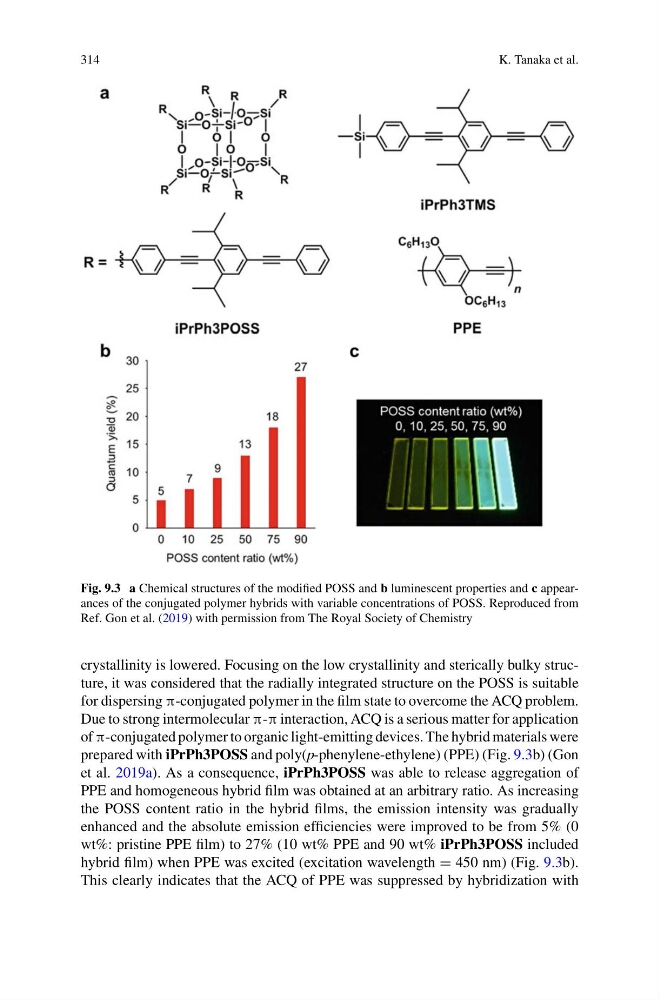
Fig. 9.3 a Chemical structures of the modified POSS and b luminescent properties and c appearances of the conjugated polymer hybrids with variable concentrations of POSS. Reproduced from
Ref. Gon et al. (2019) with permission from The Royal Society of Chemistry
crystallinity is lowered. Focusing on the low crystallinity and sterically bulky structure, it was considered that the radially integrated structure on the POSS is suitable
for dispersing π-conjugated polymer in the film state to overcome the ACQ problem.
Due to strong intermolecular π-π interaction, ACQ is a serious matter for application
of π-conjugated polymer to organic light-emitting devices. The hybrid materials were
prepared with iPrPh3POSS and poly(p-phenylene-ethylene) (PPE) (Fig. 9.3b) (Gon
et al. 2019a). As a consequence, iPrPh3POSS was able to release aggregation of
PPE and homogeneous hybrid film was obtained at an arbitrary ratio. As increasing
the POSS content ratio in the hybrid films, the emission intensity was gradually
enhanced and the absolute emission efficiencies were improved to be from 5% (0
wt%: pristine PPE film) to 27% (10 wt% PPE and 90 wt% iPrPh3POSS included
hybrid film) when PPE was excited (excitation wavelength = 450 nm) (Fig. 9.3b).
This clearly indicates that the ACQ of PPE was suppressed by hybridization with
K. Tanaka et al.
Fig. 9.3 a Chemical structures of the modified POSS and b luminescent properties and c appearances of the conjugated polymer hybrids with variable concentrations of POSS. Reproduced from
Ref. Gon et al. (2019) with permission from The Royal Society of Chemistry
crystallinity is lowered. Focusing on the low crystallinity and sterically bulky structure, it was considered that the radially integrated structure on the POSS is suitable
for dispersing π-conjugated polymer in the film state to overcome the ACQ problem.
Due to strong intermolecular π-π interaction, ACQ is a serious matter for application
of π-conjugated polymer to organic light-emitting devices. The hybrid materials were
prepared with iPrPh3POSS and poly(p-phenylene-ethylene) (PPE) (Fig. 9.3b) (Gon
et al. 2019a). As a consequence, iPrPh3POSS was able to release aggregation of
PPE and homogeneous hybrid film was obtained at an arbitrary ratio. As increasing
the POSS content ratio in the hybrid films, the emission intensity was gradually
enhanced and the absolute emission efficiencies were improved to be from 5% (0
wt%: pristine PPE film) to 27% (10 wt% PPE and 90 wt% iPrPh3POSS included
hybrid film) when PPE was excited (excitation wavelength = 450 nm) (Fig. 9.3b).
This clearly indicates that the ACQ of PPE was suppressed by hybridization with