

9 Molecular Designs for Solid-State Luminescent Properties …
315
iPrPh3POSS, and luminescent films were obtained (Fig. 9.3c). Moreover, the homogeneous hybridization brought additional functions to the luminescent hybrid films.
In the hybrid films, the emission from iPrPh3POSS was completely quenched even
when iPrPh3POSS were excited (excitation wavelength = 328 nm), meaning excited
energy of iPrPh3POSS is effectively transferred to PPE. Even in the 10 wt% PPE and
90 wt% iPrPh3POSS hybrid film, the emission from iPrPh3POSS almost disappeared. In contrast, the emission from PPE was dramatically enhanced. Such an
effective energy transfer is usually realized by direct chemical modification of light
harvesting units to the luminophores (Sato et al. 1999). In summary, by simply
mixing the designed POSS and conjugated polymers, the functional hybrid, where
effective energy transfer can proceed inside materials, was obtained. Therefore, it
is assumed that this strategy has high generality, and indeed bright emissive hybrid
materials composed of iPrPh3POSS and commodity π-conjugated polymers, such
as polyfluorene or regiorandom poly(3-hexylthiophene), were obtained. The mechanism should be potentially useful for manufacturing solid-state emissive materials
showing wavelength conversion properties.
As mentioned above, it was revealed that POSS has high affinity to π-conjugated
polymer. It is assumed that low polarity and the sterically bulky cubic structure could
be favorable for exhibiting high compatibility. To demonstrate applicability of POSS
for combining different types of polymer functionalities mediated by POSS, elastic
polyurethane and the luminescent π-conjugated polymer were focused. Polyurethane
has polar repeating units composed of urethane bonds and phase separation potentially occurs in the composition of polar polyurethane and non-polar π-conjugated
polymer. To improve the compatibility between these different kinds of polymers,
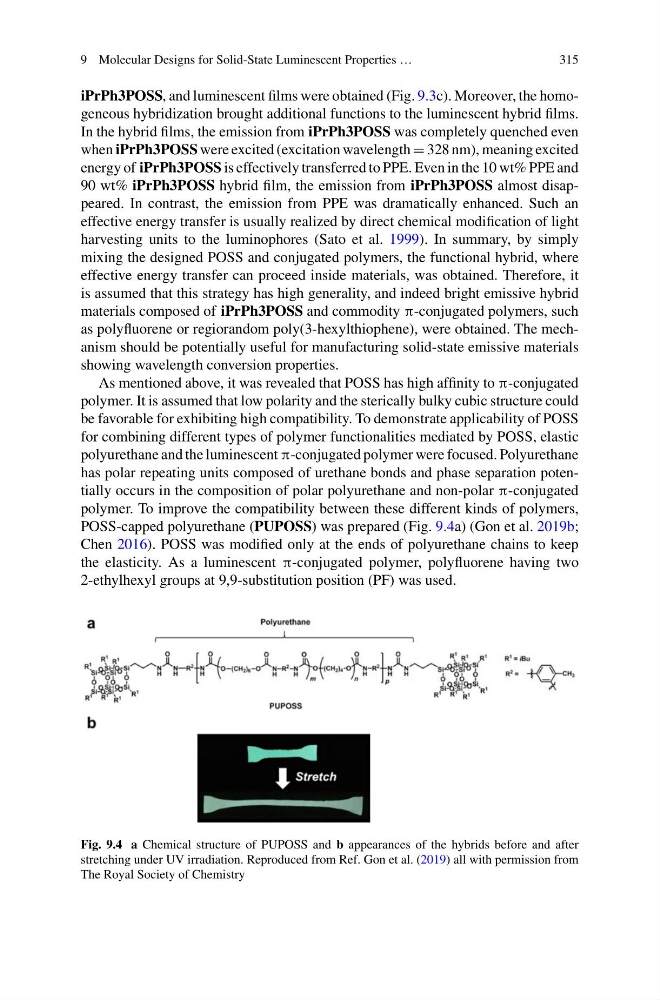
POSS-capped polyurethane (PUPOSS) was prepared (Fig. 9.4a) (Gon et al. 2019b;
Chen 2016). POSS was modified only at the ends of polyurethane chains to keep
the elasticity. As a luminescent π-conjugated polymer, polyfluorene having two
2-ethylhexyl groups at 9,9-substitution position (PF) was used.
Fig. 9.4 a Chemical structure of PUPOSS and b appearances of the hybrids before and after
stretching under UV irradiation. Reproduced from Ref. Gon et al. (2019) all with permission from
The Royal Society of Chemistry
315
iPrPh3POSS, and luminescent films were obtained (Fig. 9.3c). Moreover, the homogeneous hybridization brought additional functions to the luminescent hybrid films.
In the hybrid films, the emission from iPrPh3POSS was completely quenched even
when iPrPh3POSS were excited (excitation wavelength = 328 nm), meaning excited
energy of iPrPh3POSS is effectively transferred to PPE. Even in the 10 wt% PPE and
90 wt% iPrPh3POSS hybrid film, the emission from iPrPh3POSS almost disappeared. In contrast, the emission from PPE was dramatically enhanced. Such an
effective energy transfer is usually realized by direct chemical modification of light
harvesting units to the luminophores (Sato et al. 1999). In summary, by simply
mixing the designed POSS and conjugated polymers, the functional hybrid, where
effective energy transfer can proceed inside materials, was obtained. Therefore, it
is assumed that this strategy has high generality, and indeed bright emissive hybrid
materials composed of iPrPh3POSS and commodity π-conjugated polymers, such
as polyfluorene or regiorandom poly(3-hexylthiophene), were obtained. The mechanism should be potentially useful for manufacturing solid-state emissive materials
showing wavelength conversion properties.
As mentioned above, it was revealed that POSS has high affinity to π-conjugated
polymer. It is assumed that low polarity and the sterically bulky cubic structure could
be favorable for exhibiting high compatibility. To demonstrate applicability of POSS
for combining different types of polymer functionalities mediated by POSS, elastic
polyurethane and the luminescent π-conjugated polymer were focused. Polyurethane
has polar repeating units composed of urethane bonds and phase separation potentially occurs in the composition of polar polyurethane and non-polar π-conjugated
polymer. To improve the compatibility between these different kinds of polymers,
POSS-capped polyurethane (PUPOSS) was prepared (Fig. 9.4a) (Gon et al. 2019b;
Chen 2016). POSS was modified only at the ends of polyurethane chains to keep
the elasticity. As a luminescent π-conjugated polymer, polyfluorene having two
2-ethylhexyl groups at 9,9-substitution position (PF) was used.
Fig. 9.4 a Chemical structure of PUPOSS and b appearances of the hybrids before and after
stretching under UV irradiation. Reproduced from Ref. Gon et al. (2019) all with permission from
The Royal Society of Chemistry