

9 Molecular Designs for Solid-State Luminescent Properties …
313
are defined as a minimum functional unit containing heteroatoms (Chujo and Tanaka
2015; Gon et al. 2018a). By the combination, connection, and assembly of elementblocks, it is presumable that various types of functional materials possessing unique
functions derived from each element can be obtained. On the basis of this idea
regarding element-block materials, functional hybrids have been developed.
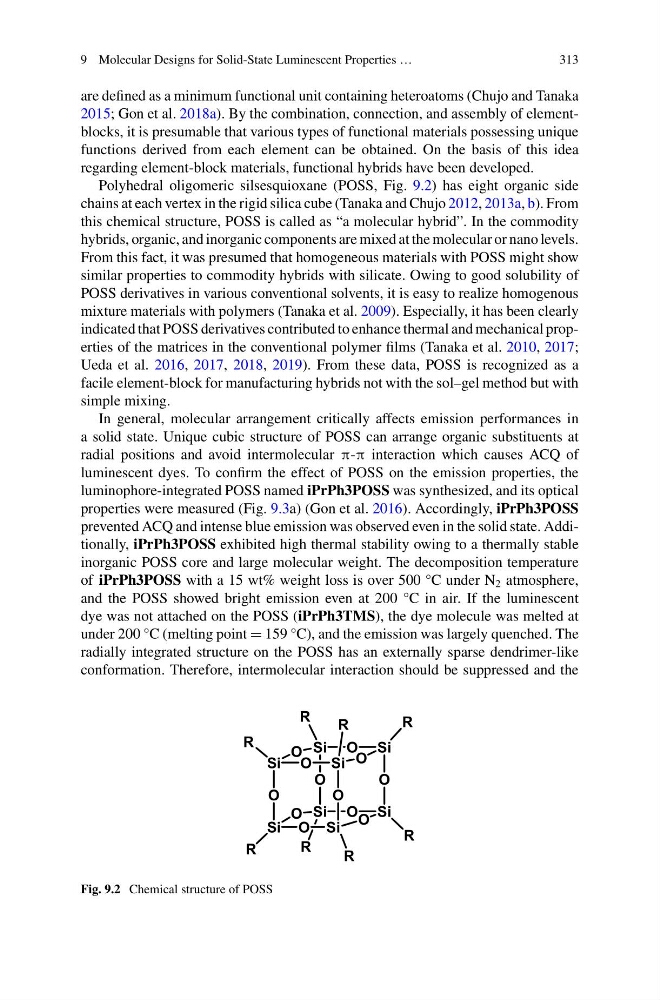
Polyhedral oligomeric silsesquioxane (POSS, Fig. 9.2) has eight organic side
chains at each vertex in the rigid silica cube (Tanaka and Chujo 2012, 2013a, b). From
this chemical structure, POSS is called as “a molecular hybrid”. In the commodity
hybrids, organic, and inorganic components are mixed at the molecular or nano levels.
From this fact, it was presumed that homogeneous materials with POSS might show
similar properties to commodity hybrids with silicate. Owing to good solubility of
POSS derivatives in various conventional solvents, it is easy to realize homogenous
mixture materials with polymers (Tanaka et al. 2009). Especially, it has been clearly
indicated that POSS derivatives contributed to enhance thermal and mechanical properties of the matrices in the conventional polymer films (Tanaka et al. 2010, 2017;
Ueda et al. 2016, 2017, 2018, 2019). From these data, POSS is recognized as a
facile element-block for manufacturing hybrids not with the sol–gel method but with
simple mixing.
In general, molecular arrangement critically affects emission performances in
a solid state. Unique cubic structure of POSS can arrange organic substituents at
radial positions and avoid intermolecular π-π interaction which causes ACQ of
luminescent dyes. To confirm the effect of POSS on the emission properties, the
luminophore-integrated POSS named iPrPh3POSS was synthesized, and its optical
properties were measured (Fig. 9.3a) (Gon et al. 2016). Accordingly, iPrPh3POSS
prevented ACQ and intense blue emission was observed even in the solid state. Additionally, iPrPh3POSS exhibited high thermal stability owing to a thermally stable
inorganic POSS core and large molecular weight. The decomposition temperature
of iPrPh3POSS with a 15 wt% weight loss is over 500 °C under N 2 atmosphere,
and the POSS showed bright emission even at 200 °C in air. If the luminescent
dye was not attached on the POSS (iPrPh3TMS), the dye molecule was melted at
under 200 °C (melting point = 159 °C), and the emission was largely quenched. The
radially integrated structure on the POSS has an externally sparse dendrimer-like
conformation. Therefore, intermolecular interaction should be suppressed and the
Si
O
Si O Si
O
Si
O
Si
O
Si
Si
O
Si
O
O
O
O
O
R
R
R
R
R
R
R
R
O
Fig. 9.2 Chemical structure of POSS
313
are defined as a minimum functional unit containing heteroatoms (Chujo and Tanaka
2015; Gon et al. 2018a). By the combination, connection, and assembly of elementblocks, it is presumable that various types of functional materials possessing unique
functions derived from each element can be obtained. On the basis of this idea
regarding element-block materials, functional hybrids have been developed.
Polyhedral oligomeric silsesquioxane (POSS, Fig. 9.2) has eight organic side
chains at each vertex in the rigid silica cube (Tanaka and Chujo 2012, 2013a, b). From
this chemical structure, POSS is called as “a molecular hybrid”. In the commodity
hybrids, organic, and inorganic components are mixed at the molecular or nano levels.
From this fact, it was presumed that homogeneous materials with POSS might show
similar properties to commodity hybrids with silicate. Owing to good solubility of
POSS derivatives in various conventional solvents, it is easy to realize homogenous
mixture materials with polymers (Tanaka et al. 2009). Especially, it has been clearly
indicated that POSS derivatives contributed to enhance thermal and mechanical properties of the matrices in the conventional polymer films (Tanaka et al. 2010, 2017;
Ueda et al. 2016, 2017, 2018, 2019). From these data, POSS is recognized as a
facile element-block for manufacturing hybrids not with the sol–gel method but with
simple mixing.
In general, molecular arrangement critically affects emission performances in
a solid state. Unique cubic structure of POSS can arrange organic substituents at
radial positions and avoid intermolecular π-π interaction which causes ACQ of
luminescent dyes. To confirm the effect of POSS on the emission properties, the
luminophore-integrated POSS named iPrPh3POSS was synthesized, and its optical
properties were measured (Fig. 9.3a) (Gon et al. 2016). Accordingly, iPrPh3POSS
prevented ACQ and intense blue emission was observed even in the solid state. Additionally, iPrPh3POSS exhibited high thermal stability owing to a thermally stable
inorganic POSS core and large molecular weight. The decomposition temperature
of iPrPh3POSS with a 15 wt% weight loss is over 500 °C under N 2 atmosphere,
and the POSS showed bright emission even at 200 °C in air. If the luminescent
dye was not attached on the POSS (iPrPh3TMS), the dye molecule was melted at
under 200 °C (melting point = 159 °C), and the emission was largely quenched. The
radially integrated structure on the POSS has an externally sparse dendrimer-like
conformation. Therefore, intermolecular interaction should be suppressed and the
Si
O
Si O Si
O
Si
O
Si
O
Si
Si
O
Si
O
O
O
O
O
R
R
R
R
R
R
R
R
O
Fig. 9.2 Chemical structure of POSS