

312
K. Tanaka et al.
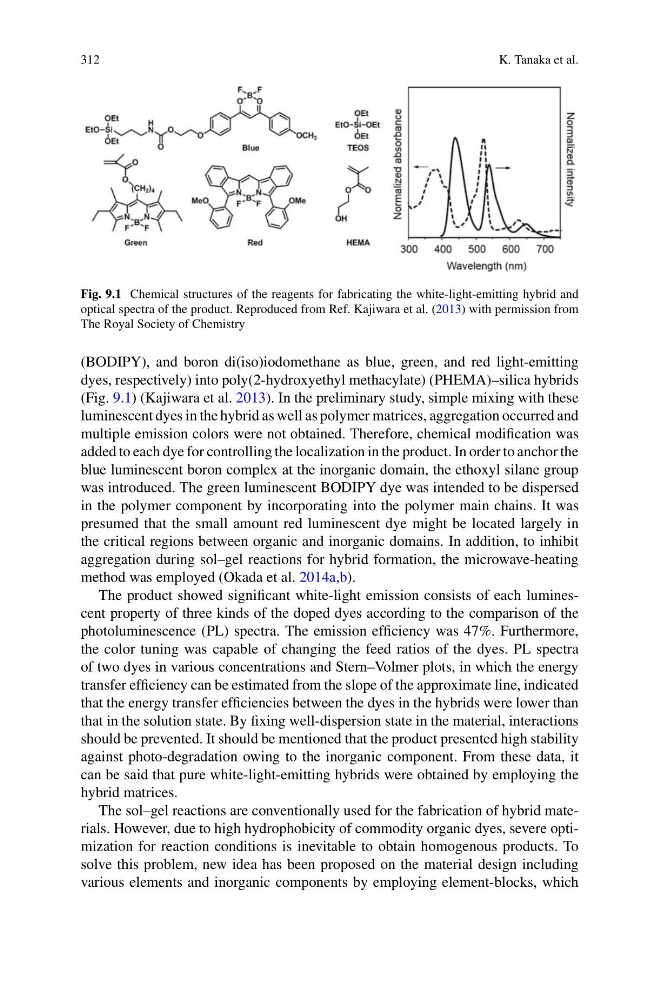
Fig. 9.1 Chemical structures of the reagents for fabricating the white-light-emitting hybrid and
optical spectra of the product. Reproduced from Ref. Kajiwara et al. (2013) with permission from
The Royal Society of Chemistry
(BODIPY), and boron di(iso)iodomethane as blue, green, and red light-emitting
dyes, respectively) into poly(2-hydroxyethyl methacylate) (PHEMA)–silica hybrids
(Fig. 9.1) (Kajiwara et al. 2013). In the preliminary study, simple mixing with these
luminescent dyes in the hybrid as well as polymer matrices, aggregation occurred and
multiple emission colors were not obtained. Therefore, chemical modification was
added to each dye for controlling the localization in the product. In order to anchor the
blue luminescent boron complex at the inorganic domain, the ethoxyl silane group
was introduced. The green luminescent BODIPY dye was intended to be dispersed
in the polymer component by incorporating into the polymer main chains. It was
presumed that the small amount red luminescent dye might be located largely in
the critical regions between organic and inorganic domains. In addition, to inhibit
aggregation during sol–gel reactions for hybrid formation, the microwave-heating
method was employed (Okada et al. 2014a,b).
The product showed significant white-light emission consists of each luminescent property of three kinds of the doped dyes according to the comparison of the
photoluminescence (PL) spectra. The emission efficiency was 47%. Furthermore,
the color tuning was capable of changing the feed ratios of the dyes. PL spectra
of two dyes in various concentrations and Stern–Volmer plots, in which the energy
transfer efficiency can be estimated from the slope of the approximate line, indicated
that the energy transfer efficiencies between the dyes in the hybrids were lower than
that in the solution state. By fixing well-dispersion state in the material, interactions
should be prevented. It should be mentioned that the product presented high stability
against photo-degradation owing to the inorganic component. From these data, it
can be said that pure white-light-emitting hybrids were obtained by employing the
hybrid matrices.
The sol–gel reactions are conventionally used for the fabrication of hybrid materials. However, due to high hydrophobicity of commodity organic dyes, severe optimization for reaction conditions is inevitable to obtain homogenous products. To
solve this problem, new idea has been proposed on the material design including
various elements and inorganic components by employing element-blocks, which
K. Tanaka et al.
Fig. 9.1 Chemical structures of the reagents for fabricating the white-light-emitting hybrid and
optical spectra of the product. Reproduced from Ref. Kajiwara et al. (2013) with permission from
The Royal Society of Chemistry
(BODIPY), and boron di(iso)iodomethane as blue, green, and red light-emitting
dyes, respectively) into poly(2-hydroxyethyl methacylate) (PHEMA)–silica hybrids
(Fig. 9.1) (Kajiwara et al. 2013). In the preliminary study, simple mixing with these
luminescent dyes in the hybrid as well as polymer matrices, aggregation occurred and
multiple emission colors were not obtained. Therefore, chemical modification was
added to each dye for controlling the localization in the product. In order to anchor the
blue luminescent boron complex at the inorganic domain, the ethoxyl silane group
was introduced. The green luminescent BODIPY dye was intended to be dispersed
in the polymer component by incorporating into the polymer main chains. It was
presumed that the small amount red luminescent dye might be located largely in
the critical regions between organic and inorganic domains. In addition, to inhibit
aggregation during sol–gel reactions for hybrid formation, the microwave-heating
method was employed (Okada et al. 2014a,b).
The product showed significant white-light emission consists of each luminescent property of three kinds of the doped dyes according to the comparison of the
photoluminescence (PL) spectra. The emission efficiency was 47%. Furthermore,
the color tuning was capable of changing the feed ratios of the dyes. PL spectra
of two dyes in various concentrations and Stern–Volmer plots, in which the energy
transfer efficiency can be estimated from the slope of the approximate line, indicated
that the energy transfer efficiencies between the dyes in the hybrids were lower than
that in the solution state. By fixing well-dispersion state in the material, interactions
should be prevented. It should be mentioned that the product presented high stability
against photo-degradation owing to the inorganic component. From these data, it
can be said that pure white-light-emitting hybrids were obtained by employing the
hybrid matrices.
The sol–gel reactions are conventionally used for the fabrication of hybrid materials. However, due to high hydrophobicity of commodity organic dyes, severe optimization for reaction conditions is inevitable to obtain homogenous products. To
solve this problem, new idea has been proposed on the material design including
various elements and inorganic components by employing element-blocks, which