

8 Red and Near-IR Fluorescent Two-Photon Absorption Dyes
299
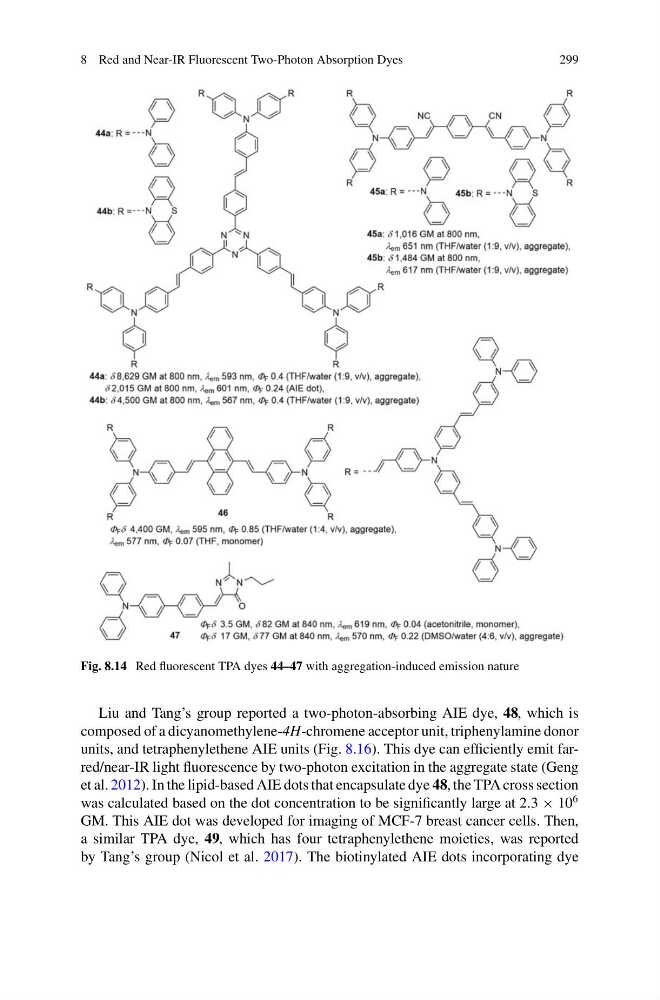
Fig. 8.14 Red fluorescent TPA dyes 44–47 with aggregation-induced emission nature
Liu and Tang’s group reported a two-photon-absorbing AIE dye, 48, which is
composed of a dicyanomethylene-4H-chromene acceptor unit, triphenylamine donor
units, and tetraphenylethene AIE units (Fig. 8.16). This dye can efficiently emit farred/near-IR light fluorescence by two-photon excitation in the aggregate state (Geng
et al. 2012). In the lipid-based AIE dots that encapsulate dye 48, the TPA cross section
was calculated based on the dot concentration to be significantly large at 2.3 × 10
6
GM. This AIE dot was developed for imaging of MCF-7 breast cancer cells. Then,
a similar TPA dye, 49, which has four tetraphenylethene moieties, was reported
by Tang’s group (Nicol et al. 2017). The biotinylated AIE dots incorporating dye
299
Fig. 8.14 Red fluorescent TPA dyes 44–47 with aggregation-induced emission nature
Liu and Tang’s group reported a two-photon-absorbing AIE dye, 48, which is
composed of a dicyanomethylene-4H-chromene acceptor unit, triphenylamine donor
units, and tetraphenylethene AIE units (Fig. 8.16). This dye can efficiently emit farred/near-IR light fluorescence by two-photon excitation in the aggregate state (Geng
et al. 2012). In the lipid-based AIE dots that encapsulate dye 48, the TPA cross section
was calculated based on the dot concentration to be significantly large at 2.3 × 10
6
GM. This AIE dot was developed for imaging of MCF-7 breast cancer cells. Then,
a similar TPA dye, 49, which has four tetraphenylethene moieties, was reported
by Tang’s group (Nicol et al. 2017). The biotinylated AIE dots incorporating dye