

8 Red and Near-IR Fluorescent Two-Photon Absorption Dyes
289
N
N
N
N
N
Eu
N
N
N
O
O
S
CF 3
3
N
N
O
O
O
O
O
i Pr
i Pr
i Pr
i Pr
O
O
O
HO 3 S
SO 3 H
SO 3 H
HO 3 S
8
7
50 GM at 840 nm,
em 619 nm, F 0.58 (water)
157 GM at 808 nm,
em 614 nm, F 0.52 (toluene)
N
S
S
Mes 2 B
Mes 2 B
H
N
698 GM at 881 nm (THF),
em 708 nm, F 0.55 (acetone)
9
Φ
Φ
Φ
λ
λ
λ
δ
δ
δ
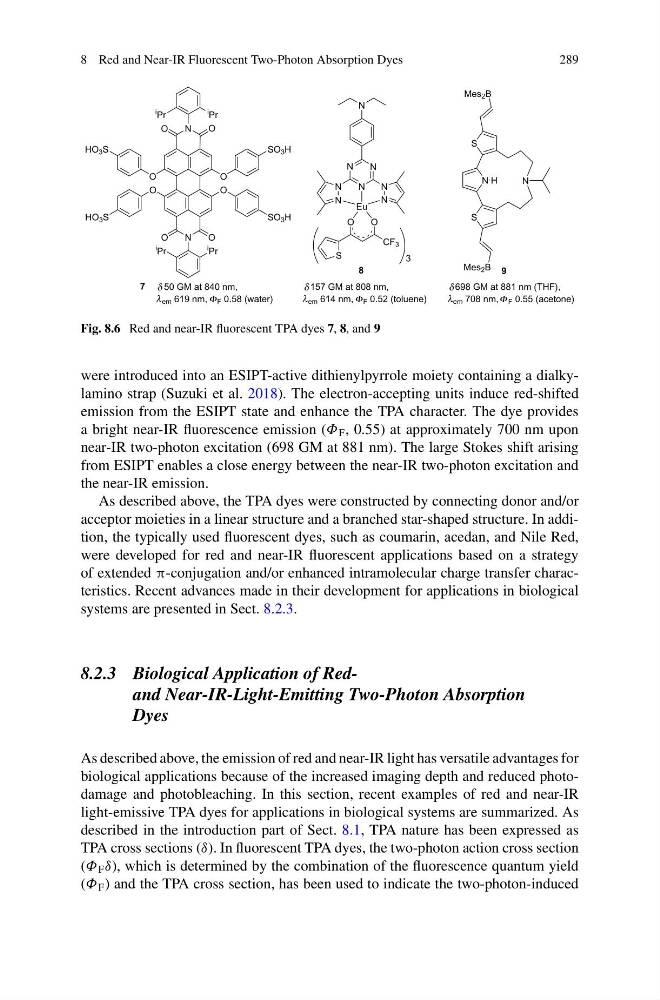
Fig. 8.6 Red and near-IR fluorescent TPA dyes 7, 8, and 9
were introduced into an ESIPT-active dithienylpyrrole moiety containing a dialkylamino strap (Suzuki et al. 2018). The electron-accepting units induce red-shifted
emission from the ESIPT state and enhance the TPA character. The dye provides
a bright near-IR fluorescence emission (Φ F , 0.55) at approximately 700 nm upon
near-IR two-photon excitation (698 GM at 881 nm). The large Stokes shift arising
from ESIPT enables a close energy between the near-IR two-photon excitation and
the near-IR emission.
As described above, the TPA dyes were constructed by connecting donor and/or
acceptor moieties in a linear structure and a branched star-shaped structure. In addition, the typically used fluorescent dyes, such as coumarin, acedan, and Nile Red,
were developed for red and near-IR fluorescent applications based on a strategy
of extended π-conjugation and/or enhanced intramolecular charge transfer characteristics. Recent advances made in their development for applications in biological
systems are presented in Sect. 8.2.3.
8.2.3 Biological Application of Redand Near-IR-Light-Emitting Two-Photon Absorption
Dyes
As described above, the emission of red and near-IR light has versatile advantages for
biological applications because of the increased imaging depth and reduced photodamage and photobleaching. In this section, recent examples of red and near-IR
light-emissive TPA dyes for applications in biological systems are summarized. As
described in the introduction part of Sect. 8.1, TPA nature has been expressed as
TPA cross sections (δ). In fluorescent TPA dyes, the two-photon action cross section
(Φ F δ), which is determined by the combination of the fluorescence quantum yield
(Φ F ) and the TPA cross section, has been used to indicate the two-photon-induced
289
N
N
N
N
N
Eu
N
N
N
O
O
S
CF 3
3
N
N
O
O
O
O
O
i Pr
i Pr
i Pr
i Pr
O
O
O
HO 3 S
SO 3 H
SO 3 H
HO 3 S
8
7
50 GM at 840 nm,
em 619 nm, F 0.58 (water)
157 GM at 808 nm,
em 614 nm, F 0.52 (toluene)
N
S
S
Mes 2 B
Mes 2 B
H
N
698 GM at 881 nm (THF),
em 708 nm, F 0.55 (acetone)
9
Φ
Φ
Φ
λ
λ
λ
δ
δ
δ
Fig. 8.6 Red and near-IR fluorescent TPA dyes 7, 8, and 9
were introduced into an ESIPT-active dithienylpyrrole moiety containing a dialkylamino strap (Suzuki et al. 2018). The electron-accepting units induce red-shifted
emission from the ESIPT state and enhance the TPA character. The dye provides
a bright near-IR fluorescence emission (Φ F , 0.55) at approximately 700 nm upon
near-IR two-photon excitation (698 GM at 881 nm). The large Stokes shift arising
from ESIPT enables a close energy between the near-IR two-photon excitation and
the near-IR emission.
As described above, the TPA dyes were constructed by connecting donor and/or
acceptor moieties in a linear structure and a branched star-shaped structure. In addition, the typically used fluorescent dyes, such as coumarin, acedan, and Nile Red,
were developed for red and near-IR fluorescent applications based on a strategy
of extended π-conjugation and/or enhanced intramolecular charge transfer characteristics. Recent advances made in their development for applications in biological
systems are presented in Sect. 8.2.3.
8.2.3 Biological Application of Redand Near-IR-Light-Emitting Two-Photon Absorption
Dyes
As described above, the emission of red and near-IR light has versatile advantages for
biological applications because of the increased imaging depth and reduced photodamage and photobleaching. In this section, recent examples of red and near-IR
light-emissive TPA dyes for applications in biological systems are summarized. As
described in the introduction part of Sect. 8.1, TPA nature has been expressed as
TPA cross sections (δ). In fluorescent TPA dyes, the two-photon action cross section
(Φ F δ), which is determined by the combination of the fluorescence quantum yield
(Φ F ) and the TPA cross section, has been used to indicate the two-photon-induced