

288
T. Ishi-i
5
N
S
N
HN
NH
NO 2
O 2 N
H 2 N
NH 2
N
S
N
6
OHC
ON
CHO
NO
+
+
PET
PET
Nonfluorescence
Fluorescence
20 GM at 800 nm, em 613 nm, F 0.009 (dichloromethane)
12 GM at 800 nm, em 628 nm, F 0.25 (dichloromethane)
Two-photon irradiation
at 800 nm
Φ
Φ
λ
λ
δ
δ
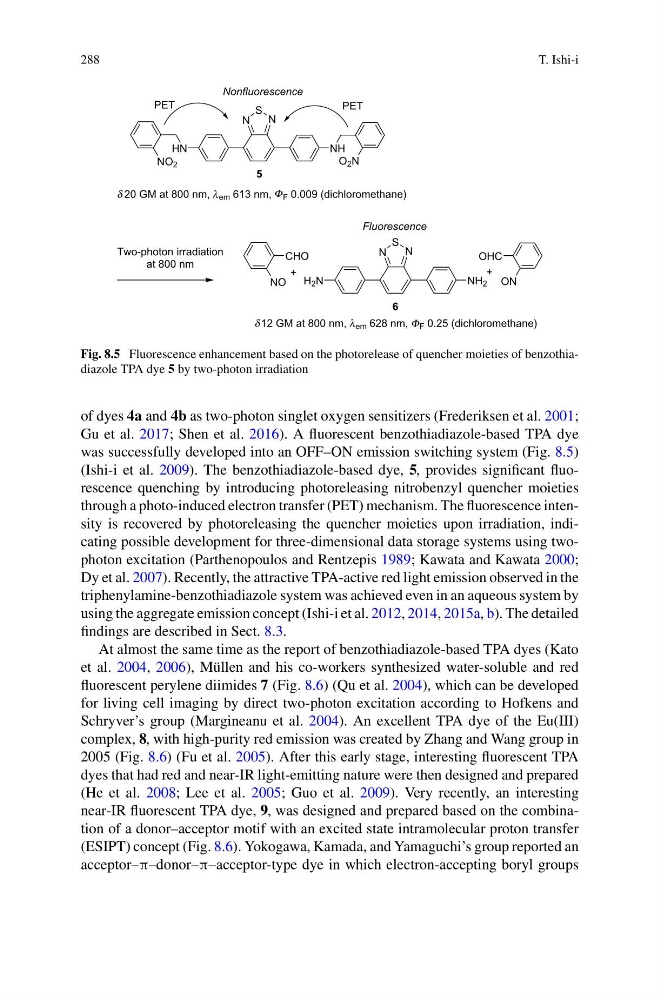
Fig. 8.5 Fluorescence enhancement based on the photorelease of quencher moieties of benzothiadiazole TPA dye 5 by two-photon irradiation
of dyes 4a and 4b as two-photon singlet oxygen sensitizers (Frederiksen et al. 2001;
Gu et al. 2017; Shen et al. 2016). A fluorescent benzothiadiazole-based TPA dye
was successfully developed into an OFF–ON emission switching system (Fig. 8.5)
(Ishi-i et al. 2009). The benzothiadiazole-based dye, 5, provides significant fluorescence quenching by introducing photoreleasing nitrobenzyl quencher moieties
through a photo-induced electron transfer (PET) mechanism. The fluorescence intensity is recovered by photoreleasing the quencher moieties upon irradiation, indicating possible development for three-dimensional data storage systems using twophoton excitation (Parthenopoulos and Rentzepis 1989; Kawata and Kawata 2000;
Dy et al. 2007). Recently, the attractive TPA-active red light emission observed in the
triphenylamine-benzothiadiazole system was achieved even in an aqueous system by
using the aggregate emission concept (Ishi-i et al. 2012, 2014, 2015a, b). The detailed
findings are described in Sect. 8.3.
At almost the same time as the report of benzothiadiazole-based TPA dyes (Kato
et al. 2004, 2006), Müllen and his co-workers synthesized water-soluble and red
fluorescent perylene diimides 7 (Fig. 8.6) (Qu et al. 2004), which can be developed
for living cell imaging by direct two-photon excitation according to Hofkens and
Schryver’s group (Margineanu et al. 2004). An excellent TPA dye of the Eu(III)
complex, 8, with high-purity red emission was created by Zhang and Wang group in
2005 (Fig. 8.6) (Fu et al. 2005). After this early stage, interesting fluorescent TPA
dyes that had red and near-IR light-emitting nature were then designed and prepared
(He et al. 2008; Lee et al. 2005; Guo et al. 2009). Very recently, an interesting
near-IR fluorescent TPA dye, 9, was designed and prepared based on the combination of a donor–acceptor motif with an excited state intramolecular proton transfer
(ESIPT) concept (Fig. 8.6). Yokogawa, Kamada, and Yamaguchi’s group reported an
acceptor–π–donor–π–acceptor-type dye in which electron-accepting boryl groups
T. Ishi-i
5
N
S
N
HN
NH
NO 2
O 2 N
H 2 N
NH 2
N
S
N
6
OHC
ON
CHO
NO
+
+
PET
PET
Nonfluorescence
Fluorescence
20 GM at 800 nm, em 613 nm, F 0.009 (dichloromethane)
12 GM at 800 nm, em 628 nm, F 0.25 (dichloromethane)
Two-photon irradiation
at 800 nm
Φ
Φ
λ
λ
δ
δ
Fig. 8.5 Fluorescence enhancement based on the photorelease of quencher moieties of benzothiadiazole TPA dye 5 by two-photon irradiation
of dyes 4a and 4b as two-photon singlet oxygen sensitizers (Frederiksen et al. 2001;
Gu et al. 2017; Shen et al. 2016). A fluorescent benzothiadiazole-based TPA dye
was successfully developed into an OFF–ON emission switching system (Fig. 8.5)
(Ishi-i et al. 2009). The benzothiadiazole-based dye, 5, provides significant fluorescence quenching by introducing photoreleasing nitrobenzyl quencher moieties
through a photo-induced electron transfer (PET) mechanism. The fluorescence intensity is recovered by photoreleasing the quencher moieties upon irradiation, indicating possible development for three-dimensional data storage systems using twophoton excitation (Parthenopoulos and Rentzepis 1989; Kawata and Kawata 2000;
Dy et al. 2007). Recently, the attractive TPA-active red light emission observed in the
triphenylamine-benzothiadiazole system was achieved even in an aqueous system by
using the aggregate emission concept (Ishi-i et al. 2012, 2014, 2015a, b). The detailed
findings are described in Sect. 8.3.
At almost the same time as the report of benzothiadiazole-based TPA dyes (Kato
et al. 2004, 2006), Müllen and his co-workers synthesized water-soluble and red
fluorescent perylene diimides 7 (Fig. 8.6) (Qu et al. 2004), which can be developed
for living cell imaging by direct two-photon excitation according to Hofkens and
Schryver’s group (Margineanu et al. 2004). An excellent TPA dye of the Eu(III)
complex, 8, with high-purity red emission was created by Zhang and Wang group in
2005 (Fig. 8.6) (Fu et al. 2005). After this early stage, interesting fluorescent TPA
dyes that had red and near-IR light-emitting nature were then designed and prepared
(He et al. 2008; Lee et al. 2005; Guo et al. 2009). Very recently, an interesting
near-IR fluorescent TPA dye, 9, was designed and prepared based on the combination of a donor–acceptor motif with an excited state intramolecular proton transfer
(ESIPT) concept (Fig. 8.6). Yokogawa, Kamada, and Yamaguchi’s group reported an
acceptor–π–donor–π–acceptor-type dye in which electron-accepting boryl groups