

7 Photochromism
275
F 2
F 2
F 2
S
S
CH 3
H 3 C
Vis.
S
Si
H 3 C
H 3 C CH 3
S
Si
CH 3
CH 3
H 3 C
F 2
F 2
F 2
S
S
CH 3
H 3 C
S
Si
H 3 C
H 3 C CH 3
S
Si
CH 3
CH 3
H 3 C
(a)
(b)
F 2
F 2
F 2
S
S
OCH 3
H 3 CO
Si
H 3 C
H 3 C CH 3
Si
CH 3
H 3 C CH 3
F 2
F 2
F 2
S
S
OCH 3
H 3 CO
Si
H 3 C
H 3 C CH 3
Si
CH 3
H 3 C CH 3
UV
Vis.
UV
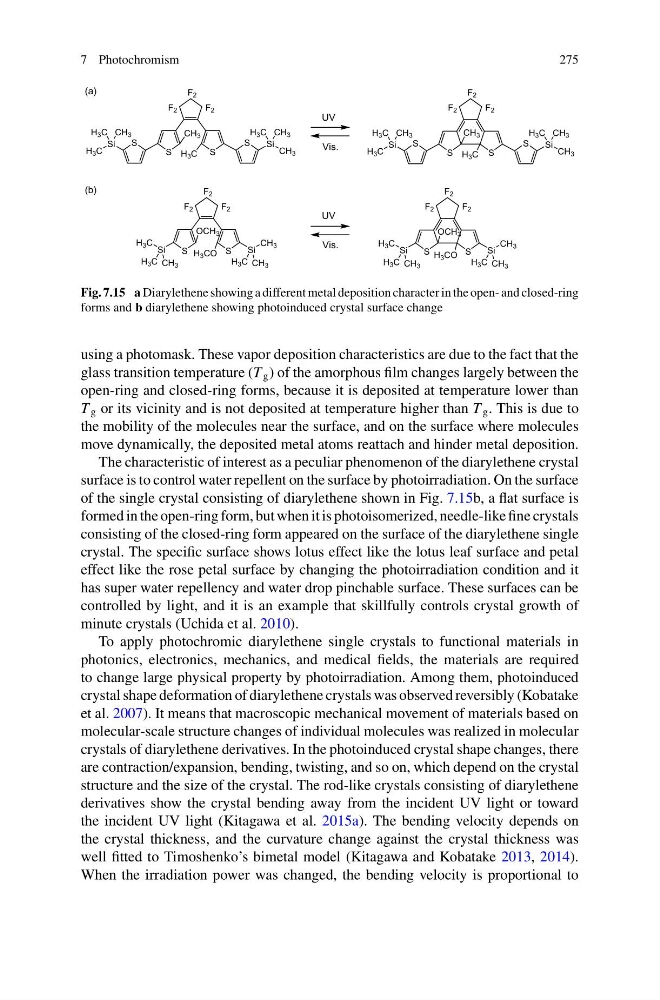
Fig. 7.15 a Diarylethene showing a different metal deposition character in the open- and closed-ring
forms and b diarylethene showing photoinduced crystal surface change
using a photomask. These vapor deposition characteristics are due to the fact that the
glass transition temperature (T g ) of the amorphous film changes largely between the
open-ring and closed-ring forms, because it is deposited at temperature lower than
T g or its vicinity and is not deposited at temperature higher than T g . This is due to
the mobility of the molecules near the surface, and on the surface where molecules
move dynamically, the deposited metal atoms reattach and hinder metal deposition.
The characteristic of interest as a peculiar phenomenon of the diarylethene crystal
surface is to control water repellent on the surface by photoirradiation. On the surface
of the single crystal consisting of diarylethene shown in Fig. 7.15b, a flat surface is
formed in the open-ring form, but when it is photoisomerized, needle-like fine crystals
consisting of the closed-ring form appeared on the surface of the diarylethene single
crystal. The specific surface shows lotus effect like the lotus leaf surface and petal
effect like the rose petal surface by changing the photoirradiation condition and it
has super water repellency and water drop pinchable surface. These surfaces can be
controlled by light, and it is an example that skillfully controls crystal growth of
minute crystals (Uchida et al. 2010).
To apply photochromic diarylethene single crystals to functional materials in
photonics, electronics, mechanics, and medical fields, the materials are required
to change large physical property by photoirradiation. Among them, photoinduced
crystal shape deformation of diarylethene crystals was observed reversibly (Kobatake
et al. 2007). It means that macroscopic mechanical movement of materials based on
molecular-scale structure changes of individual molecules was realized in molecular
crystals of diarylethene derivatives. In the photoinduced crystal shape changes, there
are contraction/expansion, bending, twisting, and so on, which depend on the crystal
structure and the size of the crystal. The rod-like crystals consisting of diarylethene
derivatives show the crystal bending away from the incident UV light or toward
the incident UV light (Kitagawa et al. 2015a). The bending velocity depends on
the crystal thickness, and the curvature change against the crystal thickness was
well fitted to Timoshenko’s bimetal model (Kitagawa and Kobatake 2013, 2014).
When the irradiation power was changed, the bending velocity is proportional to
275
F 2
F 2
F 2
S
S
CH 3
H 3 C
Vis.
S
Si
H 3 C
H 3 C CH 3
S
Si
CH 3
CH 3
H 3 C
F 2
F 2
F 2
S
S
CH 3
H 3 C
S
Si
H 3 C
H 3 C CH 3
S
Si
CH 3
CH 3
H 3 C
(a)
(b)
F 2
F 2
F 2
S
S
OCH 3
H 3 CO
Si
H 3 C
H 3 C CH 3
Si
CH 3
H 3 C CH 3
F 2
F 2
F 2
S
S
OCH 3
H 3 CO
Si
H 3 C
H 3 C CH 3
Si
CH 3
H 3 C CH 3
UV
Vis.
UV
Fig. 7.15 a Diarylethene showing a different metal deposition character in the open- and closed-ring
forms and b diarylethene showing photoinduced crystal surface change
using a photomask. These vapor deposition characteristics are due to the fact that the
glass transition temperature (T g ) of the amorphous film changes largely between the
open-ring and closed-ring forms, because it is deposited at temperature lower than
T g or its vicinity and is not deposited at temperature higher than T g . This is due to
the mobility of the molecules near the surface, and on the surface where molecules
move dynamically, the deposited metal atoms reattach and hinder metal deposition.
The characteristic of interest as a peculiar phenomenon of the diarylethene crystal
surface is to control water repellent on the surface by photoirradiation. On the surface
of the single crystal consisting of diarylethene shown in Fig. 7.15b, a flat surface is
formed in the open-ring form, but when it is photoisomerized, needle-like fine crystals
consisting of the closed-ring form appeared on the surface of the diarylethene single
crystal. The specific surface shows lotus effect like the lotus leaf surface and petal
effect like the rose petal surface by changing the photoirradiation condition and it
has super water repellency and water drop pinchable surface. These surfaces can be
controlled by light, and it is an example that skillfully controls crystal growth of
minute crystals (Uchida et al. 2010).
To apply photochromic diarylethene single crystals to functional materials in
photonics, electronics, mechanics, and medical fields, the materials are required
to change large physical property by photoirradiation. Among them, photoinduced
crystal shape deformation of diarylethene crystals was observed reversibly (Kobatake
et al. 2007). It means that macroscopic mechanical movement of materials based on
molecular-scale structure changes of individual molecules was realized in molecular
crystals of diarylethene derivatives. In the photoinduced crystal shape changes, there
are contraction/expansion, bending, twisting, and so on, which depend on the crystal
structure and the size of the crystal. The rod-like crystals consisting of diarylethene
derivatives show the crystal bending away from the incident UV light or toward
the incident UV light (Kitagawa et al. 2015a). The bending velocity depends on
the crystal thickness, and the curvature change against the crystal thickness was
well fitted to Timoshenko’s bimetal model (Kitagawa and Kobatake 2013, 2014).
When the irradiation power was changed, the bending velocity is proportional to