

276
S. Kobatake
the power of the UV irradiation, indicating that local strain acts cumulatively due to
the structural changes in individual diarylethene molecule at the initial stage of the
photochromic reaction (Hirano et al. 2017). Moreover, the bending behavior depends
on the wavelength of the incident light (Kitagawa et al. 2015b). When the crystal was
irradiated under polarized UV light, the bending speed depends on the polarization
angles (Hirano et al. 2019). A unique mechanical behavior of a molecular crystal
was induced by combination of a photochromic reaction and a reversible singlecrystal-to-single-crystal phase transition (Kitagawa et al. 2017). The photoinduced
reversible crystal twisting of a diarylethene crystal was observed upon alternating
irradiation with UV and visible light (Kitagawa et al. 2013). The crystal twisting
takes place in both a left-handed helix and a right-handed helix. The direction of the
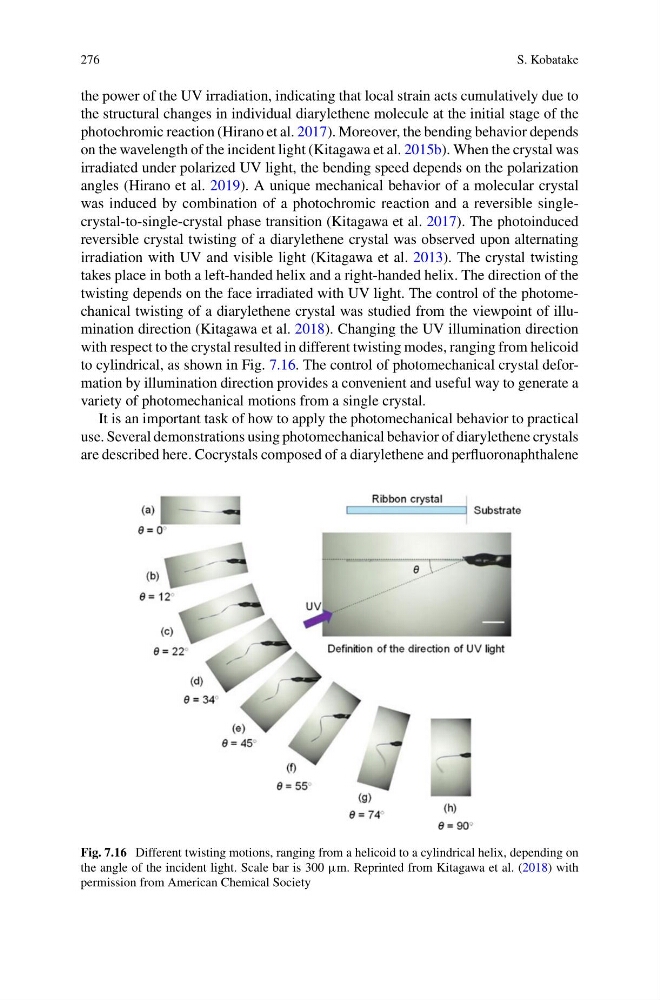
twisting depends on the face irradiated with UV light. The control of the photomechanical twisting of a diarylethene crystal was studied from the viewpoint of illumination direction (Kitagawa et al. 2018). Changing the UV illumination direction
with respect to the crystal resulted in different twisting modes, ranging from helicoid
to cylindrical, as shown in Fig. 7.16. The control of photomechanical crystal deformation by illumination direction provides a convenient and useful way to generate a
variety of photomechanical motions from a single crystal.
It is an important task of how to apply the photomechanical behavior to practical
use. Several demonstrations using photomechanical behavior of diarylethene crystals
are described here. Cocrystals composed of a diarylethene and perfluoronaphthalene
Fig. 7.16 Different twisting motions, ranging from a helicoid to a cylindrical helix, depending on
the angle of the incident light. Scale bar is 300 μm. Reprinted from Kitagawa et al. (2018) with
permission from American Chemical Society
S. Kobatake
the power of the UV irradiation, indicating that local strain acts cumulatively due to
the structural changes in individual diarylethene molecule at the initial stage of the
photochromic reaction (Hirano et al. 2017). Moreover, the bending behavior depends
on the wavelength of the incident light (Kitagawa et al. 2015b). When the crystal was
irradiated under polarized UV light, the bending speed depends on the polarization
angles (Hirano et al. 2019). A unique mechanical behavior of a molecular crystal
was induced by combination of a photochromic reaction and a reversible singlecrystal-to-single-crystal phase transition (Kitagawa et al. 2017). The photoinduced
reversible crystal twisting of a diarylethene crystal was observed upon alternating
irradiation with UV and visible light (Kitagawa et al. 2013). The crystal twisting
takes place in both a left-handed helix and a right-handed helix. The direction of the
twisting depends on the face irradiated with UV light. The control of the photomechanical twisting of a diarylethene crystal was studied from the viewpoint of illumination direction (Kitagawa et al. 2018). Changing the UV illumination direction
with respect to the crystal resulted in different twisting modes, ranging from helicoid
to cylindrical, as shown in Fig. 7.16. The control of photomechanical crystal deformation by illumination direction provides a convenient and useful way to generate a
variety of photomechanical motions from a single crystal.
It is an important task of how to apply the photomechanical behavior to practical
use. Several demonstrations using photomechanical behavior of diarylethene crystals
are described here. Cocrystals composed of a diarylethene and perfluoronaphthalene
Fig. 7.16 Different twisting motions, ranging from a helicoid to a cylindrical helix, depending on
the angle of the incident light. Scale bar is 300 μm. Reprinted from Kitagawa et al. (2018) with
permission from American Chemical Society