

274
S. Kobatake
F2
F2
F2
S
S
CH3
H3C
S
S
O
N
N
O
S
S
O
N
N
O
F2
F2
F2
S
S
CH3
H3C
S
S
O
N
N
O
S
S
O
N
N
O
Vis.
UV
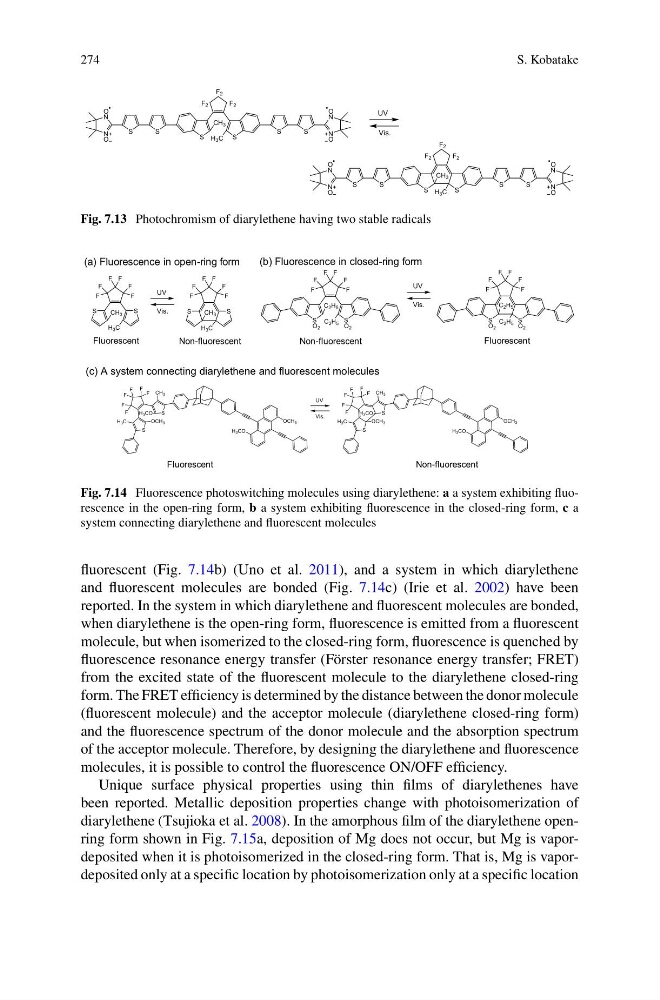
Fig. 7.13 Photochromism of diarylethene having two stable radicals
Fluorescent
(a) Fluorescence in open-ring form
Non-fluorescent
(b) Fluorescence in closed-ring form
(c) A system connecting diarylethene and fluorescent molecules
Non-fluorescent
Fluorescent
Fluorescent
Non-fluorescent
Fig. 7.14 Fluorescence photoswitching molecules using diarylethene: a a system exhibiting fluorescence in the open-ring form, b a system exhibiting fluorescence in the closed-ring form, c a
system connecting diarylethene and fluorescent molecules
fluorescent (Fig. 7.14b) (Uno et al. 2011), and a system in which diarylethene
and fluorescent molecules are bonded (Fig. 7.14c) (Irie et al. 2002) have been
reported. In the system in which diarylethene and fluorescent molecules are bonded,
when diarylethene is the open-ring form, fluorescence is emitted from a fluorescent
molecule, but when isomerized to the closed-ring form, fluorescence is quenched by
fluorescence resonance energy transfer (Förster resonance energy transfer; FRET)
from the excited state of the fluorescent molecule to the diarylethene closed-ring
form. The FRET efficiency is determined by the distance between the donor molecule
(fluorescent molecule) and the acceptor molecule (diarylethene closed-ring form)
and the fluorescence spectrum of the donor molecule and the absorption spectrum
of the acceptor molecule. Therefore, by designing the diarylethene and fluorescence
molecules, it is possible to control the fluorescence ON/OFF efficiency.
Unique surface physical properties using thin films of diarylethenes have
been reported. Metallic deposition properties change with photoisomerization of
diarylethene (Tsujioka et al. 2008). In the amorphous film of the diarylethene openring form shown in Fig. 7.15a, deposition of Mg does not occur, but Mg is vapordeposited when it is photoisomerized in the closed-ring form. That is, Mg is vapordeposited only at a specific location by photoisomerization only at a specific location
S. Kobatake
F2
F2
F2
S
S
CH3
H3C
S
S
O
N
N
O
S
S
O
N
N
O
F2
F2
F2
S
S
CH3
H3C
S
S
O
N
N
O
S
S
O
N
N
O
Vis.
UV
Fig. 7.13 Photochromism of diarylethene having two stable radicals
Fluorescent
(a) Fluorescence in open-ring form
Non-fluorescent
(b) Fluorescence in closed-ring form
(c) A system connecting diarylethene and fluorescent molecules
Non-fluorescent
Fluorescent
Fluorescent
Non-fluorescent
Fig. 7.14 Fluorescence photoswitching molecules using diarylethene: a a system exhibiting fluorescence in the open-ring form, b a system exhibiting fluorescence in the closed-ring form, c a
system connecting diarylethene and fluorescent molecules
fluorescent (Fig. 7.14b) (Uno et al. 2011), and a system in which diarylethene
and fluorescent molecules are bonded (Fig. 7.14c) (Irie et al. 2002) have been
reported. In the system in which diarylethene and fluorescent molecules are bonded,
when diarylethene is the open-ring form, fluorescence is emitted from a fluorescent
molecule, but when isomerized to the closed-ring form, fluorescence is quenched by
fluorescence resonance energy transfer (Förster resonance energy transfer; FRET)
from the excited state of the fluorescent molecule to the diarylethene closed-ring
form. The FRET efficiency is determined by the distance between the donor molecule
(fluorescent molecule) and the acceptor molecule (diarylethene closed-ring form)
and the fluorescence spectrum of the donor molecule and the absorption spectrum
of the acceptor molecule. Therefore, by designing the diarylethene and fluorescence
molecules, it is possible to control the fluorescence ON/OFF efficiency.
Unique surface physical properties using thin films of diarylethenes have
been reported. Metallic deposition properties change with photoisomerization of
diarylethene (Tsujioka et al. 2008). In the amorphous film of the diarylethene openring form shown in Fig. 7.15a, deposition of Mg does not occur, but Mg is vapordeposited when it is photoisomerized in the closed-ring form. That is, Mg is vapordeposited only at a specific location by photoisomerization only at a specific location