

7 Photochromism
273
can be controlled by changing the substituent group, and it can be used properly
according to the application.
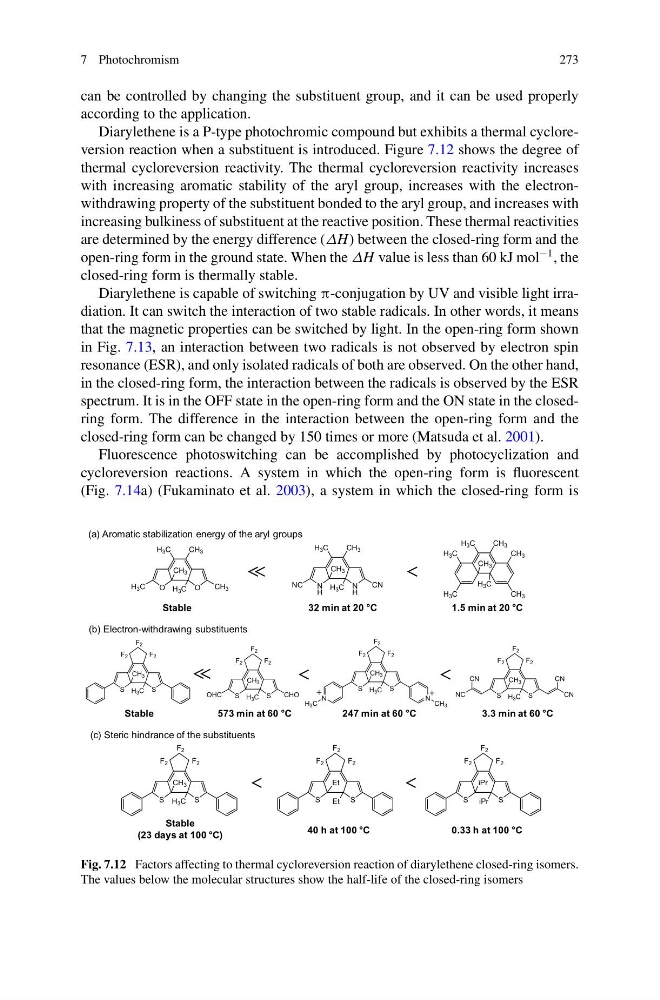
Diarylethene is a P-type photochromic compound but exhibits a thermal cycloreversion reaction when a substituent is introduced. Figure 7.12 shows the degree of
thermal cycloreversion reactivity. The thermal cycloreversion reactivity increases
with increasing aromatic stability of the aryl group, increases with the electronwithdrawing property of the substituent bonded to the aryl group, and increases with
increasing bulkiness of substituent at the reactive position. These thermal reactivities
are determined by the energy difference (ΔH) between the closed-ring form and the
open-ring form in the ground state. When the ΔH value is less than 60 kJ mol
−1 , the
closed-ring form is thermally stable.
Diarylethene is capable of switching π-conjugation by UV and visible light irradiation. It can switch the interaction of two stable radicals. In other words, it means
that the magnetic properties can be switched by light. In the open-ring form shown
in Fig. 7.13, an interaction between two radicals is not observed by electron spin
resonance (ESR), and only isolated radicals of both are observed. On the other hand,
in the closed-ring form, the interaction between the radicals is observed by the ESR
spectrum. It is in the OFF state in the open-ring form and the ON state in the closedring form. The difference in the interaction between the open-ring form and the
closed-ring form can be changed by 150 times or more (Matsuda et al. 2001).
Fluorescence photoswitching can be accomplished by photocyclization and
cycloreversion reactions. A system in which the open-ring form is fluorescent
(Fig. 7.14a) (Fukaminato et al. 2003), a system in which the closed-ring form is
(a) Aromatic stabilization energy of the aryl groups
(c) Steric hindrance of the substituents
(b) Electron-withdrawing substituents
Stable
32 min at 20 °C
1.5 min at 20 °C
Stable
(23 days at 100 °C)
40 h at 100 °C
0.33 h at 100 °C
Stable
3.3 min at 60 °C
573 min at 60 °C
247 min at 60 °C
O
O
H 3 C
CH 3
CH 3
H 3 C
CH 3
H 3 C
N
H
N
H
H 3 C
CH 3
CN
NC
CH 3
H 3 C
H 3 C
CH 3
CH 3
H 3 C
CH 3
H 3 C
CH 3
H 3 C
S
S
CH 3
H 3 C
F 2
F 2
F 2
S
S
Et
Et
F 2
F 2
F 2
S
S
iPr
iPr
F 2
F 2
F 2
S
S
CH3
H3C
F2
F2
F2
S
S
CH3
H3C
CN
NC
F2
F2
F2
CN
CN
S
S
CHO
OHC
CH3
H3C
F2
F2
F2
S
S
CH3
H3C
N
N
F2
F2
F2
H3C
CH3
Fig. 7.12 Factors affecting to thermal cycloreversion reaction of diarylethene closed-ring isomers.
The values below the molecular structures show the half-life of the closed-ring isomers
273
can be controlled by changing the substituent group, and it can be used properly
according to the application.
Diarylethene is a P-type photochromic compound but exhibits a thermal cycloreversion reaction when a substituent is introduced. Figure 7.12 shows the degree of
thermal cycloreversion reactivity. The thermal cycloreversion reactivity increases
with increasing aromatic stability of the aryl group, increases with the electronwithdrawing property of the substituent bonded to the aryl group, and increases with
increasing bulkiness of substituent at the reactive position. These thermal reactivities
are determined by the energy difference (ΔH) between the closed-ring form and the
open-ring form in the ground state. When the ΔH value is less than 60 kJ mol
−1 , the
closed-ring form is thermally stable.
Diarylethene is capable of switching π-conjugation by UV and visible light irradiation. It can switch the interaction of two stable radicals. In other words, it means
that the magnetic properties can be switched by light. In the open-ring form shown
in Fig. 7.13, an interaction between two radicals is not observed by electron spin
resonance (ESR), and only isolated radicals of both are observed. On the other hand,
in the closed-ring form, the interaction between the radicals is observed by the ESR
spectrum. It is in the OFF state in the open-ring form and the ON state in the closedring form. The difference in the interaction between the open-ring form and the
closed-ring form can be changed by 150 times or more (Matsuda et al. 2001).
Fluorescence photoswitching can be accomplished by photocyclization and
cycloreversion reactions. A system in which the open-ring form is fluorescent
(Fig. 7.14a) (Fukaminato et al. 2003), a system in which the closed-ring form is
(a) Aromatic stabilization energy of the aryl groups
(c) Steric hindrance of the substituents
(b) Electron-withdrawing substituents
Stable
32 min at 20 °C
1.5 min at 20 °C
Stable
(23 days at 100 °C)
40 h at 100 °C
0.33 h at 100 °C
Stable
3.3 min at 60 °C
573 min at 60 °C
247 min at 60 °C
O
O
H 3 C
CH 3
CH 3
H 3 C
CH 3
H 3 C
N
H
N
H
H 3 C
CH 3
CN
NC
CH 3
H 3 C
H 3 C
CH 3
CH 3
H 3 C
CH 3
H 3 C
CH 3
H 3 C
S
S
CH 3
H 3 C
F 2
F 2
F 2
S
S
Et
Et
F 2
F 2
F 2
S
S
iPr
iPr
F 2
F 2
F 2
S
S
CH3
H3C
F2
F2
F2
S
S
CH3
H3C
CN
NC
F2
F2
F2
CN
CN
S
S
CHO
OHC
CH3
H3C
F2
F2
F2
S
S
CH3
H3C
N
N
F2
F2
F2
H3C
CH3
Fig. 7.12 Factors affecting to thermal cycloreversion reaction of diarylethene closed-ring isomers.
The values below the molecular structures show the half-life of the closed-ring isomers