

7 Photochromism
265
N
N
N
N
N N
UV
Vis. or
N O
NO 2
H 3 C CH 3
CH 3
N
H 3 C CH 3
CH 3
O
NO 2
N O
N
H 3 C CH 3
CH 3
N
H 3 C CH 3
CH 3
N
O
N
N
N
N
2
O
Ph
Ph
O
Ph
Ph
OH
N
O
N
H
UV
Vis. or
UV
Vis. or
UV
UV or
UV
UV
Vis. or
UV
Vis. or
O
O
O
CH 3
O
H 3 C
CH 3
H 3 C
CH 3
O
O
O
O
CH 3
H 3 C
CH 3
H 3 C
CH 3
F
F
F
F
F
F
S
S
CH 3
H 3 C
F
F
F
F
F
F
S
S
CH 3
H 3 C
O
O
OPh
OPh
O
O
UV
Vis.
UV
Vis.
UV
Vis.
T-type photochromic compounds
P-type photochromic compounds
Δ
Δ
Δ
Δ
Δ
Δ
Δ
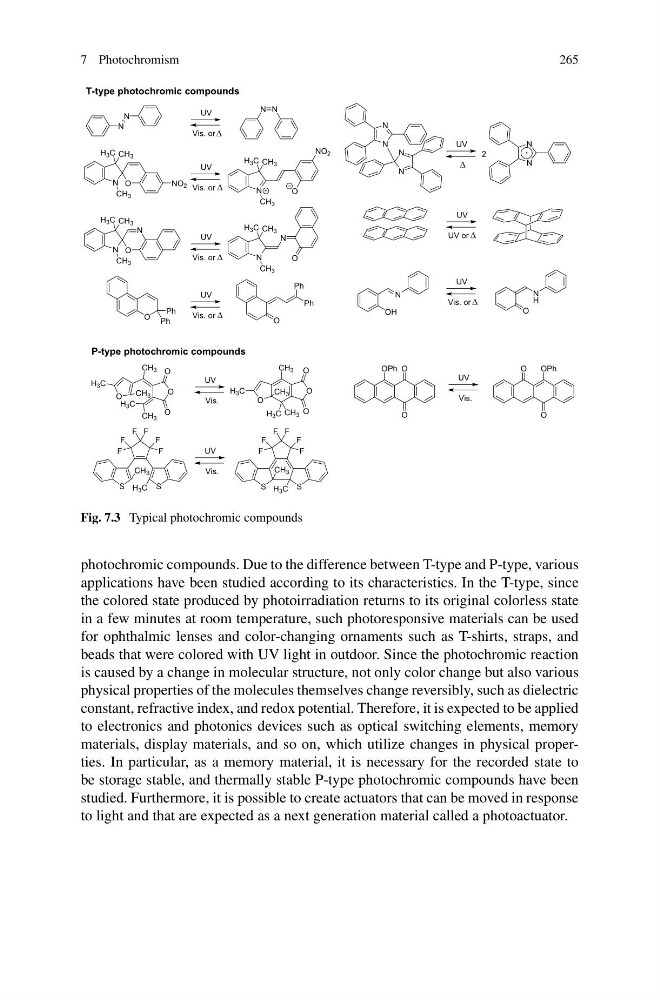
Fig. 7.3 Typical photochromic compounds
photochromic compounds. Due to the difference between T-type and P-type, various
applications have been studied according to its characteristics. In the T-type, since
the colored state produced by photoirradiation returns to its original colorless state
in a few minutes at room temperature, such photoresponsive materials can be used
for ophthalmic lenses and color-changing ornaments such as T-shirts, straps, and
beads that were colored with UV light in outdoor. Since the photochromic reaction
is caused by a change in molecular structure, not only color change but also various
physical properties of the molecules themselves change reversibly, such as dielectric
constant, refractive index, and redox potential. Therefore, it is expected to be applied
to electronics and photonics devices such as optical switching elements, memory
materials, display materials, and so on, which utilize changes in physical properties. In particular, as a memory material, it is necessary for the recorded state to
be storage stable, and thermally stable P-type photochromic compounds have been
studied. Furthermore, it is possible to create actuators that can be moved in response
to light and that are expected as a next generation material called a photoactuator.
265
N
N
N
N
N N
UV
Vis. or
N O
NO 2
H 3 C CH 3
CH 3
N
H 3 C CH 3
CH 3
O
NO 2
N O
N
H 3 C CH 3
CH 3
N
H 3 C CH 3
CH 3
N
O
N
N
N
N
2
O
Ph
Ph
O
Ph
Ph
OH
N
O
N
H
UV
Vis. or
UV
Vis. or
UV
UV or
UV
UV
Vis. or
UV
Vis. or
O
O
O
CH 3
O
H 3 C
CH 3
H 3 C
CH 3
O
O
O
O
CH 3
H 3 C
CH 3
H 3 C
CH 3
F
F
F
F
F
F
S
S
CH 3
H 3 C
F
F
F
F
F
F
S
S
CH 3
H 3 C
O
O
OPh
OPh
O
O
UV
Vis.
UV
Vis.
UV
Vis.
T-type photochromic compounds
P-type photochromic compounds
Δ
Δ
Δ
Δ
Δ
Δ
Δ
Fig. 7.3 Typical photochromic compounds
photochromic compounds. Due to the difference between T-type and P-type, various
applications have been studied according to its characteristics. In the T-type, since
the colored state produced by photoirradiation returns to its original colorless state
in a few minutes at room temperature, such photoresponsive materials can be used
for ophthalmic lenses and color-changing ornaments such as T-shirts, straps, and
beads that were colored with UV light in outdoor. Since the photochromic reaction
is caused by a change in molecular structure, not only color change but also various
physical properties of the molecules themselves change reversibly, such as dielectric
constant, refractive index, and redox potential. Therefore, it is expected to be applied
to electronics and photonics devices such as optical switching elements, memory
materials, display materials, and so on, which utilize changes in physical properties. In particular, as a memory material, it is necessary for the recorded state to
be storage stable, and thermally stable P-type photochromic compounds have been
studied. Furthermore, it is possible to create actuators that can be moved in response
to light and that are expected as a next generation material called a photoactuator.